
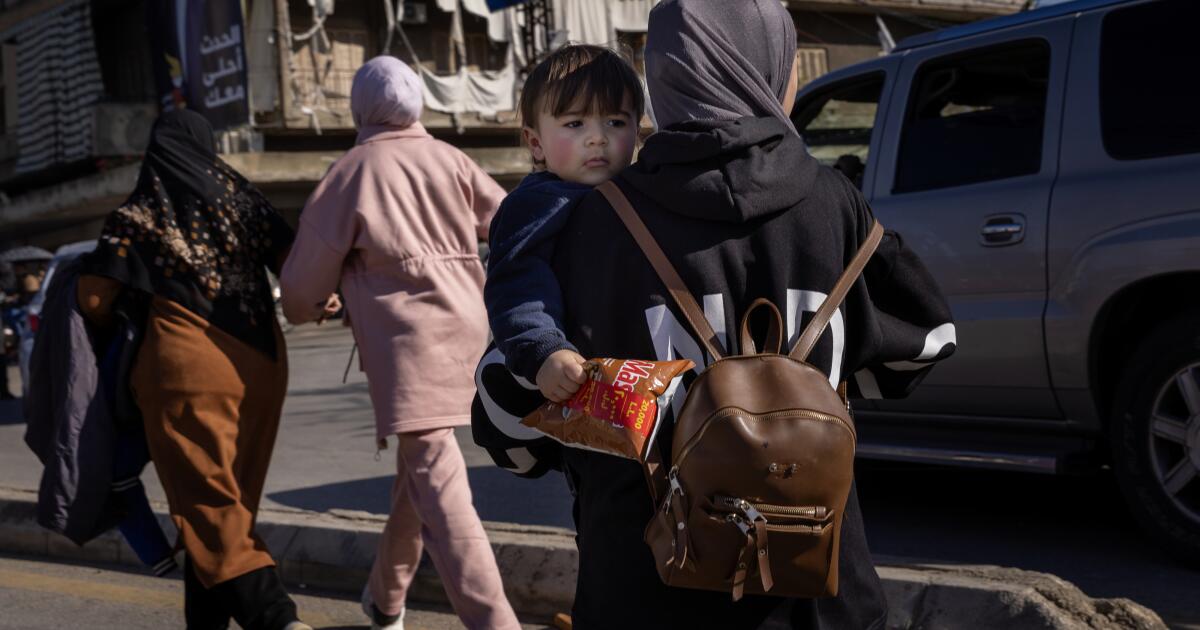
BEIRUT — The Israeli military issued evacuation orders for entire neighborhoods of Beirut’s southern suburbs, sparking pandemonium as hundreds of thousands of people joined a panicked exodus out towards Lebanon’s north.
On Thursday afternoon, the Israeli military’s Arabic-language spokesman told residents of the Dahiyeh — the Hezbollah-dominated southern suburbs of the Lebanese capital — to “save your lives and evacuate your homes immediately.”
The evacuation order was unprecedented in scale, encompassing a 6-square-mile, densely populated section on the capital’s southern edge. Although often described as a Hezbollah “stronghold,” the Dahiyeh comprises four residential neighborhoods, with high-rises, commercial thoroughfares and restaurants, that are home to hundreds of thousands of Shiites but also Lebanese of other sects, refugees and migrants.
Soon after the announcement, motorists flooded the roads, with cars, trucks, scooters, motorcycles — anything with wheels. Beirut’s traffic — a shambolic affair in the best of times — became even more chaotic, with motorists honking and shouting in a bid to reach the highway.
Some people parked their vehicles on the side near the exit from the Dahiyeh, ready to leave if necessary.
Gaggles of residents gathered at a media vantage point in the nearby hills, many of them keeping one eye on Dahiyeh for signs of an attack and another on their phone for updates on social media.
“Dahiyeh? There’s not going to be a Dahiyeh any more,” said one young man as he talked to a family member on the phone.
Another man shouted on the phone, exhorting a family member to leave and saying that he would go there in his stead.
“You come here and I’ll go in your place. If I die, I die,” he said.
The latest round of Israeli-Hezbollah conflict was triggered by the U.S.-Israeli war on Iran, now in its sixth day. Hezbollah, a Shiite militant group that is backed by Iran, launched attacks on Israeli targets in what it said was vengeance for the killing of Iranian Supreme Leader Ali Khamenei. The strikes are also a response to Israel’s near-daily attacks despite a ceasefire that took effect in 2024.
That ceasefire, which was brokered by the U.S. in November 2024, stipulated that Hezbollah give up arms in southern Lebanon and that the Lebanese army dismantle its military infrastructure in the area in exchange for Israel withdrawing back across the border.
Instead, Israeli forces remained in five positions on Lebanese territory, while committing more than 10,000 violations in the first year of the ceasefire, according to the United Nations peacekeeping mission.
The violence has in effect transformed a strip of territory along Lebanon’s southern border into a no-man’s-land, with villages and towns flattened and about 64,000 people unable to return home. Since the ceasefire was announced but before the current hostilities, more than 330 people have been killed in Israeli fire, including at least 127 civilians, according to health authorities.
Israel says its attacks are aimed at thwarting any attempt by Hezbollah to reconstitute a presence near the border. It has also demanded that the Lebanese government destroy the group’s military capabilities in all parts of the country.
The Lebanese government issued a decision in August to put all weapons in the country under state control, tasking the army to disarm Hezbollah. But the army says it cannot take the militant group’s arsenal by force for fear of sparking a civil war.
When the U.S.-Israeli assault on Iran began Saturday, many Lebanese hoped Hezbollah — weakened by Israel’s assassinations of its senior leadership and damage to its infrastructure — would remain on the sidelines.
In recent weeks, as tensions between the U.S. and Iran intensified, figures in Lebanon’s government exhorted Hezbollah to stay out of the fight and received assurances that the group would do so.
Even some of its adherents were surprised Monday when the group launched a barrage of rockets and drones on Israeli positions across the border.
Israel responded with a massive aerial campaign on dozens of towns and villages, as well as the Dahiyeh, killing 102 people and displacing more than 83,000 others, according to Lebanese government tallies from before Thursday’s evacuation order. Israeli troops advanced deeper into Lebanese territory and occupied additional villages after the Lebanese military withdrew.
Enraged at Hezbollah’s escalation, Lebanese Prime Minister Nawaf Salam announced a ban on the group’s military activities.
“We declare our rejection of any military or security operations launched from Lebanese territory outside the framework of legitimate institutions,” he said, adding that Hezbollah’s military actions were “illegal.” He called on security forces to stop all attacks coming out of Lebanese territory.
It was notable that the measure was endorsed even by Hezbollah’s staunchest allies in parliament — a reflection, observers say, of the widespread anger at the group for embroiling the country in war once again.
But in his speech Wednesday, Hezbollah chief Naim Qassem responded to criticism of the escalation by saying, “Were we expected to remain endlessly patient?”
He added that Israel’s wide-scale attack was “not a response” but “an aggression that had been prepared in advance.”
Israeli Finance Minister Bezalel Smotrich, a hard-liner in the government who has long called for Arab expulsion, said in a video statement from Israel’s northern border on Thursday that the Dahiyeh “will look like Khan [Yunis],” a reference to the southern Gaza city all but razed by the Israeli military’s operations against the militant group Hamas.
“Hezbollah made a mistake, and it will pay dearly for it,” he wrote. “We are cutting off the head of the octopus in Iran, and in parallel, we are also severing the arm of Hezbollah.”
With evening falling on Beirut and the attack yet to materialize, reports came of frenzied entreaties by senior Lebanese figures for Western governments to help quell the violence. State media said Lebanese President Joseph Aoun asked French counterpart Emmanuel Macron to intercede with Israel to stop the Dahiyeh’s targeting and bring about a ceasefire.
Soon after, Macron issued a statement on X saying that, in a bid “to halt the war and prevent the worst,” he was talking to “Lebanon’s highest authorities in order to establish a plan” to end the fighting. He said the officials had given him “their commitment to take control of the positions held by Hezbollah and to fully assume responsibility for security across the entire national territory.”
He said that Hezbollah “must renounce its weapons,” but also made an appeal to Israeli Prime Minister Benjamin Netanyahu. “At this moment of great danger, I call on the Israeli Prime Minister not to expand the war to Lebanon,” he wrote. “I call on Iranian leaders not to further draw Lebanon into a war that is not its own.”
Minutes after his statement, the Israeli military issued fresh orders for Hezbollah-affiliated towns in the Bekaa Valley in Lebanon’s east.
A series of warning shots echoing through the southern suburbs made clear Macron’s entreaties had no effect. Soon after, balls of fire erupted among the Dahiyeh’s densely packed buildings; one particularly powerful strike elicited gasps among people — both reporters and residents — on the vantage point.
Meanwhile, Lebanon’s government was racing to deal with the escalating displacement crisis. In recent days, it had turned schools into shelters and was opening up additional areas, but the most recent evacuation orders were likely to overwhelm their already meager resources.
“We didn’t expect an entire area being emptied,” said Lebanon’s public works and transport minister, Fayez Rasamny. “Can you imagine behavior more criminal than this?”