
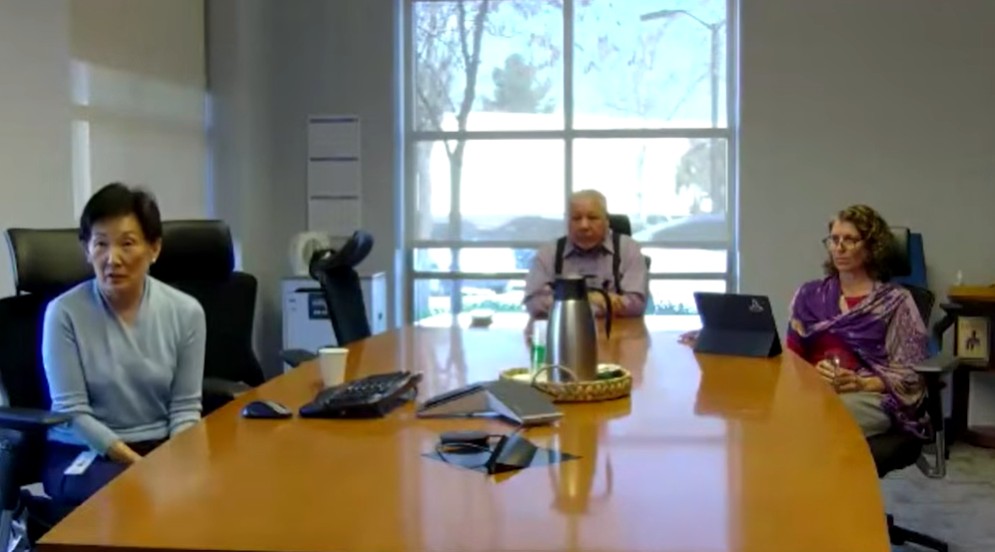
Employees at Silicon Valley’s largest water agency fired angry questions at three of the agency’s board members last week during a tense staff meeting after the board voted to pay its departing CEO $520,000 to resign and continue working as a “special advisor” for another year following an investigation that found he sexually harassed staff members.
More than 450 employees at the Santa Clara Valley Water District, a government agency based in San Jose, attended the Zoom meeting last Thursday. They raised critical questions to board members Tony Estremera, Shiloh Ballard and Nai Hsueh over the ethics of the vote involving former CEO Rick Callender, whether it was a defensible use of public money and what message it sent to female employees.
During the video meeting, the chat function was turned off. Employee questions were sent to a moderator via email.
Board members sought to reassure the staff, saying that sexual harassment is not tolerated at the district, which provides drinking water and flood protection to 2 million people in Santa Clara County. They cut the deal to avoid a lawsuit Callender had threatened, they said. Meanwhile, some employees lit up the screen with emojis of excrement, snakes, piles of cash, clown faces, circus tents and tomatoes.
Matt Keller, the district’s media and public relations supervisor, served as the moderator, telling the group that employees had emailed more than 100 questions. He read several at the beginning of the meeting.
“Years ago, Callender had a previous harassment complaint against him,” Keller read from one email he said was typical of others. “Yet the district promoted him to CEO. Now there are three additional complaints against Callender, and he is still getting a full salary and will continue for an additional year. When will the district and the board stop condoning this kind of behavior? What is the district going to do moving forward to protect its employees from predators like Callender, who feel entitled and abuse their employees based on their power? This is disgusting. The board should be ashamed.”
Moments later, Keller read another:
“Does this not signal that Valley Water tolerates harassment at all levels giving its willingness to use tax dollars to pay an abuser of power?”
Board chairman Estremera said the agreement the board approved in closed session Feb. 20 with Callender was “a mutually agreed-upon separation” that aimed to protect the district after Callender threatened to sue in January 2025, two months after the board hired an outside law firm to investigate the complaints of three female staff members.
“Extensive litigation for us with any case requires tremendous destruction, obstruction and distraction from our mission,” Estremera told the staff. “Our employees are subject to be brought into court to be witnesses and so on. The tremendous expense to the district is much, much, much more — many times more — than the six extra months we provided CEO Callender in that agreement.”
Estremera said the district has a standard separation agreement it has signed with each of its last three CEOs, providing six months of severance pay if they leave and allowing them to approve a public statement on the condition that they not sue.
On the day Callender resigned, the district issued a statement quoting Estremera saying: “(Callender’s) tenure is defined by integrity, transparency, and mission-driven leadership focused on safe, reliable water and responsible stewardship of our resources.”
Four days later, the board released summaries of the investigative reports into the complaints against Callender, following a 10-month investigation conducted by Atkinson, Andelson, Loya, Ruud & Romo, a Cerritos-based law firm it hired.
“Callender engaged in severe or pervasive conduct that violated the District’s prohibition on sexual harassment,” the report concluded.
Callender, 55, who is Black and also serves as president of the California-Hawaii NAACP State Conference, has denied any wrongdoing and said he had planned to retire all along. He has said the investigation was racially motivated.
On the day the district released the investigative reports, Callender distributed a letter from the San Jose / Silicon Valley chapter of the NAACP that said “racialized framing” had occurred.
“The issue is not whether any individual is beyond scrutiny,” the letter said. “It is whether a Black executive was subjected to a form of scrutiny in which ordinary, informal, direct, or self-deprecating communications were interpreted through a lens of suspicion, sexualization, or presumed impropriety, while comparable context and benign explanations were discounted.”
Citing texts, witness statements and Facebook Messenger messages, the investigation found that Callender sent inappropriate photos to two female staff members, made comments about his own sexual or romantic activities, and pressured them for after-hours activities, including coming to his house to water his plants and attending Sharks games with him.
In one instance, he asked a female employee if she had ever “been with” an African American man and spoke about his own personal life and exploits, the report found. In another, at 10:12 p.m., he texted a female employee: “Showered yet? Just playing.”
On July 21, 2023, he messaged the same woman at 8 p.m. asking what she was doing that night. When she said she had no plans, he responded: “I look forward to eventually getting (the woman’s) happy hour invite.”
During the questioning Thursday from employees at the staff meeting, board member Ballard said in response to questions about employee safety that Callender will not be invited on the district campus over the next year when he is being paid as a “special advisor,” a job board members said so far has no duties, hours or assignments.
“There may be a time when Tony (Estremera) needs to pick up the phone and say, ‘Rick, we have this particular issue, and what’s your advice?’” Ballard said. “He’s not going to be in the building.”
Ballard said she welcomed more employee input and feedback, and reiterated Estremera’s statement that board members, who are elected to four-year terms by voters, were trying to avoid a lawsuit.
“I think every woman and probably a lot of men have been through sexual harassment issues,” Ballard said. “We take this stuff very seriously. We are between a rock and a hard place. We are making very, very difficult decisions.”