
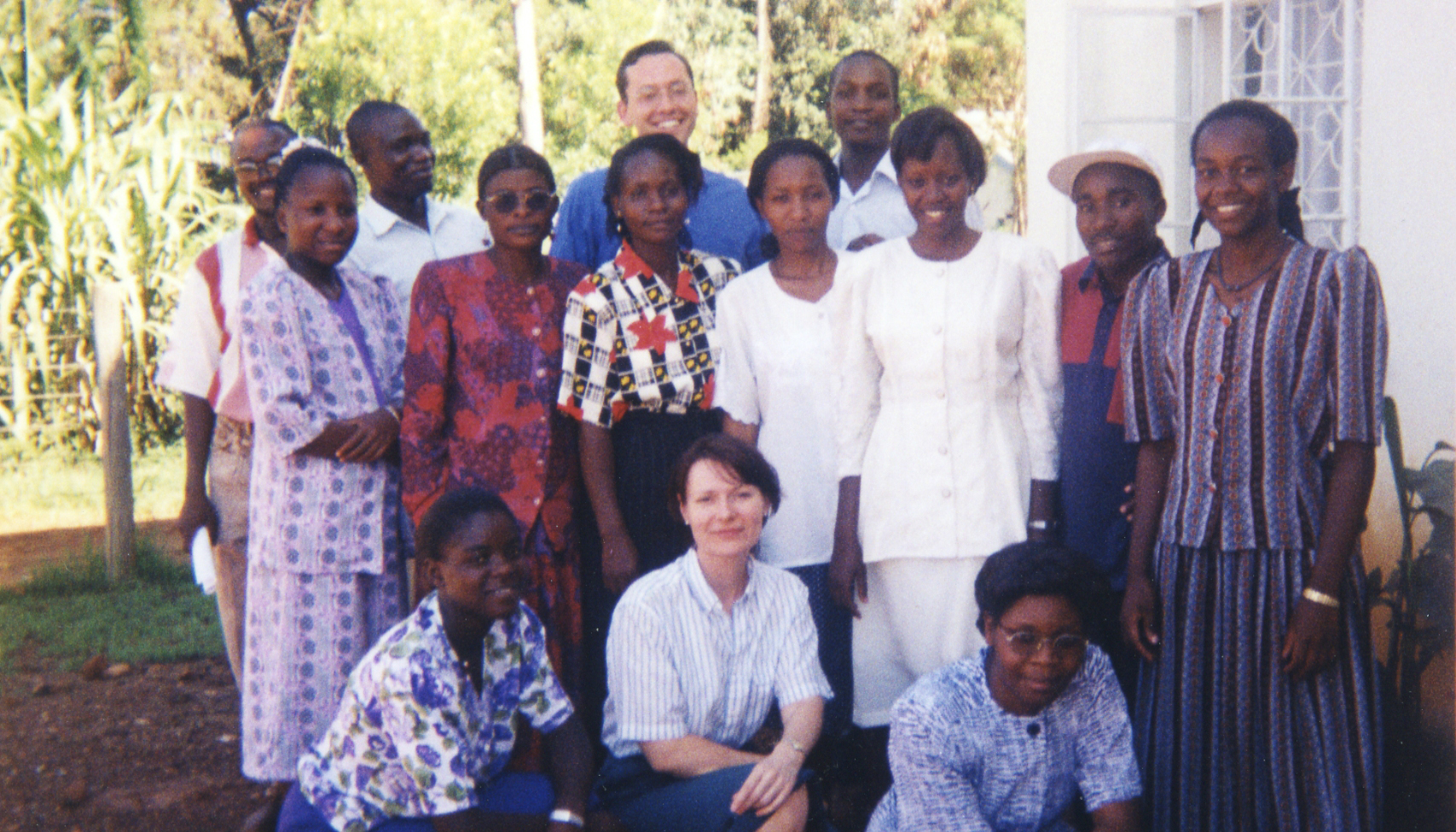
Anne Brice (narration): Looking back on her childhood in the 1980s, Carol Nekesa remembers her village in Kenya’s Busia County as one big household.
(Music: “Chafftop” by Blue Dot Sessions)
Carol Nekesa: We were always happy. There was just lots of simplicity, friendship, togetherness that shaped our childhood. What we lacked in material things was made up by just the strong bonds we had in our everyday lives.
Anne Brice (narration): Life was interconnected and bustling. With a population of about 400,000, Busia always had people crossing the border to Uganda on foot or motorbikes to trade things like coffee and sugar for textiles or electronics.
(Music fades out)
Like many rural regions in Sub-Saharan Africa at the time, Busia lacked the infrastructure for clean water and modern sanitation. While the region had some basic pit latrines, they were often overwhelmed or in disrepair, leading to widespread outdoor defecation. This meant that the soil that children played on and the water they drank became the primary vehicles for infectious diseases.
(Music fades out
While parents feared high-fatality emergencies like malaria or cholera, parasitic worm infections were accepted as a normal, if unpleasant, part of life.
Carol Nekesa: As a child, my understanding of worms was very basic and I would say limited. I also did not know where these worms came from and how they affected the body or even how they could be prevented. To me and my friends, the people I grew up with, they were simply something unpleasant that led to big bellies, stomach discomfort, sometimes diarrhea. It felt very normal.
Anne Brice (narration): At the time, about nine in 10 children in Busia had an active parasitic worm infection. The main offenders were roundworms, hookworms, whipworms and blood flukes. They caused all sorts of health problems, including chronic diarrhea, severe anemia, stunted growth and organ damage.
But since the infections weren’t usually fatal, parents didn’t feel an immediate sense of urgency.
Anne Brice: You mentioned that parents didn’t really understand exactly what was going on either, and I’m wondering, what kind of things did they attribute the symptoms to? Were there other illnesses that were like, “Well, maybe this is it?” And how did they attempt to treat these symptoms?
Carol Nekesa: Parents would associate it with some local illnesses. Sometimes people would say, “My child was looked at badly.” That is like a very common superstitious way that your child is sick because someone maybe has bewitched your child.
Anne Brice (narration): To treat these illnesses, parents might go to a local herbalist who would mix up a concoction to address a range of symptoms, or they might look for a person who could practice a ritual to ward off bad spirits. Concoctions were often made of bitter herbs with mild worm-killing properties; if that didn’t work, families might go to a more renowned herbalist to treat them.
The worms would eventually die off, often as part of their natural life cycle — the herbs weren’t usually strong enough to fully eliminate them — and a child’s symptoms would improve for a while until they were inevitably reinfected.
(Music: “Greylock” by Blue Dot Sessions)
After primary school, Carol attended a boarding school in a large town in a different county. After graduation, missing her home and family, she returned to Busia. There, she began working as a data entry clerk for the NGO International Child Support, or ICS.
At the time, she was just looking for a way to give back to her community. She had no idea she was about to help kickstart a global health revolution.
Anne Brice (narration): This is Berkeley Voices, a UC Berkeley News podcast. I’m Anne Brice.
(Music comes up, then fades out)
In the mid-1990s, there was a debate happening among development economists, or economists who study low- and middle-income countries.
The traditional view was that by advancing infrastructure and industrialization in developing countries — building things like roads, dams and factories — prosperity would eventually find its way to everyone.
But a shift was happening in the field. New reports argued that you couldn’t fix an economy without first addressing the health of its people.
Ted Miguel: It was a period of time where there really was a renewed focus on the possible economic burden of tropical disease in poor countries.
Anne Brice (narration): Ted Miguel is a professor of economics at UC Berkeley, where he studies the link between health and wealth in developing countries. He teaches courses on global poverty and political economy, and he also serves as the director of the Center for Effective Global Action, or CEGA.
As these new ideas were taking hold back in the ‘90s, Miguel was just getting started in his career, working as a graduate student at Harvard University with his adviser and economics professor Michael Kremer. The two researchers were looking at how to use rigorous data to solve global poverty.
Ted Miguel: There had been a number of influential research articles. A few years earlier, there’d been a very influential World Bank, what’s called the World Development Report, which is like their big flagship publication for the year, really making the case that health matters.
And it was an area that had been kind of neglected among development economists. When everybody thinks about what kind of work economists do, they think about interest rates and investment and industrial policy and all that kind of stuff, and certainly that is part of development economics, a very important part.
But there’s this other part of development economics that links to human development and human capital — health, education, nutrition. And it turns out that investing in those things can potentially be very important.
Anne Brice (narration): Miguel and Kremer decided to focus on treating parasitic worm infections, one of the most common chronic health conditions in the world. At the time, over a billion people — most of them children — were living with these parasites globally.
In the early 20th century, a well-known deworming program that ran in the Southern U.S. had resulted in improved school attendance. Kremer, who’d taught secondary school in Western Kenya in the mid-’80s after college, thought a similar project could be transformative for a region like Busia.
Ted Miguel: I think we were drawn to studying these infections, or understanding them, for a couple reasons. One was, from the early descriptions of these worm infections, hookworm and others, there had been claims, not really based on very solid scientific evidence, but observational claims, that they could affect kids’ schooling.
And it makes sense: If you’re weak, tired and anemic, you’re just not going to perform as well in almost anything you’re doing. And when you need to focus and concentrate and study and have energy, you’re not going to do as well at school. So we were very focused on that. That was really central for us.
(Music: “Tarte Tatin” by Blue Dot Sessions)
Anne Brice (narration): The other reason was that generic medication for the infections had recently become available, making it possible to treat these worm infections for less than a dollar per child per year if distributed at a large scale.
Ted Miguel: The side effects from the drugs are pretty minimal, or non-existent in many cases. And they’re cheap. So the idea we had in our minds, I think, as economists, was something along the lines of, “Well, this is almost free. So if there’s really, like, any benefit, it’s probably worth doing. And let’s try to measure and see what kind of benefits actually exist.”
Anne Brice (narration): Miguel and Kremer began laying the groundwork for what would become one of the world’s first rigorous studies on large-scale school deworming.
But first, they had to convince the communities to be part of the project.
(Music comes up, then fades out)
Anne Brice (narration): The researchers selected 75 schools in Busia County to participate in the Primary School Deworming Project.
(Music fades out)
Each school averaged 400 students, so overall, about 30,000 kids were slated to participate.
With funding from the World Bank, the researchers set up a randomized control trial — then an uncommon method in economics, which typically relied on observational data, structural models or natural experiments.
They would treat 25 primary schools the first year, then add a second 25 schools the next year and a final 25 a couple of years later.
Before they could launch the study, though, they had to convince community members and schools to be a part of the program. That’s where local partners like the NGO International Child Support, where Carol had just started working, were essential in building trust and coordinating participation.
Carol Nekesa: During the first year, I would say it was both challenging and really eye-opening. Many schools had never participated in a structured research project, so we were really building almost everything from scratch.
Anne Brice (narration): Many parents, and even some teachers, were skeptical and confused about the program. They didn’t understand why the researchers were interested in treating worms in the first place.
Carol Nekesa: You know, it was just a normal part of childhood. Therefore we had to spend a lot of time explaining what the program was about, why deworming mattered, and how the drugs work. This meant having community meetings, school visits, one-on-one conversations.
You need to speak to people in a manner and the language in which they understand. Therefore, working with a person like me and other colleagues who primarily understand the local context, primarily know the expectations of these communities, was a very key factor.
I felt like these were just as important as the medical side of the project.
Anne Brice (narration): After they secured community buy-in and parental consent, then came a huge logistical challenge: delivering deworming medications and collecting stool samples from thousands of kids across rural Busia.
(Music: “Talens Bal” by Blue Dot Sessions)
The study launched in 1998. During the first phase of the study, Carol and other NGO members would load up a vehicle with boxes of deworming drugs, bumping along red-clay roads — sometimes getting stuck in the mud during the rainy season — to reach the most remote schools.
Once the bus pulled in, Carol says, the school’s energy shifted. It felt less like a medical visit and more like a community event. Teachers set up outdoor stations under shady trees, where kids lined up by height and age. Each child got two pills and a snack.
Then came data collection.
(Music fades out)
Because parasitic worms live in a person’s intestines, larvae are present in the infected person’s feces. To prove the medication worked, the team had to track the worm load in treated children. This meant collecting stool samples from across dozens of schools and rushing them to a lab to count microscopic eggs.
Carol Nekesa: Operationally, it was quite intense because, you know, moving from school to school, organizing pupils, working with teachers, getting the data manually, because by then we didn’t have electronic data-collection systems.
Anne Brice (narration): The research team worked closely with the government of Kenya’s Ministry of Health labs to analyze the findings. Miguel says that even he and Kremer were surprised by what the data clearly showed.
Ted Miguel: We did see those big reductions in worm infections in the treatment schools, so that made sense. The drugs worked. And then there were some improvements in terms of growth, some moderate improvements in anemia, and pretty big improvements in kids just saying they felt healthy. When you have these worm infections, you just feel weak, you don’t feel good. You’re not necessary sure why. But there were significant improvements in kids just saying, “Yeah, I feel good. I feel healthy.”
Anne Brice (narration): Next, when analyzed the data on how the study affected the children’s education, a striking pattern emerged: School absenteeism fell right away by about a quarter. That meant one in four kids was able to attend school when they weren’t before the program.
Ted Miguel: Kids were going to school more, they were dropping out less, they were absent less, and that was just really the kind of core finding, I think, of the study, is there was this link between improving kids’ health and their education.
Anne Brice (narration): And it wasn’t just kids in the study who benefited. Researchers noticed spillover effects: Treated children stopped shedding eggs into the environment, breaking the transmission chain. So even untreated people nearby saw fewer reinfections.
Carol Nekesa: What had once felt like a normal part of childhood was clearly a major public health issue that could be addressed with a relatively simple intervention. And I would say that that experience stayed with me and continues to influence how I think about the field research and development today.
Ted Miguel: And again, you know, thinking about the longer term effects of the program — improving people’s health alone can have a bunch of consequences, but that’ll be compounded when they’re also getting more schooling and learning more. If you’re doing better in school, it opens up the possibility you’re going to get a better job, you’re going to earn more in the future.
And so, once we found the schooling gains, the wheels started turning about like, “Well, what could the long-term effects of this really be?”
(Music: “Ever So Casual” by Blue Dot Sessions)
Anne Brice (narration): In 2004, Kremer and Miguel published their landmark study in the journal Econometrica. It showed that deworming — a simple, low-cost health intervention — could boost school attendance more effectively than many conventional approaches like providing textbooks or free meals.
That finding didn’t just prove a point. It sparked a movement that has reshaped Kenya and other parts of the world.
Anne Brice (narration): Since that study launched nearly 30 years ago, it has evolved from a research experiment into a cornerstone of Kenya’s national infrastructure.
The Kenyan government, in a joint effort between the Ministry of Health and the Ministry of Education, now runs the National School-Based Deworming Programme, partnering with the NGO Evidence Action’s Deworm the World Initiative.
(Music fades out)
Every year, they reach about 6 million children nationwide, treating them about once a year to keep infections at bay. In Busia, infection rates have plummeted from over 90% to around 6%.
Miguel returns to Busia every year to meet with government and NGO leaders, and his research team continues to follow up with about a quarter of the participants in the original project. It’s now one of the longest-running and most influential studies in the history of economics.
Ted Miguel: I sometimes joke around that it’s the first research project I ever worked on and it’ll probably be the last project I work on. I’ll be working on it 20 years from now when I’m retiring. (Lightly laughs)
Anne Brice (narration): Kremer shared the 2019 Nobel Prize in Economics for his “experimental approach to alleviating global poverty” — with the deworming work cited as a prime example of how small, evidence-based changes can transform millions of lives.
(Music: “Brek PKL” by Blue Dot Sessions)
Anne Brice (narration): The researchers have found that the kids who were treated in the original study continue to thrive in remarkable ways.
Ted Miguel: If you look at them 20 years later, they are more likely to have moved to cities. They’re more likely to be working outside of subsistence agriculture. They’re more likely to be earning wages.
Earnings and food consumption in even urban residents all increase by roughly 10%, that’s just the number that comes out of the analysis. So when you think about, you know, if I over my lifetime am earning 10% more, and these drugs cost 20 cents per kid for a year, the rate of return is just astronomical.
So the indication from all of it put together is improving kids’ health in a low-income setting, dealing with these pervasive tropical diseases in a low-income setting, can lead to meaningful improvements in people’s health, education and economic outcomes even decades later.
(Music fades out)
Anne Brice (narration): Over the past several years, researchers have also been collecting data on the participants’ children and have found that their lives have improved significantly from just one generation ago.
Ted Miguel: You look at the kids of those born to our population, infant mortality falls 20% in the next generation for the children of those who were in those early treatment schools. So it’s just like a staggering finding that literally shows the life chances of the next generation are also improved when they happen to have a parent who had better health when they were kids themselves.
Anne Brice (narration): Carol is now the founding director of her own research firm, REMIT, where she oversees major public health and economic studies that continue to shape policy across East Africa.
She says Busia is more dynamic and prosperous today than it’s ever been. It has a university now, and better roads, a more advanced electrical grid and mobile connectivity that has boosted cross-border business. The deworming program, she believes, played a foundational role in this progress.
Carol Nekesa: When you improve the children’s health, as time goes by, they are the people shaping now the economy. These people who were de-wormed, they have finished school, they are in their career space right now. And in that sense, I would say the program did contribute by removing a major invisible barrier that would have held them back as children.
Anne Brice (narration): After the success of the deworming program, a number of NGOs and donors have been funding and carrying out mass deworming programs in other low- and middle-income countries, from Ethiopia and Nigeria to Vietnam and Pakistan.
The largest has been in India, where over the last decade, up to 100 million kids a year have been receiving deworming drugs. In many of the regions, Miguel says rates have dropped to 1 or 2%.
(Music: “Dirtbike Lovers” by Blue Dot Sessions)
Ted Miguel: It’s kind of mind blowing to be a researcher and know that your research is being cited and used as a justification for these large-scale programs. It’s nothing I could have dreamed on.
When you start the life of being a researcher, a scholar, you want to learn about the world, you wanna have some positive effect on the world. And to think that the first project I worked on in grad school has helped to deliver billions of doses of drugs to help poor kids around the world, it’s … I almost want to cry. I mean, it’s amazing.
Over the course of a couple decades, with concerted international efforts and collaboration and really basing the work on research findings, we can make a dent in global health problems.
(Music fades out)
Anne Brice (narration): Miguel says he’s been disheartened watching the U.S. slash billions of dollars to global health aid, funds that have been used to propel programs treating and preventing infectious diseases like HIV/AIDS and malaria in Kenya and other developing countries. But he remains hopeful that it’s temporary.
Ted Miguel: I’m really proud of the work that our team has done in trying to understand the importance of tropical disease for economic development. And I’m proud of the whole development economics and global health communities.
I’m just so amazed by how far we’ve come in the last 30 years. Like, the quality of the research, the quantity of the research, the impact of the research — it’s just like an order of magnitude greater than it was 30 years ago. So many people have dedicated their careers to work in this field. We’ve made so much progress. We’ve learned so much. It’s shaped policy in so many positive ways.
Anne Brice (narration): Miguel credits Berkeley’s unique environment for enabling the sustained, collaborative work behind his research.
Ted Miguel: For the kind of work that I do and for the growth of the center that I direct, the Center for Effective Global Action, I really don’t know if it could have happened anywhere but Berkeley.
We’ve been so fortunate to be in an institution where we’ve received so much support for this kind of work. I think it’s really in the ethos of the place and in the DNA of the place that we care about inequality and poverty, and we want to do something positive to improve the lives of poor people around the world.
(Music: “Cases to Rest” by Blue Dot Sessions)
And Berkeley is also a very interdisciplinary place. I’ve benefited so much from conversations with colleagues in the School of Public Health, and from computer scientists and anthropologists and sociologists and others here at Berkeley. And so being in such an amazing institution with quality colleagues and graduate students and undergrads across fields has really made a lot of this possible.
Anne Brice (narration): I’m Anne Brice, and this is Berkeley Voices, a UC Berkeley News podcast from Strategic Communications — our office’s new name. Music by Blue Dot Sessions.
You can find Berkeley Voices wherever you listen to podcasts, including YouTube @BerkeleyNews.
This is the fifth episode of our new season of Berkeley Voices. In six episodes, we hear from UC Berkeley scholars working on life-changing research and the people whose lives are changed by it. New episodes come out on the first Thursday of every month throughout the academic year, from November through April.
We also have another show, Berkeley Talks, that features lectures and conversations at Berkeley. You can find all of our podcast episodes, with transcripts and photos, on UC Berkeley News at news.berkeley.edu/podcasts.