
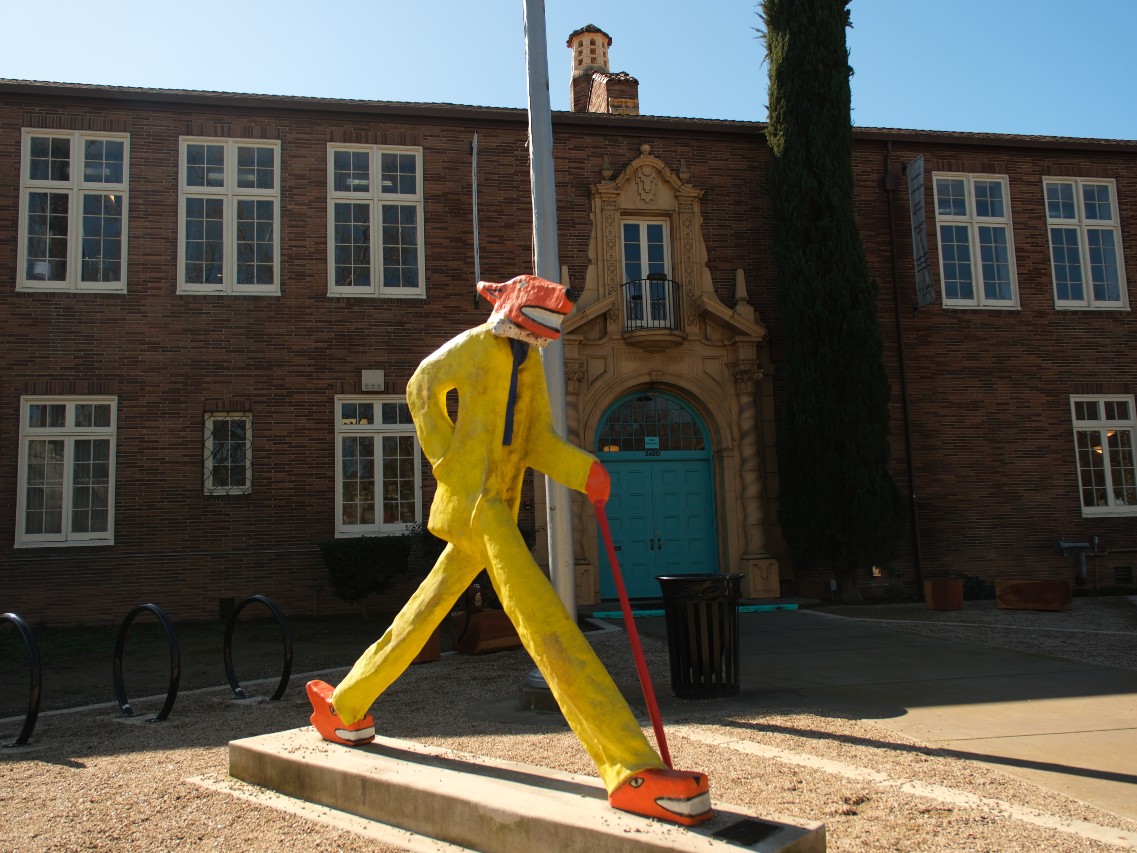
Driving down N street in Midtown Sacramento, you might see a seven foot statue of a dog – or fox, depending who you ask – mid-stride in a bright-yellow suit.
The statue is called “Homie, Walking the Dogs” and was built by Gilbert Luján in 2000. While it originally sat at the Safe Convention Center before it was remodeled in 2018. After being stored for a couple years, he strutted over to the CLARA Center in 2020.
The people down at the CLARA Center love looking out from their offices and admiring the swanky giant that stands outside their building. According to Megan Wygant, the CLARA’s executive director, she sees people hanging out with him all the time.
“You’ll see people come up, you see kids playing on him a little, you see people walking around him. You see a lot of selfies with him,” Wygant said. “And usually, it’s people who aren’t aware they’re being watched. Its kind of a very intimate, personal experience to just get to watch on a daily basis.”
According to Diana Argueta, the operations manager there, Homie’s what most people first notice about the building.
“He’s definitely a really good marker for the building,” Argueta said. “So if I’m telling people like, ‘oh, you know, we have like a very bright yellow fox man out in the front.’ People are always like, ‘oh yeah, the fox.’”
The statue’s almost devilish grin and bright orange color have led many people in Sacramento to think he’s a fox. However, according to an interview that Luján gave to the Smithsonian’s Archive of American Art in 1997, Luján built a system of symbols for his artwork. One recurring theme was these anthropomorphized dog characters.
“I started making these little dogs, and it became these pyramid dogs,” Luján said. “Which was just an invention on my part, was to be the metaphor for indigenous Mexican-Indian heritage.”
He started forming this system in the sixties when the Chicano rights movement, or El Moviemento, first started to take the hold.
“Chicanos understood in the sixties—at least, I’m one of many—who understood that we were Indian people,” Luján said. “The European invasion that came over here in the fourteen hundreds… it was an invasion. It wasn’t anything else.”
In the early seventies, Luján started working with three other artists: Frank Romero, Carlos Almaraz and Beto de la Rocha. They called themselves Los Four, and made sculptures and murals together. They helped shape the burgeoning Chicano art movement, and held their first widely-recognized exhibition at UC Irvine in 1973. That show was curated by Hal Glicksman, Irvine’s gallery director at that time. Glicksman said that they elevated graffiti to the station of fine art.
“They sprayed graffiti and then they would paint over each other’s work day after day until the painting was thick with paint. It looked like a Jackson Pollock, you know, splash and drip painting. But it was graffiti,” Glicksman said.
Luján said that with his work, he wanted to craft a vision of a whole new world based on the indigenous myth of Atzlán, a paradise lying to the north of modern day Mexico. He called his version “Magulandia” after his nickname from high school. According to Glicksman, his classmates compared him to Mr. Magoo, an extremely nearsighted cartoon character.
“He went with a high school class to the county museum, and he stood in front of each painting up close, looking at the brushwork,” Glicksman said.
This world is where he said he implemented his system of themes and symbols, to show what this paradise might look like to him.
“[I’m] trying to produce a world, a Magulandia, that represents another world – you know, the Wizard of Oz, the Emerald City,” Luján said. “That’s what I’m doing. I have buildings, I have dogs, people, carritos, kids on skateboards. I have a world that I’ve developed all over these years.”
Gilbert “Magu” Luján passed away in 2011. His work is on display at The Cheech Marin Center for Chicano Art & Culture at the Riverside Art Museum.
CapRadio provides a trusted source of news because of you. As a nonprofit organization, donations from people like you sustain the journalism that allows us to discover stories that are important to our audience. If you believe in what we do and support our mission, please donate today.