
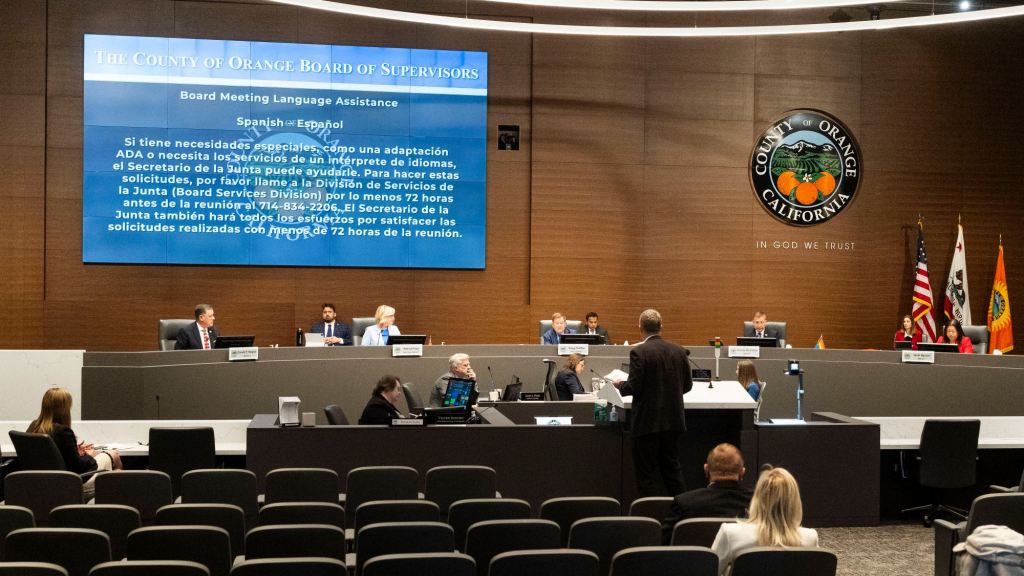
Orange County’s Board of Supervisors last month approved a climate action plan designed to prod local governments and residents to reduce their carbon footprint, but supervisors were at least realistic about what it’s all about: state funding. Calling it a “grotesque waste of money,” Supervisor Don Wagner explained that the CAP is necessary “to get the funding that is absolutely critical to this government doing the basic function it needs to do,” per news reports.
Counties need a plan to receive a variety of state grants. As the California Air Resources Board explains, CAPs aren’t mandatory — but they are recommended as a “framework for quantifying, tracking and reducing GHG [greenhouse gas] emissions within a jurisdiction’s purview.” The most contentious element monitors how private businesses are reducing their carbon footprint, but supervisors made it clear that none of it is binding.
We understand the supervisors’ dilemma, but the county should provide a cost-benefit analysis. How much time and how many employees are needed to develop this voluminous report and implement its targets v. how much money the state would risk losing? We question why a county’s ability to fund its basic functions is tied to state grants related to emission-reduction policies.
Oddly, the plan says “a full CEQA analysis of the municipal measures in the CAP would be initiated at that time before implementation of any proposed measures.” The California Environmental Quality Act is California’s landmark environmental law, which triggers a complex process for analyzing the potential environmental effects of any project.
Subjecting hundreds of pages of county climate proposals to another governmental review process requiring hundreds of pages of reviews layers red tape upon red tape. CEQA often is blamed not only for holding up housing production, but for also delaying environmentally-friendly projects. How this helps the environment is anyone’s guess.
There are good ideas in the document, from expanding EV charging stations to improving water efficiency and reducing solid waste. But there’s no reason they couldn’t be implemented without all the bureaucracy. But it is what it is, as one might say.