
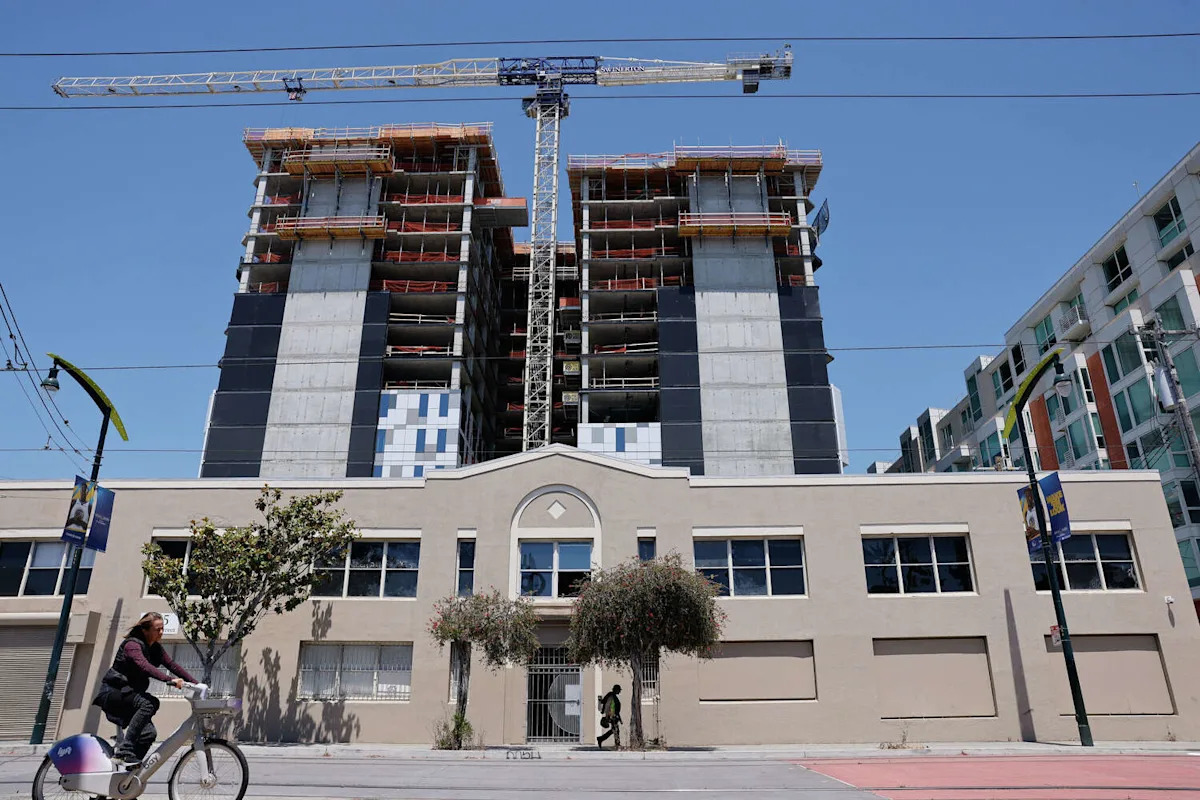
Statewide reforms in California have made it relatively fast to get projects approved but San Francisco still lags behind comparable cities in the time it takes to obtain building permits.
Despite a full-throttle effort to cut red tape in the city’s planning and building departments, San Francisco takes much longer to issue building permits for new housing than comparable cities, according to a new report from the Board of Supervisors’ Budget and Legislative Analyst.
The report found that processing time for building permits for housing was a median of 280 days and took three rounds of review. The report, which was requested by Supervisor Bilal Mahmood, looked at data between Jan. 1, 2024 and Aug. 12, 2025.
San Francisco’s 280-day median processing time is three times that of Austin, which clocked in at 91 days. It was more than twice that of Washington D.C. at 93 days and Seattle, which averaged about 133 days. The only city that came close to San Francisco was Denver, where post-approval permits took an average of 274 days.
The delays were caused by the fact that most projects went through at least three rounds of review, which typically involved San Francisco Planning, the Department of Building Inspection, the fire department, San Francisco Public Works and the San Francisco Public Utilities Commission, according to the report.
But the report also showed that the permitting reforms introduced by Mayor Daniel Lurie and former Mayor London Breed have already had an impact. Projects that were submitted after Jan. 1, 2024 received permits much faster at a median 114 days. Some reforms that likely sped up the process were under Lurie’s Permit SF initiative.
“It shows that Permit SF has actually made measured improvement over the last two years to hasten the time to building permit issuance,” Mahmood said. “What we are finding is that Permit SF initiative made measurable progress on this problem even while we were studying it.”
Mahmood said he supports a ballot measure to reform the city charter to make it easier to change or consolidate departments and functions, including the building department and the planning department, which Lurie said in January he would like to combine.
Mahood said he is working with Board President Rafael Mandelman to incorporate recommendations from the charter-reform working group into measures for the November ballot. Mahmood said “the low-hanging fruit” that was gumming up San Francisco’s permitting process has been addressed.
“Now we need to move to the complex problems like charter reform,” he said.
The report comes as the city recently rezoned swaths of the north and west sides to allow for more height and density, part of San Francisco’s attempt to meet the state housing goal of accommodating 82,000 new units between 2023 and 2031. Three years into the eight-year cycle the city has produced less than 10,000 new units.
About 50,000 units, many of them approved before the pandemic, are stuck in the pipeline because they are not economically feasible.
This article originally published at S.F. lagged behind other big cities in getting housing permitted but it’s speeding up.