
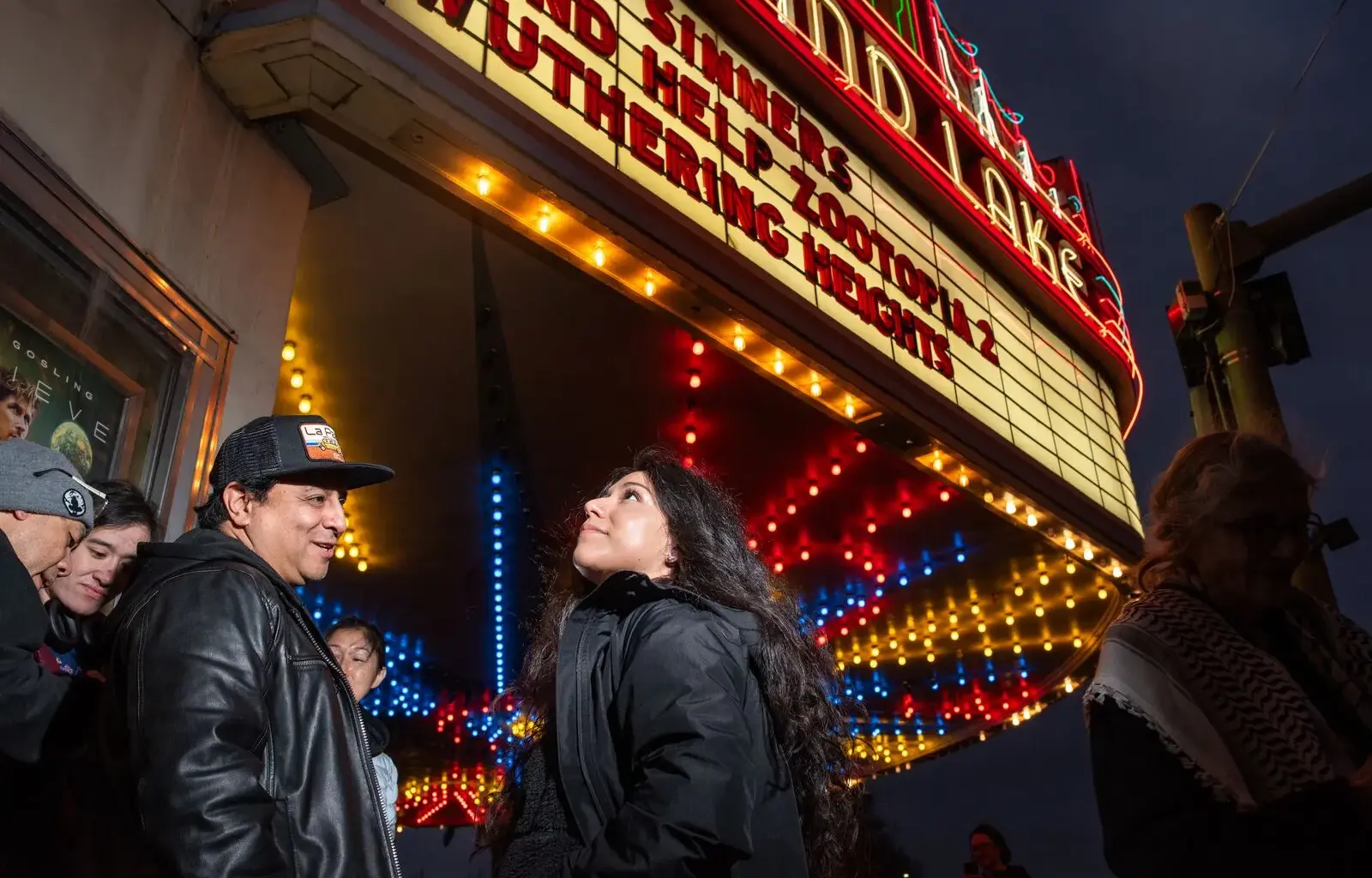
It’s a Tuesday afternoon in Oakland, and Grand Lake Theater is bustling. Out front, on the corner of Grand and Lake Park avenues, protesters are gathering for their weekly anti-Trump vigil, as moviegoers begin to form lines outside for what is poised to be a busy evening. Inside the theater, ticket takers flank the doors inside the ornate neoclassical lobby, while concession workers busy themselves filling bags of freshly popped popcorn.
Since the Grand Lake Theater opened its doors on March 6, 1926, it has become an Oakland icon — a hub for political protests and a home to Oakland filmmakers so familiar that its towering neon sign, studded with nearly 3,000 lights, has become synonymous with The Town.
That night, the theater would be hosting a private screening for San Francisco International Film Festival members of “Sinners” by Oakland filmmaker Ryan Coogler, the most Oscar-nominated film in history. In a few hours, Coogler would arrive with one of those nominees, the actor Delroy Lindo, for a post-screening Q&A.
Coogler has held special screenings for every one of his films here, starting with his 2013 debut feature, “Fruitvale Station,” about the life and death of Oscar Grant, who was killed by a BART police officer in Oakland in 2009.
“I first met Ryan before ‘Fruitvale Station’ came out,” Allen Michaan, who has run Grand Lake Theater since 1979, told the Oaklandside. “Mainstream theaters didn’t want to screen the film because of how political it was. We did, and we had packed houses. Years later, we screened ‘Black Panther.’ The first week, we showed the film on screens one, two, and three, and we were selling out every show.”
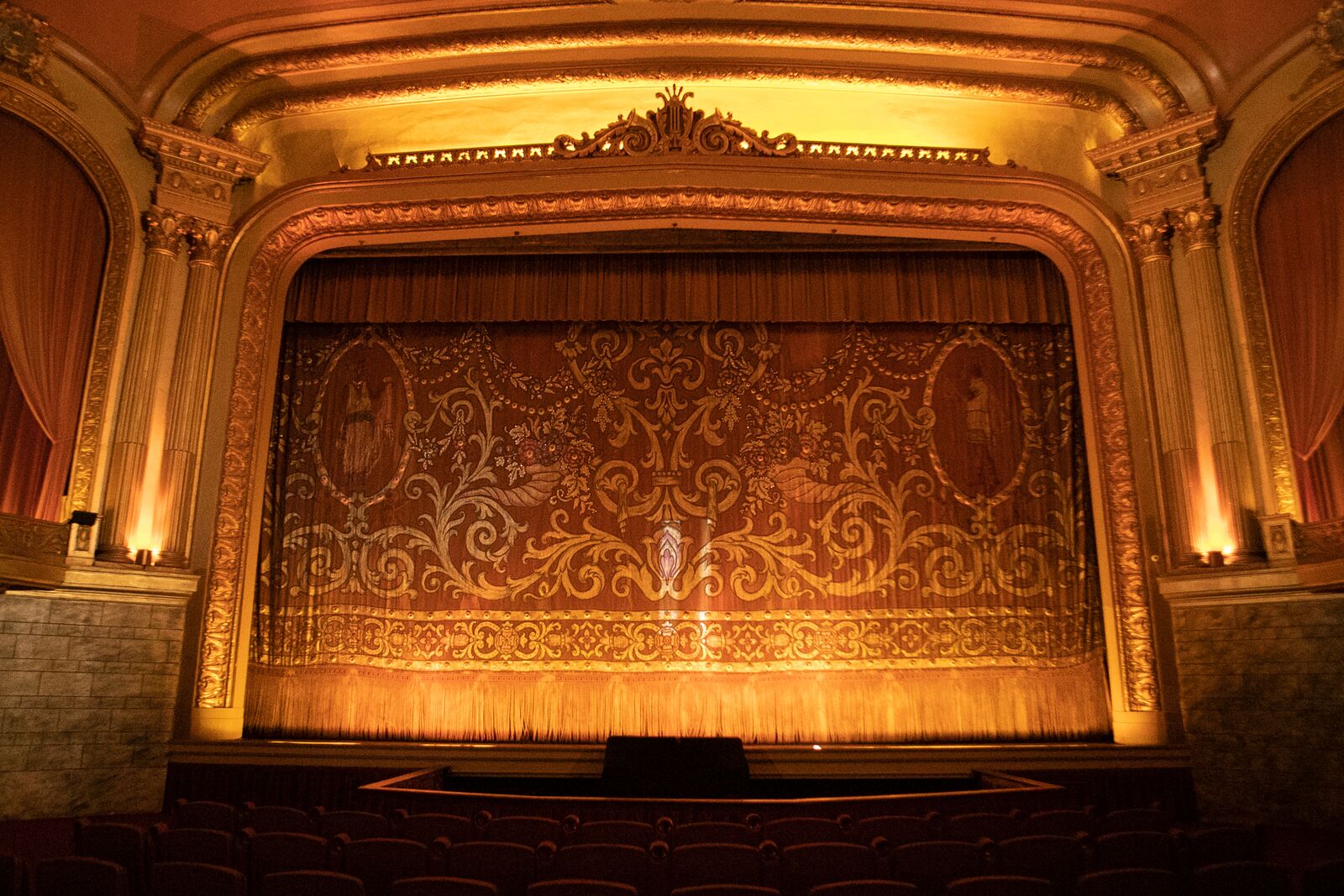
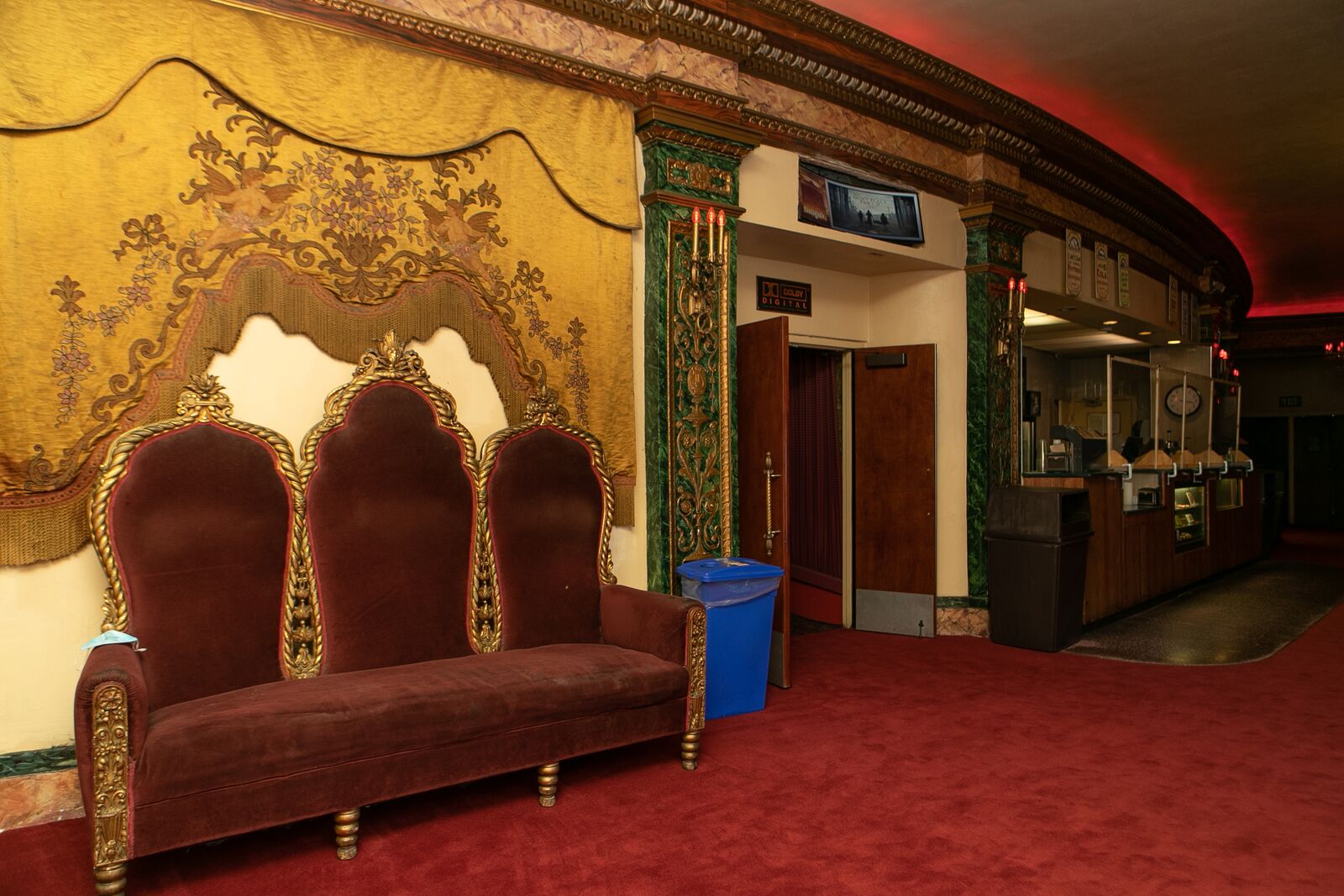
 Top to bottom: Grand Lake Theater’s ornate main screening room; vintage furniture upholstered in velvet in the lobby; a detail from the embroidered curtain, salvaged from San Francisco’s Fox Theatre. Credits: Amir Aziz/The Oaklandside, Ximena Natura for The Oaklandside
For years, landing a screening at Grand Lake Theater has been a rite of passage for Oakland filmmakers.
In a single year, 2018, Grand Lake Theater hosted hometown screenings of three films: Coogler’s “Black Panther,” Boots Riley’s “Sorry to Bother You,” and Daveed Diggs and Rafael Casal’s “Blindspotting.”
Diggs and Casal returned to the theater in 2023 after “Blindspotting” was picked up for a second season on STARZ, to screen a teaser. That year, SFFILM also screened the documentary “Stephen Curry: Underrated,” a documentary by filmmaker Peter Nicks about the beloved Golden State Warriors point guard.
The theater has become so central to Oakland filmmakers that it played a pivotal role in last year’s film “Freaky Tales” by Oakland-raised filmmaker Ryan Fleck and his co-writer Anna Boden. The filmmaking duo committed to filming entirely on location in Oakland. In one scene, repeated from different perspectives throughout the film, moviegoers are confronted by neo-Nazi skinheads as they exit under the distinct lights of the theater’s awning.
“We’re making a movie in Oakland, that is a love letter to Oakland, to the places I remember going to as a kid,” Fleck told the Oaklandside ahead of the movie’s release in April 2025.
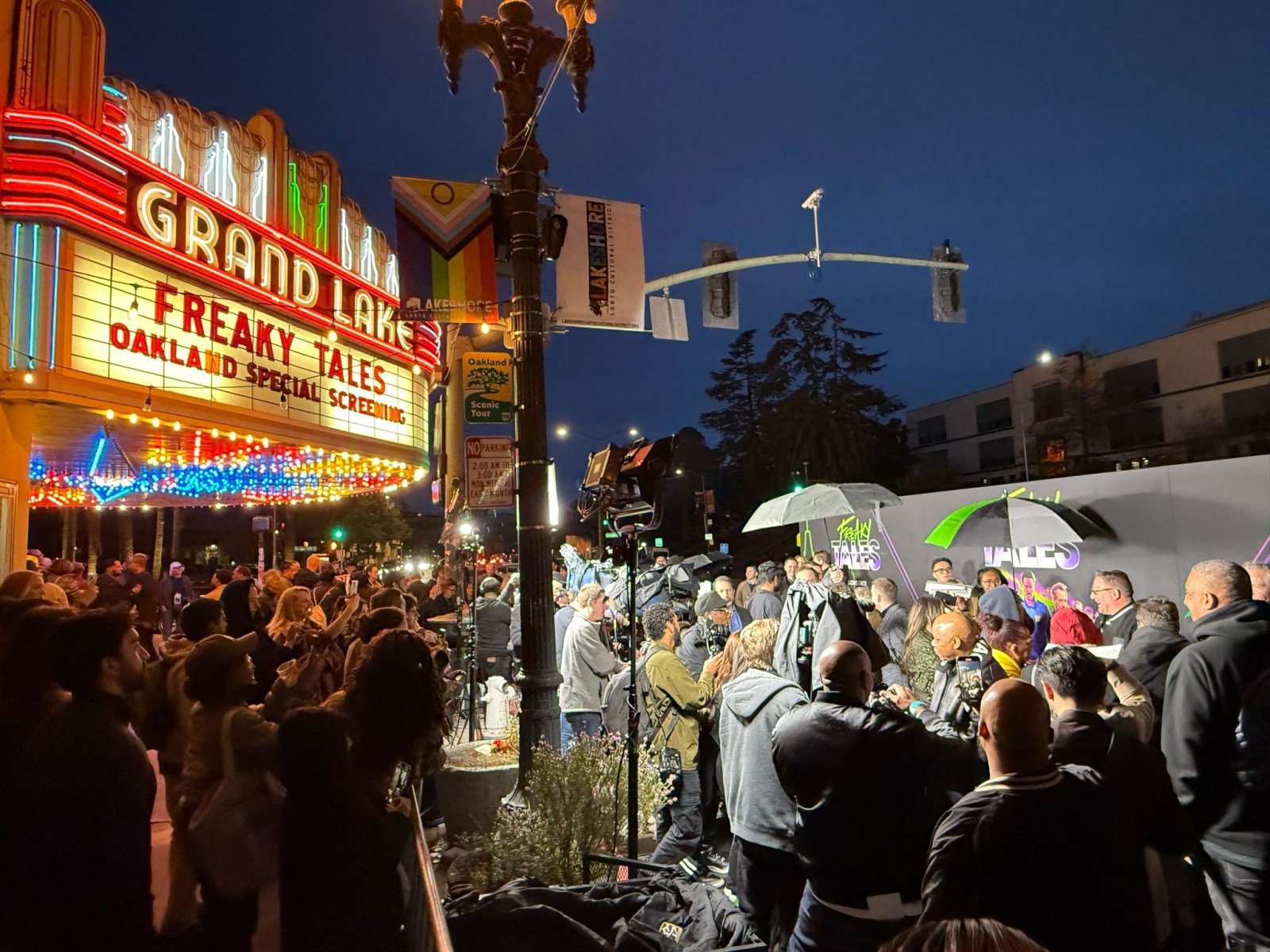 The Oakland premiere of “Freaky Tales” in April 2025 brought out the star-studded cast to the red carpet including Too $hort, Pedro Pascal and Jay Ellis. Credit: Jose Fermoso/The Oaklandside
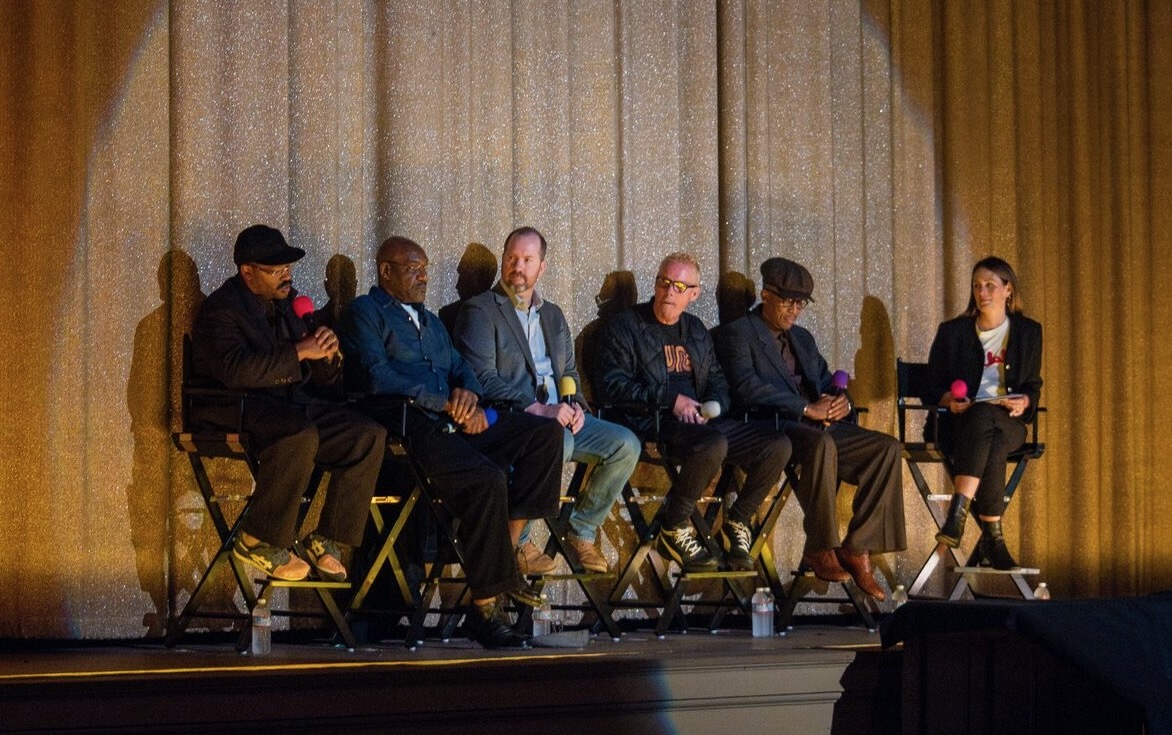 A post-screening discussion of the movie “Sinners” in February 2026 with, from left, Ryan Coogler, actor Delroy Lindo, sound editor Benny Burtt, sound director Steve Boeddeker, Oakland musician Raphael Saadiq and SFFILM programming director Jessie Fairbanks. Credit: Ximena Natera for The Oaklandside
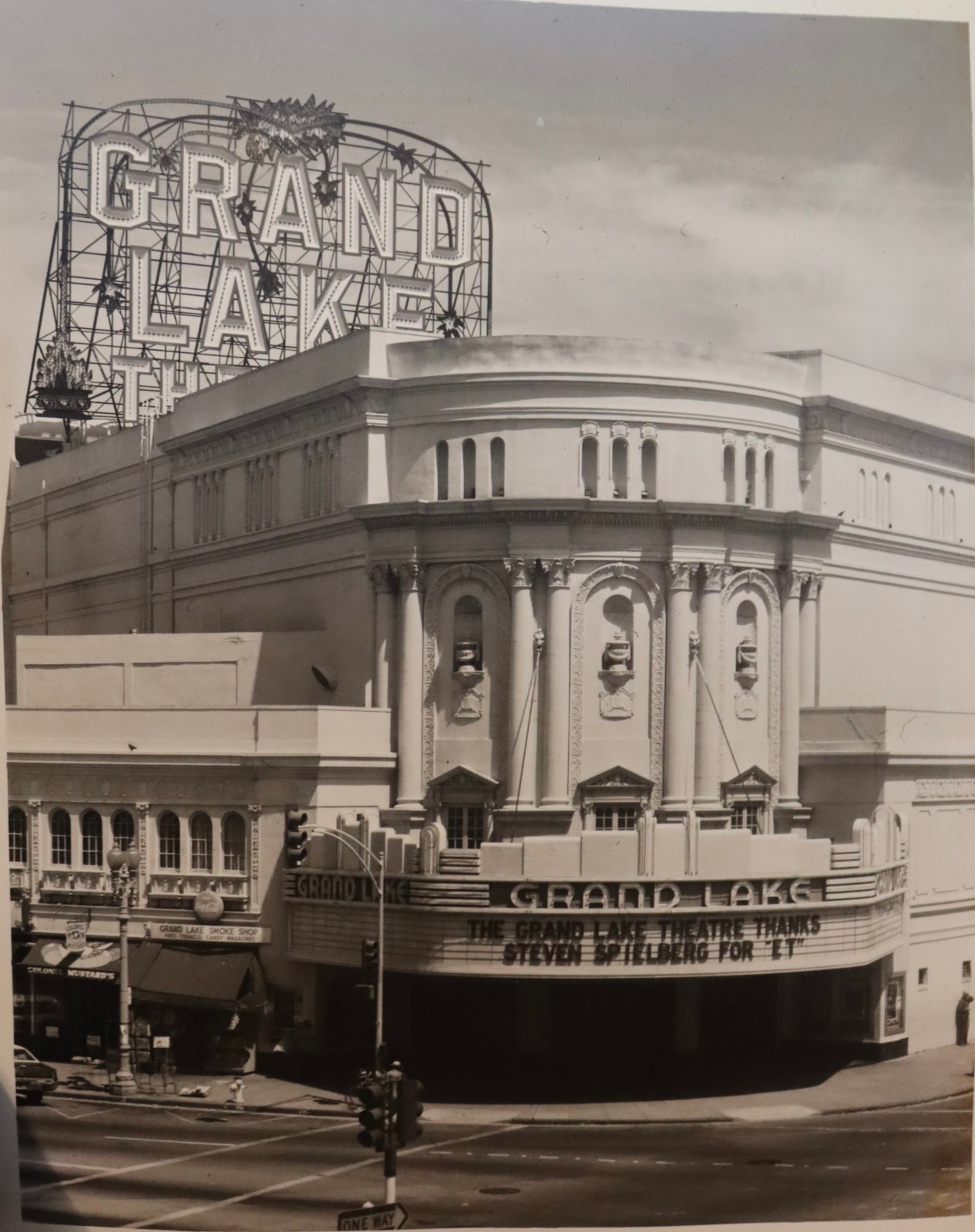 The theater just after its epic run of “E.T.” in 1982, with a 70-millimeter print that put the theater on the map. Credit: Courtesy of Allen Michaan
For years, landing a screening at Grand Lake Theater has been a rite of passage for Oakland filmmakers.
In a single year, 2018, Grand Lake Theater hosted hometown screenings of three films: Coogler’s “Black Panther,” Boots Riley’s “Sorry to Bother You,” and Daveed Diggs and Rafael Casal’s “Blindspotting.”
Diggs and Casal returned to the theater in 2023 after “Blindspotting” was picked up for a second season on STARZ, to screen a teaser. That year, SFFILM also screened the documentary “Stephen Curry: Underrated,” a documentary by filmmaker Peter Nicks — and produced by Coogler — about the beloved Golden State Warriors point guard.
The theater has become so central to Oakland filmmakers that it played a narrative role in last year’s film “Freaky Tales” by Oakland-raised filmmaker Ryan Fleck and his co-writer Anna Boden. The filmmaking duo committed to filming entirely on location in Oakland. In one scene, shown from different perspectives throughout the film, moviegoers are confronted by neo-Nazi skinheads as they exit under the distinct light of the theater’s awning.
“We’re making a movie in Oakland, that is a love letter to Oakland, to the places I remember going to as a kid,” Fleck told the Oaklandside ahead of the movie’s release in April 2025.
“And so if we’re going to shoot there, we better shoot in those places that I remember, and hopefully, other people remember them too.”
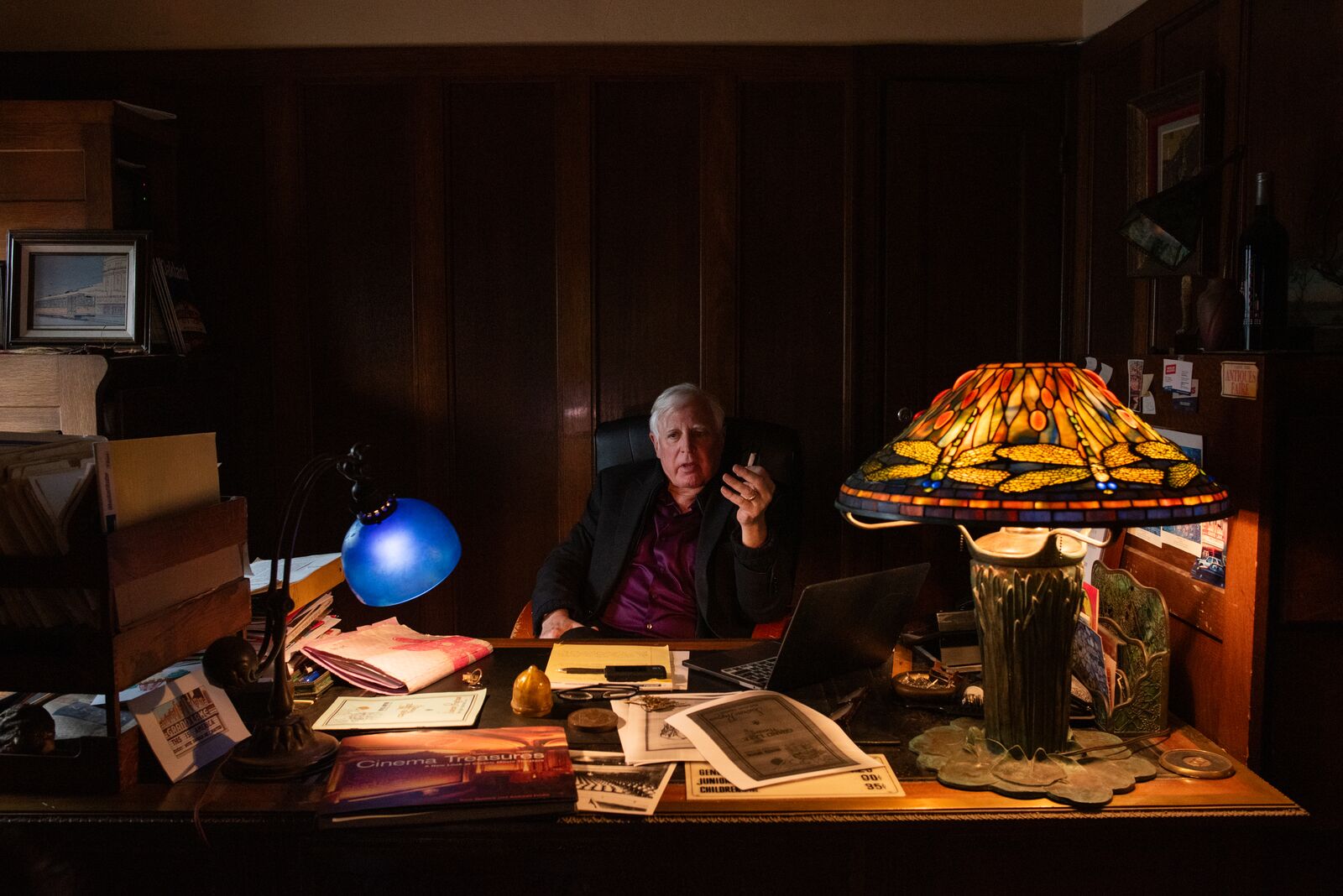
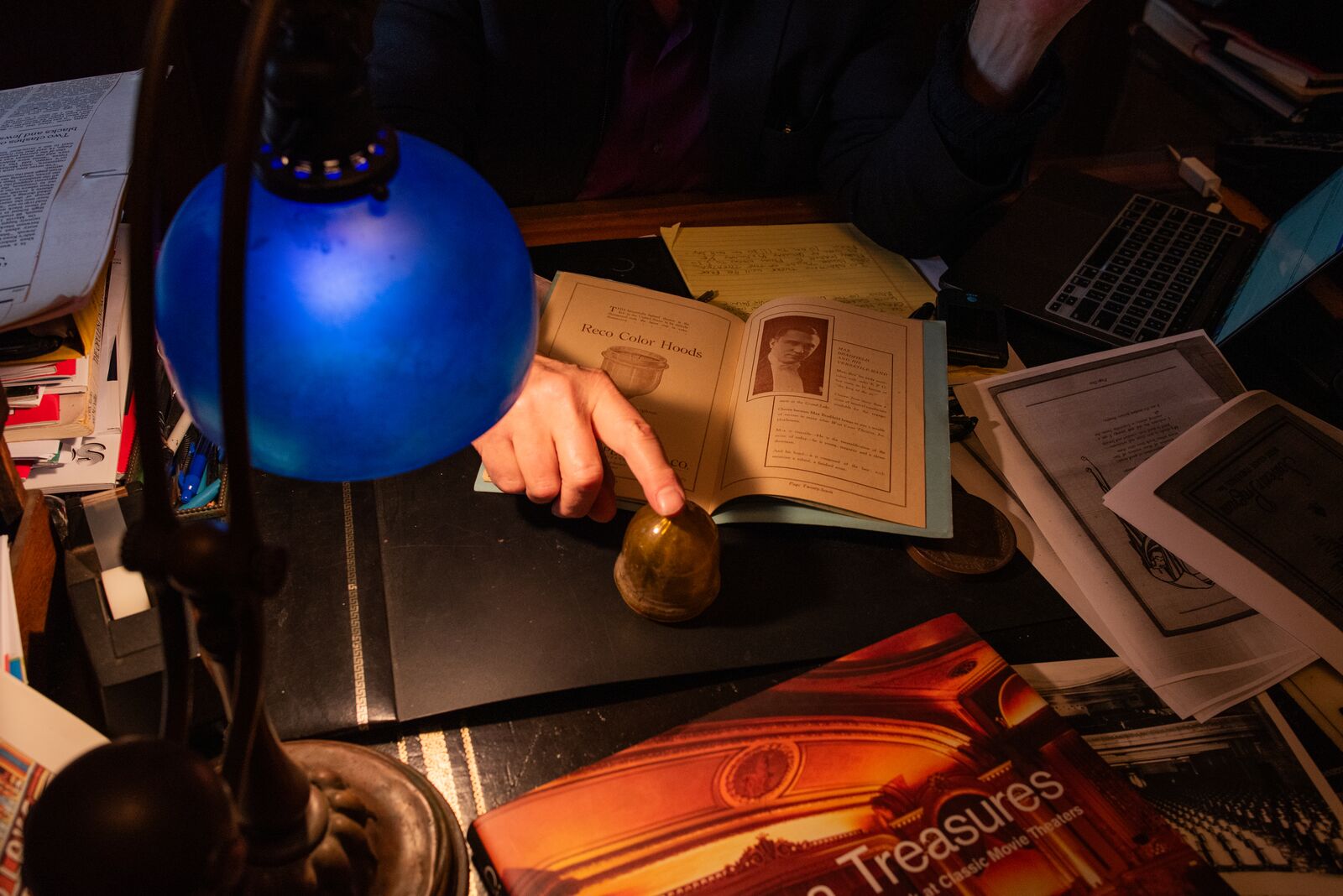 Allen Michaan, the owner of the Grand Lake Theater, in his office inside the theater, surrounded by his archives. Credit: Ximena Natera for The Oaklandside
When “Sinners” opened that same spring, Coogler explained why Grand Lake Theater was one of only five theaters selected to screen the 70-millimeter version of the film.In a profile in the New Yorker, Coogler talked about watching “Boyz ‘ N the Hood” at Grand Lake in the summer of 1991 when he was just five years old. Jelani Cobb writes that Coogler watched the entire film from his father’s lap.
In February, Curry hosted a screening here for the animated film “Goat,” which he co-produced, and in which he voices Lenny the Giraffe. “This is our home, and this is a place that when I got started, I was starting my true underdog journey,” Curry said on the red carpet. “Seventeen years later, we’ve moved across the bridge, but we still want to plant our flag here and have Oakland represented on the national stage.”
In late April, SFFILM plans to host the hometown premiere of Riley’s latest film, “I Love Boosters” at Grand Lake Theater.
A place where political views are loud
I head upstairs, to find Michaan sitting at his office desk, tucked away behind a wooden door across from Theater 2. He is typing on a laptop and chatting on a flip phone as he arranges the details for the theater’s centennial celebration with Anne Mavromatis, the theater’s projectionist.
“What was the first film that was ever screened here?” Mavromatis asked.
“I don’t think it’s listed on the original program,” Michaan said, flipping through a souvenir program from the theater’s grand opening. “Films from 1926 are public domain now. Can we find a way to load them?”
“I’ll look into it,” Mavromatis said.
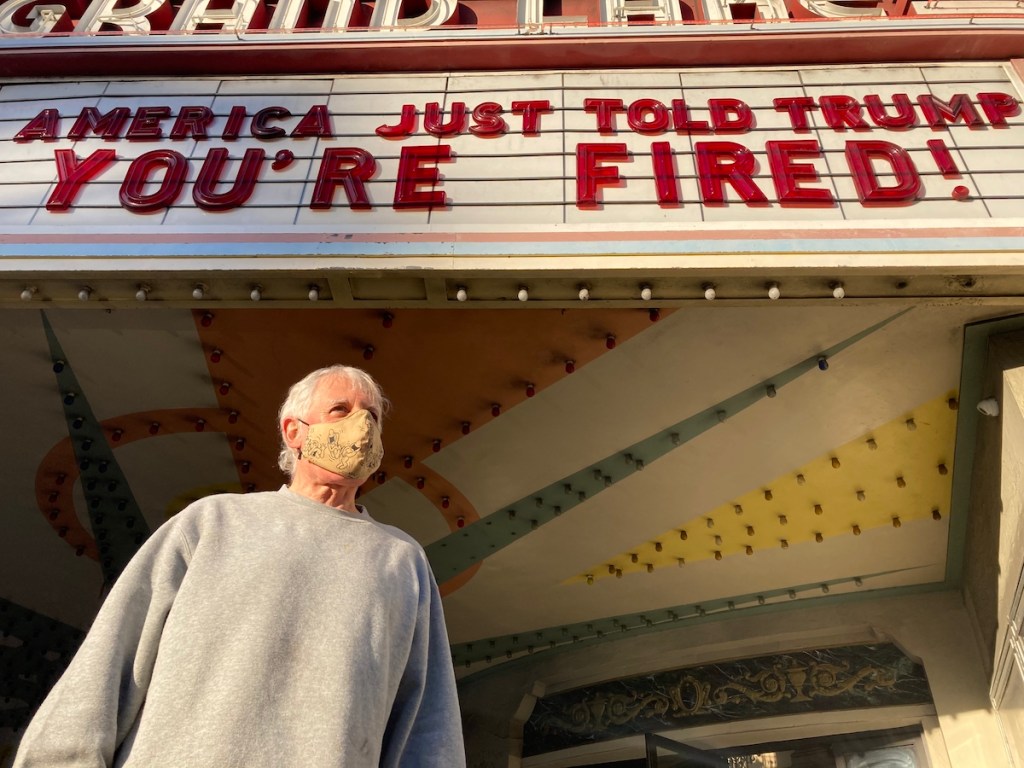 One of Michaan’s many political messages, added to the marquee after Donald Trump lost the presidential election to Joe Biden, Nov. 20, 2020. Credit: Darwin BondGraham/The Oaklandside Credit: Darwin BondGraham
Michaan has an ideal vantage point of Grand Avenue from his office window, and just as Mavromatis heads out, we hear the lound honking of cars supporting the anti-Trump protesters on the sidewalk below.
“It’s their duty as citizens to do what they’re doing,” he said. “And I wish every American were doing the same thing. Because we see what’s happening, and if we don’t rise up as a people to stop it, it’s going to be something we can’t stop.”
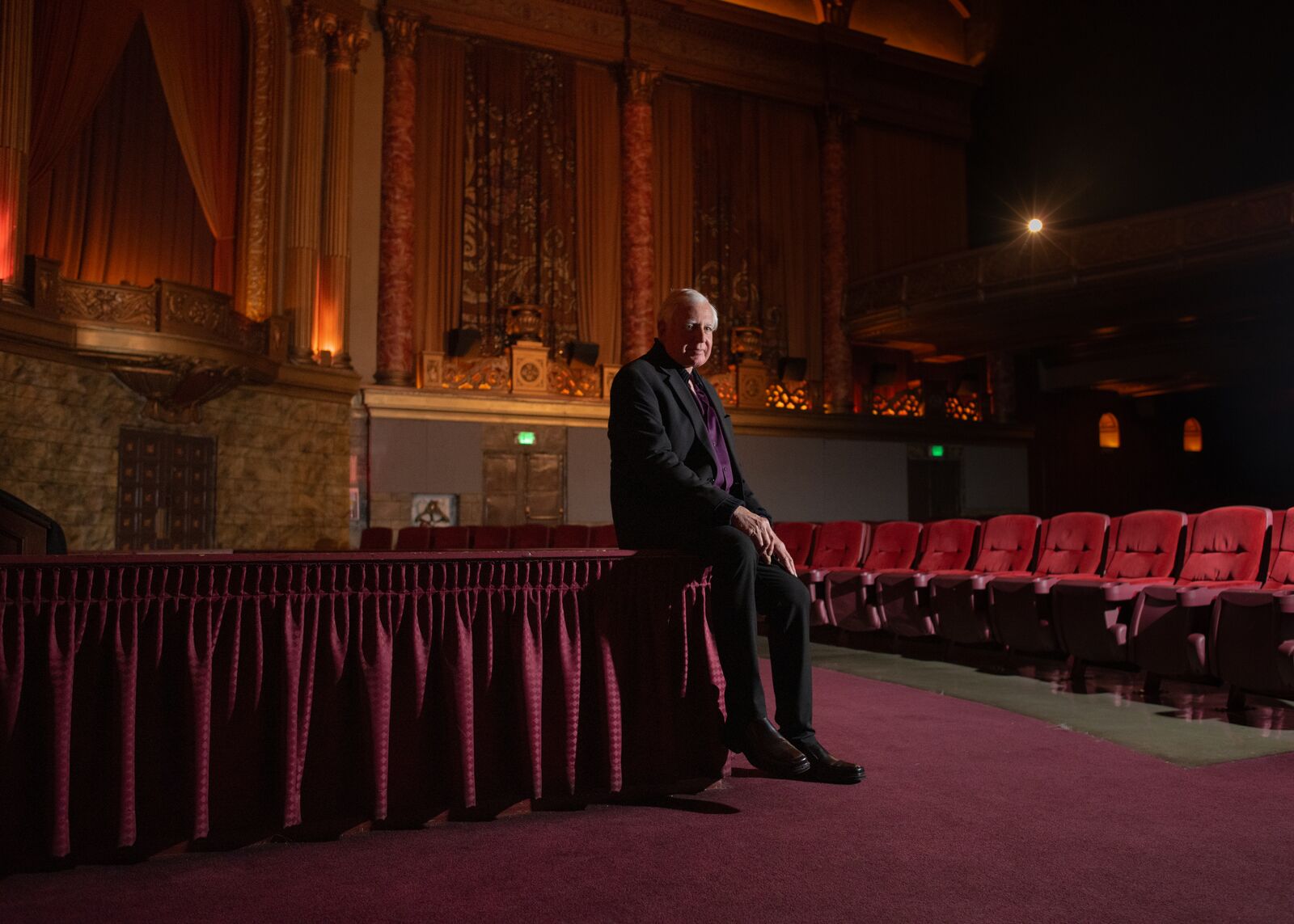 Michaan inside the main theater on Feb. 24, 2026. Credit: Ximena Natera for The Oaklandside
Michaan has never hesitated to be vocal about his political views. In fact, he’s been using the theater’s marquee to denounce government wrongdoing and celebrate local political wins for over two decades. He said one of his favorite messages is the one he put up after the U.S. declared war in Iraq on March 19, 2003.
“Shortly after it became so apparent that the war was completely unjustified,” Michaan said, “and it was just a theft of money — all wars are — I put up a message that said ‘Congratulations to Dick Cheney and Halliburton on your glorious financial victory in Iraq.’”
From ‘one of the most costly theaters in America’ to disrepair
Michaan has always loved films. He moved from the East Coast in 1970 to attend UC Berkeley. In order to support himself, he would show classic films in rented auditoriums around Berkeley. He created a midnight film series at the Palace Theater in San Francisco’s North Beach. And, just a year after moving to the Bay Area, he built the Rialto Theater in Berkeley at an old warehouse on Gilman Street.
Before the close of the 1970s, Michaan owned over 20 theaters across the Bay Area, including the Rialto and Shattuck cinemas in Berkeley under his new company, Renaissance Rialto Theaters.
“Sometime in the late ‘70s, I had a friend who was an usher at Grand Lake who told me that I ought to go watch a movie here,” Michaan said. “So one night after I closed down at the Rialto, I drove over here, and he gave me a tour of the theater. We ended up on the roof, looking at the sign, which he had turned on — and was forbidden because the sign on the roof was in bad shape.”
Michaan said that he had always admired the Grand Lake Theater, but in 1979 he pulled the plug and signed a lease.
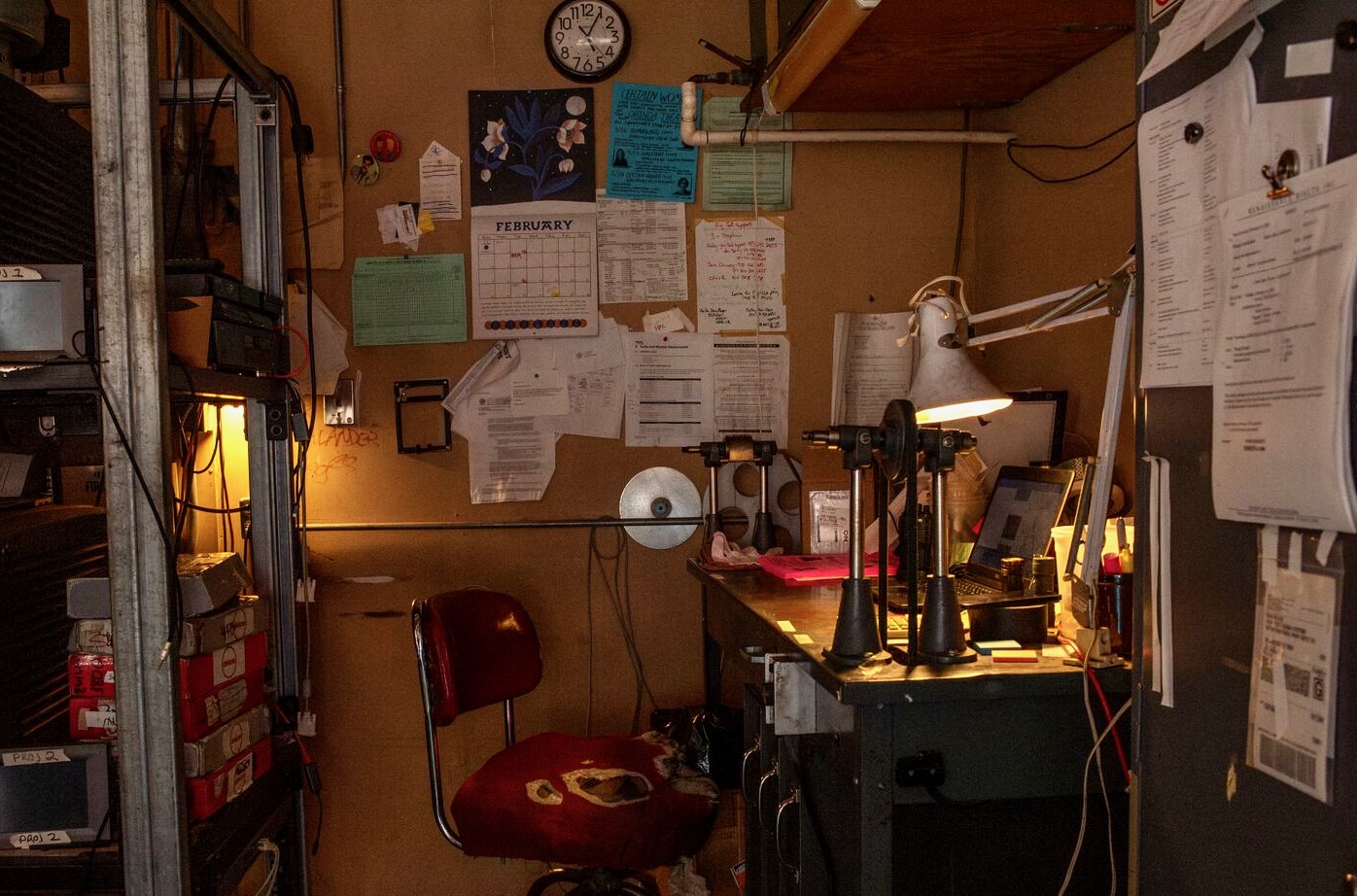
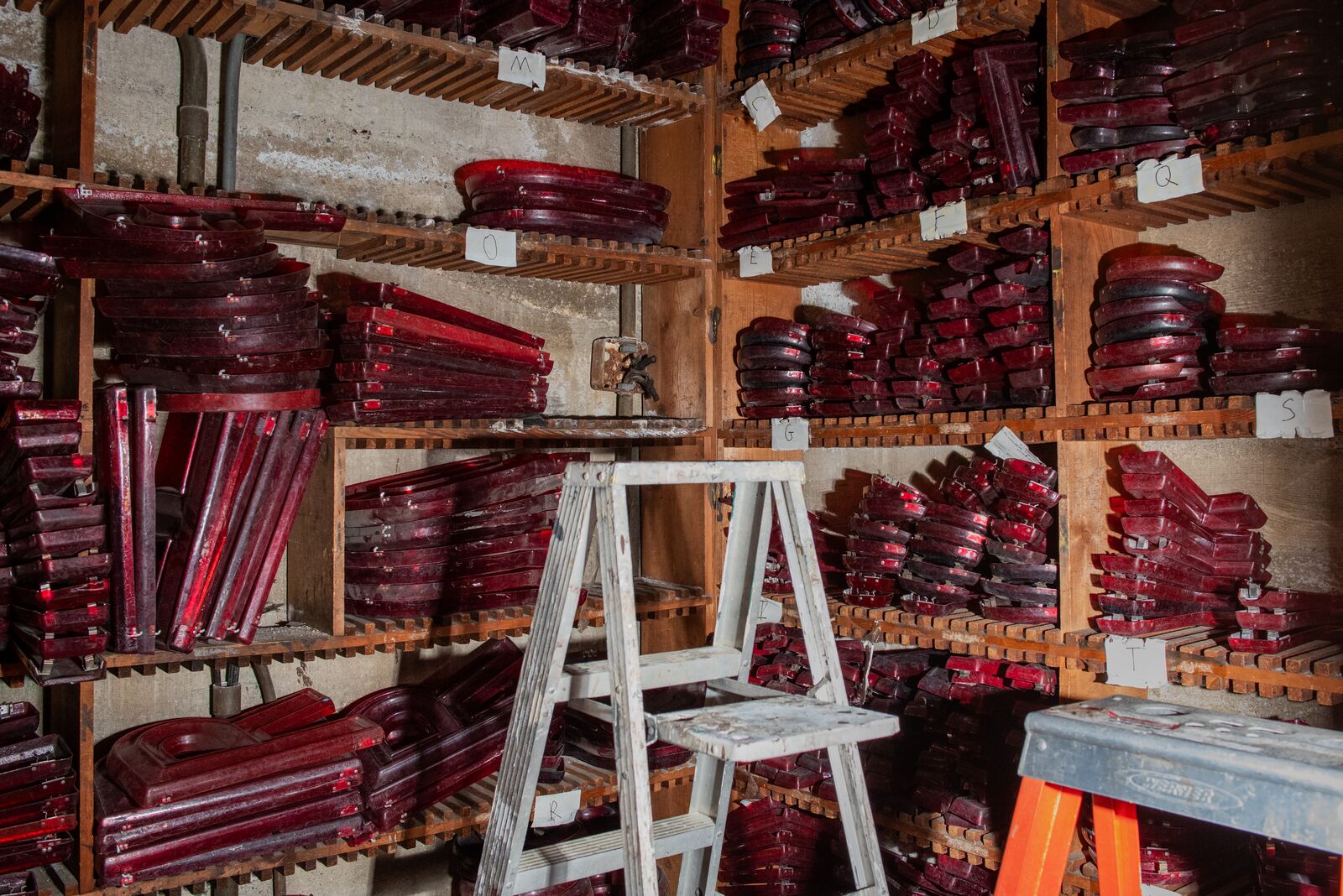
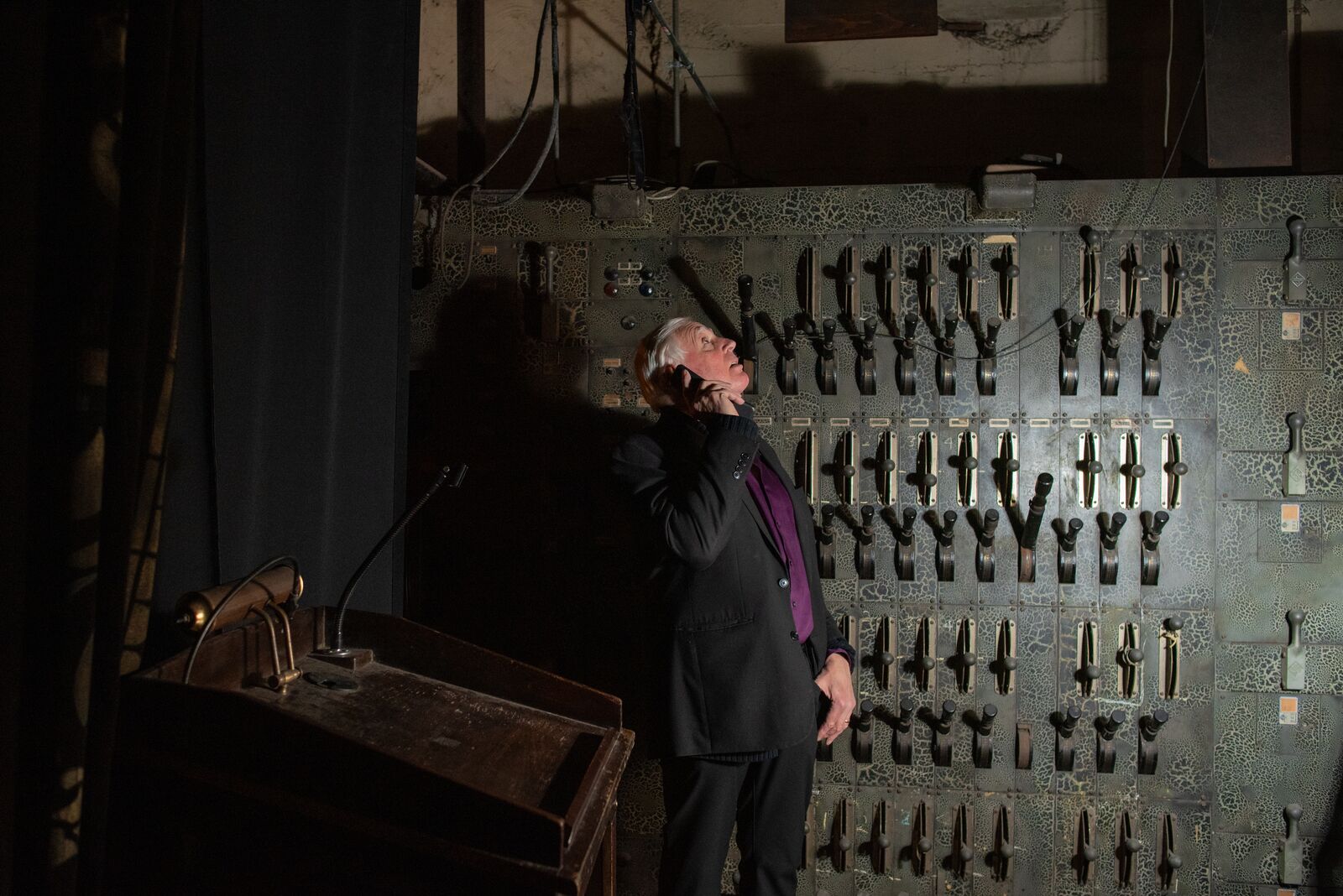 Top to bottom: the projection room; a former dressing room from the days when the theater staged live shows, now used for storage; a functional board previously used for live theater productions. Credit: Ximena Natera for The Oaklandside
According to newspaper archives from 1926, the Grand Lake Theater was built by West Coast Theaters, a Southern California movie chain, in collaboration with two prominent Oakland businessmen, A.C. Karski and Louis Kaliski, and was designed by the Reid Brothers, a San Francisco architectural firm. The construction had a price tag of $1 million (roughly $18 million in today’s dollars) and the building could seat 2,800. A story published in the Oakland Tribune on opening day called it “one of the finest and most costly neighborhood theaters in America.”
At the time of its opening, Grand Lake was mostly a venue for live theater, attracting crowds with plays and vaudeville productions. Michaan said he has preserved what were once dressing rooms for these live productions, now used as storage space for items like the red letters used on the marquee and the bulb caps that illuminate the iconic sign on the roof.
“We have a full stage, we have fly lofts,” Michaan said. “This building can host major Broadway productions. It’s that much of a theatrical building.”
But soon Grand Lake Theater also became home to a new form of entertainment: motion pictures. By the 1940s, Oakland’s movie theaters reached their peak, with dozens across the city.
“A theater like this with 2,000-plus seats could sell out several times a day,” Michaan said.
By the early 1950s, the rise in popularity of TV disrupted theater attendance. In Oakland, many theaters were razed or repurposed as offices, apartments, or churches.
The unveiling of BART in 1972 further disrupted Oakland theaters, as residents could more easily travel to other cities for entertainment, a transition boosted by rising crime rates.
“It was a big deal to acquire the Grand Lake,” Michaan said of taking over the theater’s lease in 1979. “In those days, in the ‘70s, the Grand Lake was a dingy, rundown place.” Years later, he went on to purchase the building from descendants of its original owners.
Restoring the theater to its glory days
The theater’s grand structure covers some 22,000 square feet, with ornamental plasterwork interiors, tall painted ceilings, and a Mighty Wurlitzer pipe organ that is played every Friday and Saturday evening. Inside the main theater, a gold curtain drapes over the screen before each screening — a curtain, Michaan said, that once hung in the Fox Theatre Auditorium in San Francisco, which was demolished in 1963.
After Michaan took over the theater’s lease, he shut it down for several days of extensive repairs.
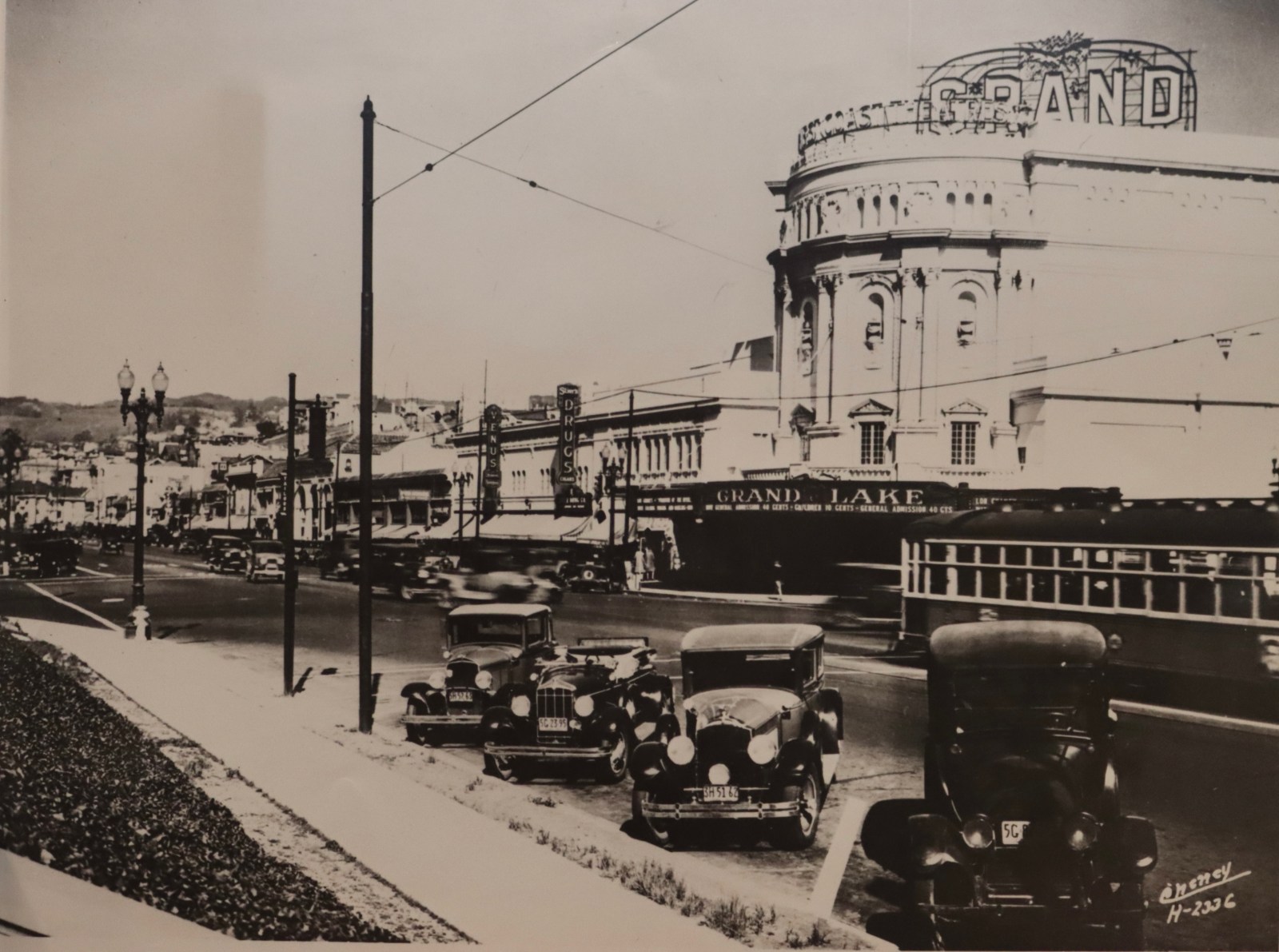
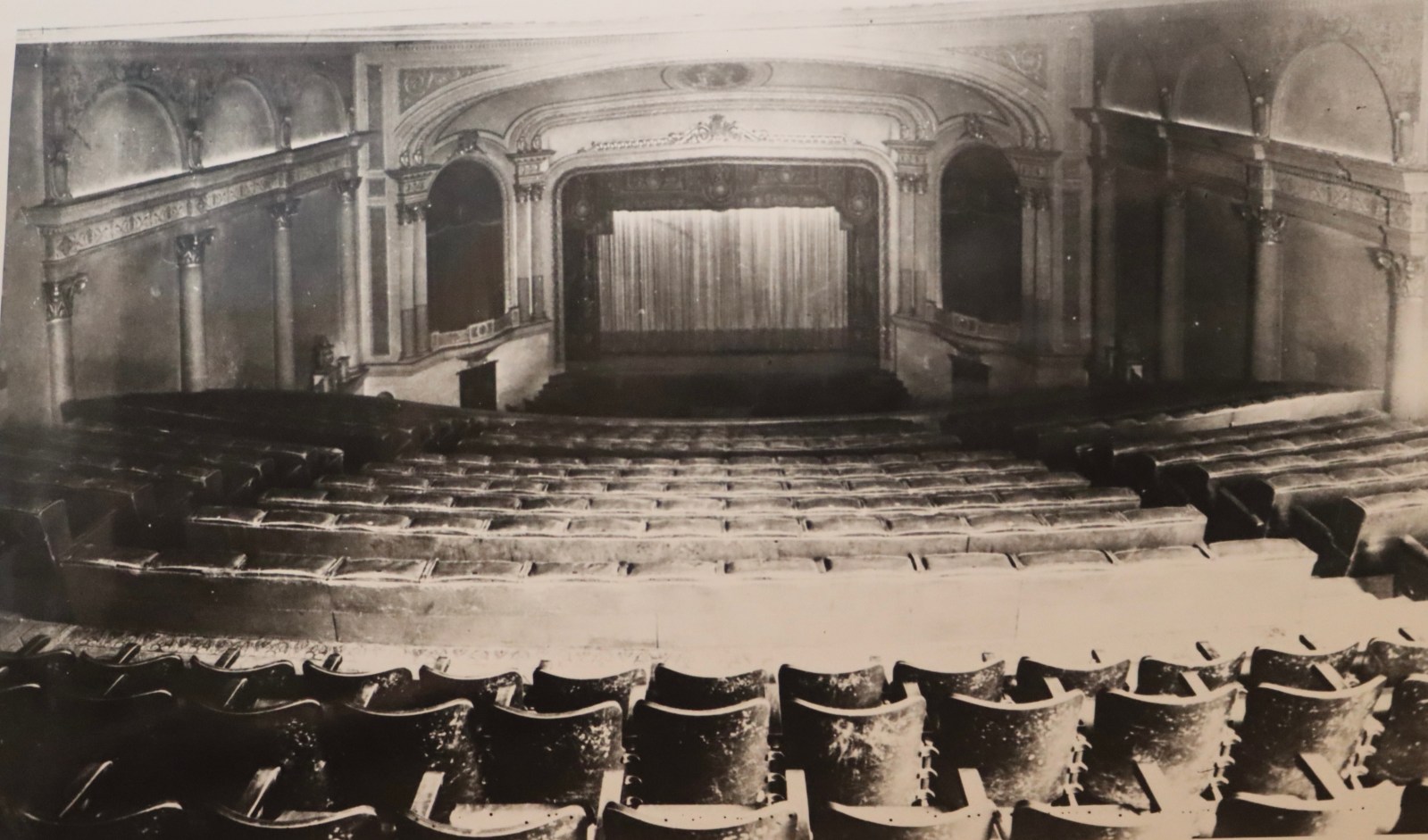 The theater’s exterior and interior, not long after its doors opened in 1926. Credit: Courtesy of Allen Michaan
“During the week we closed, we worked furiously,” he said. “We replaced 9,000 light bulbs on the interior of the theater that had burned out and had never been replaced over all those years. We put in new projector lenses and a Dolby stereo system. We reopened the theater on a Thursday with a big party for the press and for all the people who worked for the film companies in San Francisco.”
Despite all his hard work, exclusive deals meant the theater struggled to secure screenings of new movies. When Grand Lake Theater reopened on Jan. 8, 1980, it did so with screenings of old movies for weekend family matinees.
Michaan’s investment in the building never stopped. Within the first year of reopening, he added a 70-millimeter projector. In 1981, he walled off the balcony of the original auditorium to create a second screen with 450 seats. That same year, the building was designated as an Oakland landmark.
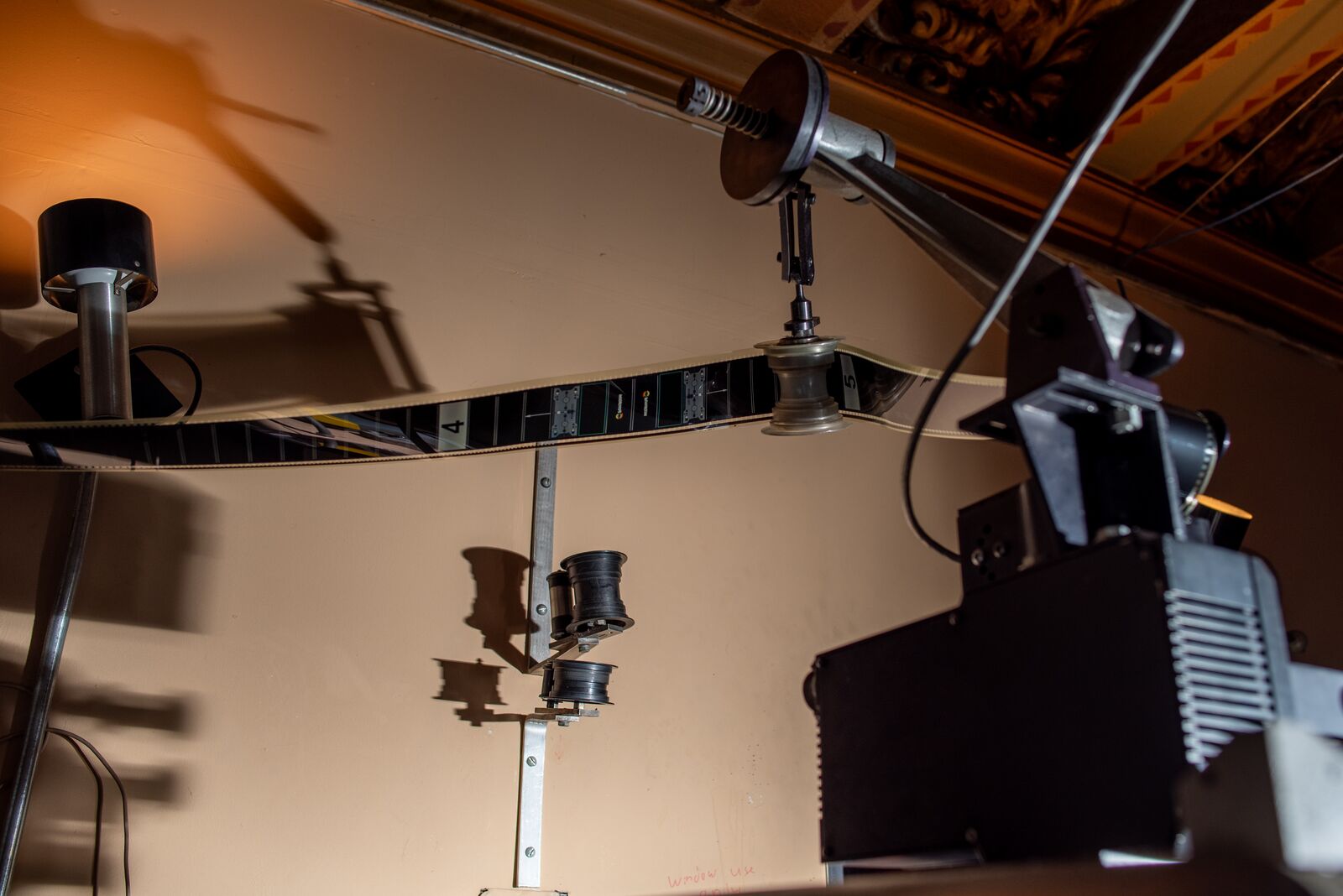
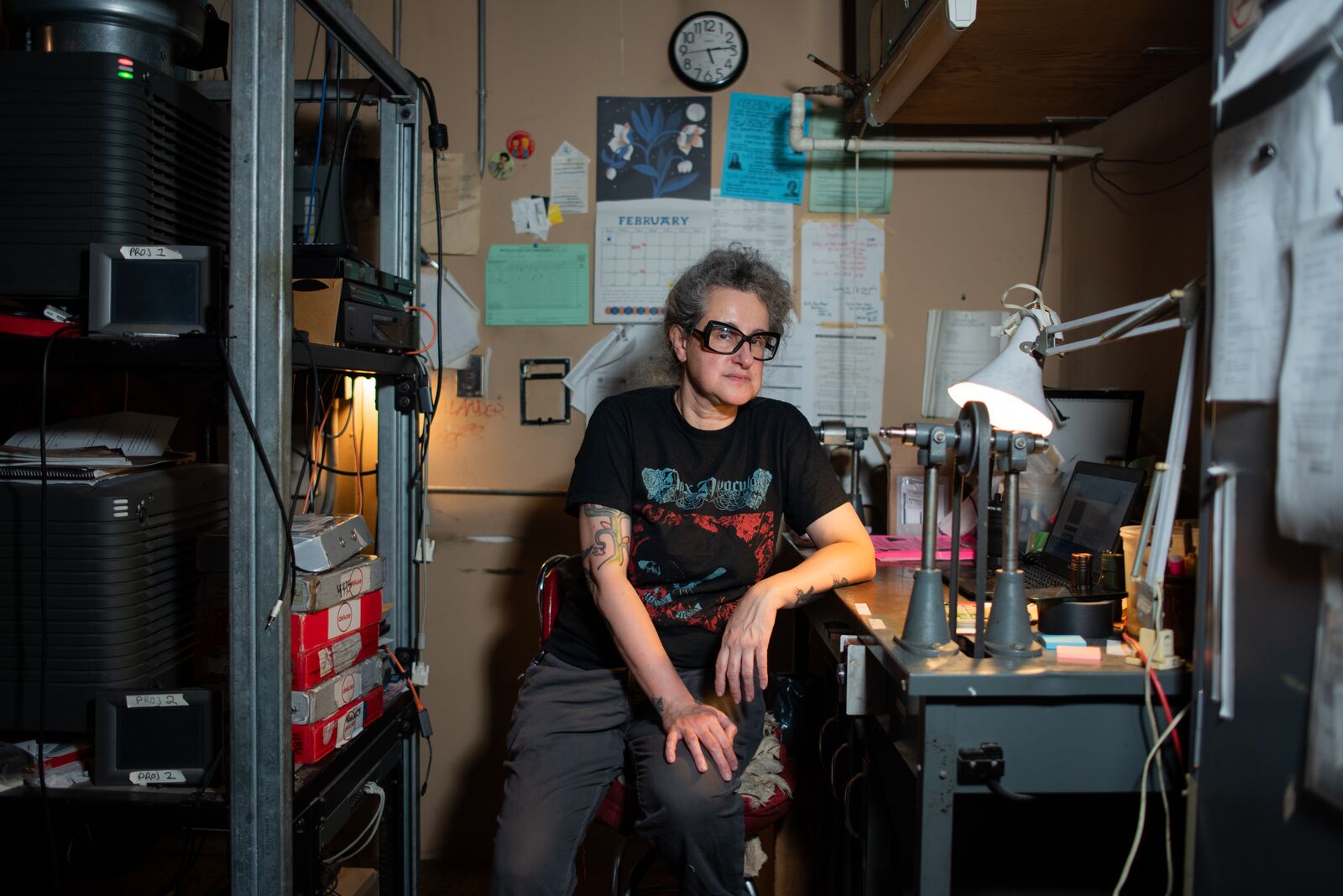 A 70-millimenter copy of “Sinners” cued up to play in the main theater’s projection room, top; Anne Mavromatis, the theater’s projectionist since 2002, bottom. Credit: Ximena Natera for The Oaklandside
“Allen is in it for the love of films,” Mavromatis said. “I appreciate that so much about Allen. He loves the theater experience.”
That investment in the 70-millimeter projector paid off when Steven Spielberg made “E.T.” in 1982.
“I met Steven Spielberg at a theater convention event in Las Vegas, and I was telling him about the theater,” Michaan said. “So he says, ‘I will request a 70-millimeter print for you.’”
He ended up getting an exclusive 36-week run of the film, one of the longest runs in the country. According to Michaan, Oakland screenings outpaced those in San Francisco.
“The ‘E.T.’ run established the Grand Lake,” he said. “And after that, we were able to pretty much get anything we wanted.”
Mavromatis, who has been a projectionist at the theater since 2002, said that the Grand Lake Theater takes pride in caring for the film prints it receives.
“We always return what we get in as good condition as we get it,” she said.
For Mavromatis, there’s no better way to watch a movie than when it comes on film.
“We ran ‘Tenet’ from Christopher Nolan,” she said. “We had it just for a week after we reopened after the pandemic. It looked so beautiful. It was sharp, shot on film, and it looked incredible.”
Facing down multiplexes — and a pandemic
By the late 1980s, Grand Lake Theater faced a new threat: the rapid expansion of chain multiplexes. In 1989, United Emery Bay (which closed in 2014 and redeveloped into housing) opened in Emeryville. Six years later, Jack London Cinemas 9 (now Regal Cinemas) opened in Jack London Square. AMC Bay Street 16 in Emeryville would eventually open in 2002.
Before they opened, Grand Lake Theater and Piedmont Theater had exclusive rights for first-run movies. Then that changed.
“For over two years, we couldn’t get any first-run films because Regal would say that we were too close,” Michaan said. “Even though they played equidistant to Emeryville.”
According to reports in the Oakland Tribune, Michaan, fed up with being boxed out of screening blockbusters, sued Jack London Cinemas 9. His 1998 lawsuit claimed that the multiplex had pressured Hollywood studios to deny major films to Grand Lake Theater, what Michaan called “unfair competition.” Michaan sought to recoup what he estimated as $2 million in lost revenue.
His victory in that case, he said, changed the way films are distributed, ending exclusive runs. Now any movie theater can screen whatever new film it wants.
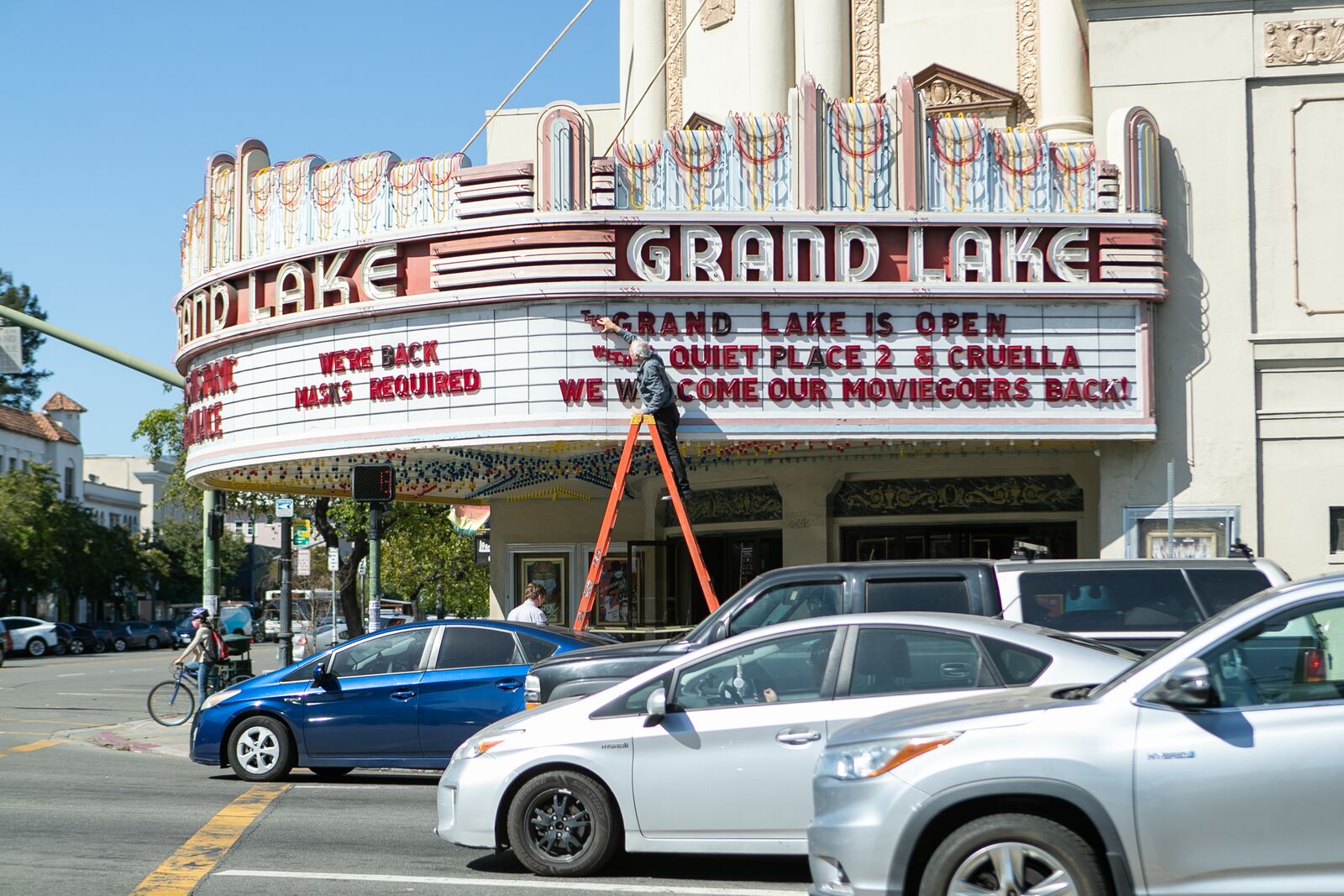 The theater reopens on May 27, 2021 after a 14-month closure during the pandemic. Credit: Amir Aziz/The Oaklandside
When Covid lockdowns arrived, it was just another obstacle to overcome. Grand Lake closed in March 2020 for 14 months.
Michaan, true to form, used the closure to engage in overdue repairs and renovations, including new carpet in the entrance lobby, a fresh coat of paint for the ticket lobby, and even some much-needed plumbing repairs.
He also had solar panels installed on the roof, which now allows the theater to generate most of the electricity it consumes.
Not long after the theater reopened in May 2021, Michaan took on yet another restoration project: replacing the 3,000 incandescent light bulbs that illuminated the sign on the roof with energy-efficient LED bulbs.
A movie-going resurgence
The pandemic, Michaan said, changed the way people enjoy movies — and the way studios distribute them.
“Even some of the studios that actually had films ready to go into release decided they weren’t going to wait for the reopening, and they put the films on streaming,” he said. “It was a betrayal.”
Slowly, Michaan said, he’s been seeing signs of a rebound.
In the summer of 2023, when the blockbusters “Barbie” and “Openheimer” opened on the same weekend in a phenomenon dubbed “Barbenheimer,” Michaan saw a record number of people coming back to Grand Lake Theater. He said that opening weekend was the best for the theater since “Black Panther” was released in 2018.
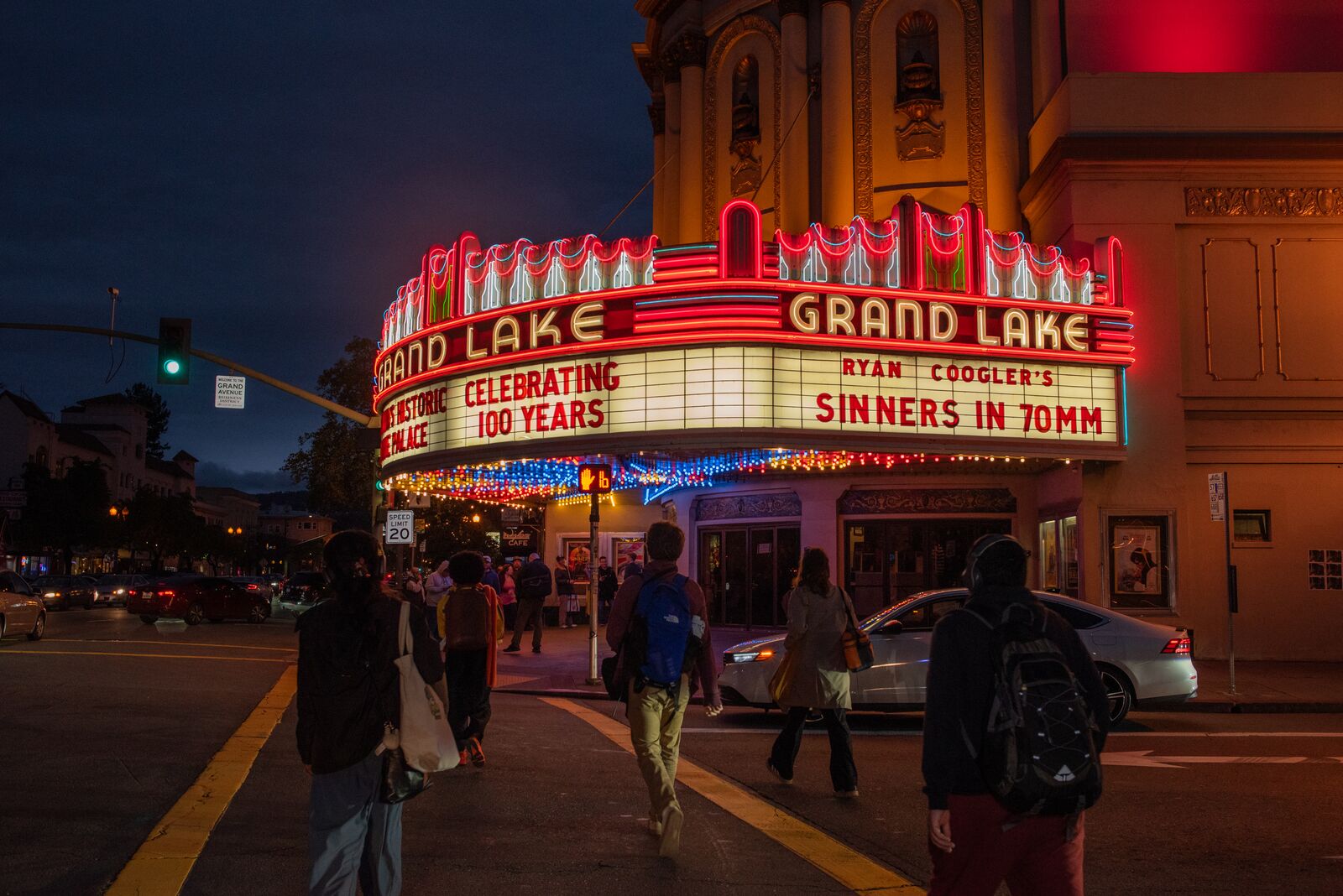 The theater is offering tours in celebration of its centennial anniversary. Credit: Ximena Natera for The Oaklandside
“Ryan always comes back,” Michaan said. “We’re happy to work with him and do events for him.” Michaan said he’s always on the look out for the next rising star, too — “all kinds of independent filmmakers and new filmmakers.”
Kiante Marron is one of those up-and-coming Oakland filmmakers, someone with a dream of one day screening his own feature film at Grand Lake. He has worked as an usher at the theater since 2022 and has seen what the place means to local filmmakers.
“Before getting a job at the theater, I remember driving by one day and saying that one day I’m going to screen my movie here,” Marron said. “My favorite part about working at Grand Lake is the community. We are the go-to when it comes to the movies we show, and the events that take place here.”
Michaan hopes that Grand Lake Theater continues its momentum for years to come.
“We will continue with the Mighty Wurlitzer organ played before the movie,” he said. “We’ve never shown a commercial on our screens here. Our concessions are very traditional. We pop our own popcorn, and we use real butter. Our prices are the lowest of any theater in the Bay Area. We cater so that going to the Grand Lake is a special experience.”
Grand Lake Theater will offer free tours of the building to commemorate the centennial anniversary, on Friday, March 6 at 2 p.m., 2:30 p.m, and 3 p.m., and Saturday, March 7, and Sunday, March 8 at 10 a.m., 10:30 a.m. and 11 a.m.
“*” indicates required fields