
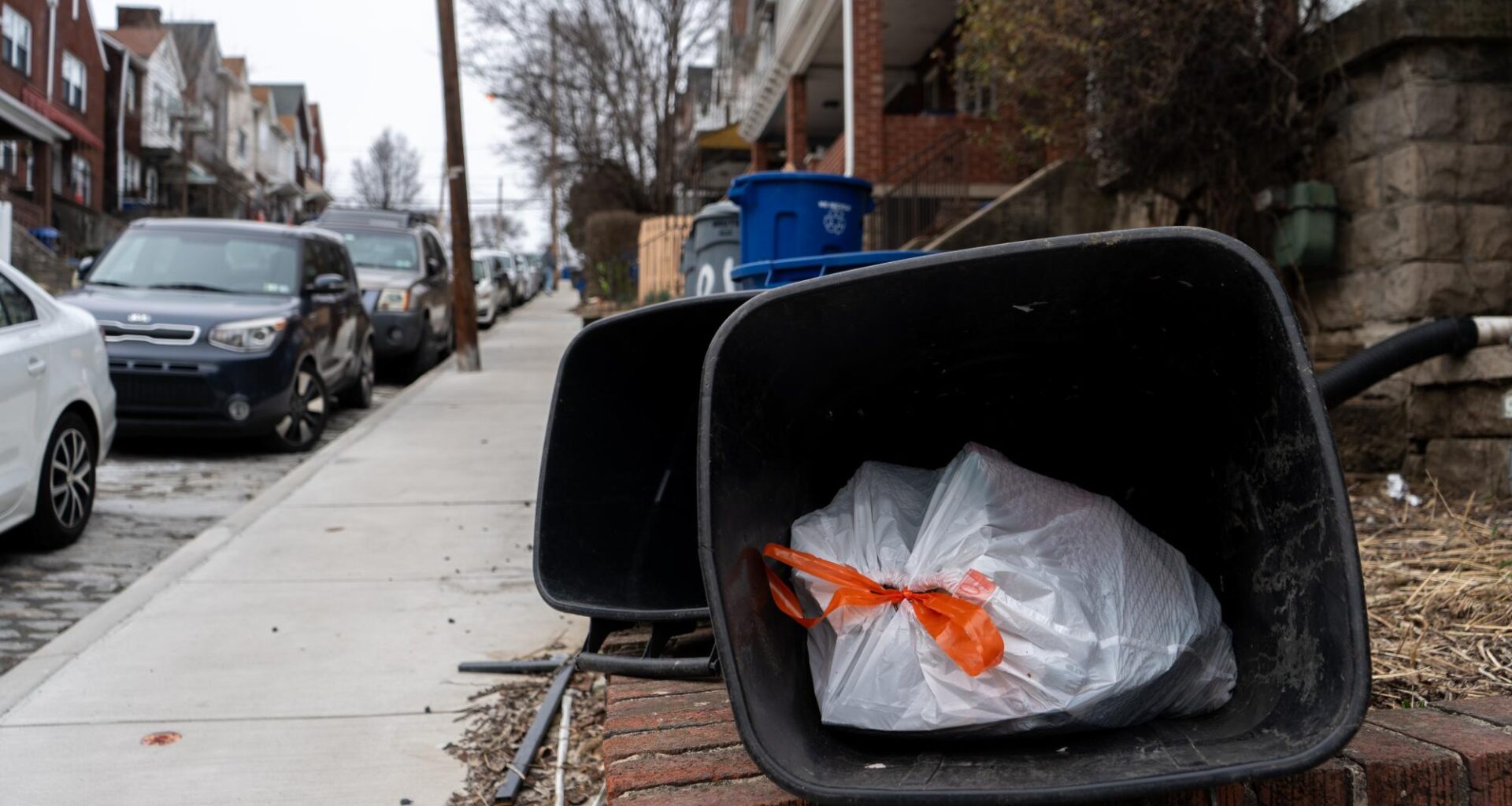
Trash has long been a hot topic in Oakland.
Complaints of litter-ridden streets and delayed pickups in Oakland have been consistent for years, with students and residents noting the problem for the last three decades. Oakland Planning and Development Corporation staff said student residents contribute most to the issue, but it may not be on purpose.
Andrea Boykowycz, executive director of the OPDC, is a longtime Oakland resident who said the garbage plight is nothing new.
According to Boykowycz, Oakland’s trash issue dates back to at least the 1970s. The City’s first Oakland plan outlined how to improve and address problems within the community and eventually led to the creation of the OPDC, Boykowycz said.
“Trash has been a perennial problem here for as long as I can remember in different ways, in different capacities,” Boykowycz said. “It was one of the things that was first noted in the very first Oakland plan that was published in 1979.”
Though student residents generate much of the trash throughout the streets, Boykowycz said the main issues are a lack of sufficient trash and recycling cans or “inadequate containerization.”
“It isn’t that students are slobs,” Boykowycz said. “Garbage cans have the tendency to not have lids, they tip over, raccoons get into them, they tear open the bags, stuff gets strewn all over the street, the wind blows everything everywhere — and that is the bulk of the trash that you see on the street.”
Mackenzie Gutberlet, a sophomore bioengineering major, said, as an out-of-state student, it’s important for her to “give back” to the Pittsburgh community by taking care of the environment.
“I’m really conscientious about how I treat the environment — seeing litter on the streets, I’ll try to pick it up, and I’m really adamant about recycling,” Gutberlet said. “It’s a passion that I have. If I can continue to do [cleanups], I will.”
Gutberlet lives in central Oakland, where she sees plenty of litter on the streets, especially in alleyways between houses. Gutberlet said many of her neighbors don’t seem to understand or “care” about trash etiquette.
“People will leave their trash cans out on the curb, and then the wind will blow them over, trash will be everywhere [and] people will leave whatever’s fallen out of their trash cans on the street,” Gutberlet said. “I feel like some people just don’t care.”
The majority of residents in Oakland are students at nearby universities with short-term leases. Lizabeth Gray, OPDC’s community liaison, said trash education is more difficult because of the constant turnover, which means there is a new student “audience” who needs to learn their responsibilities as renters each year.
“Sometimes, once you get somebody trained into something, then all of a sudden, they’ll go off to another job,” Gray said. “It’s kind of the same thing here.”
According to Boykowycz, the OPDC often receives complaints from Oakland residents about neighbors who don’t take proper care of their garbage cans. She said accumulated litter can also cause health concerns and public hazards for pedestrians.
“The trash that accumulates on the sidewalk in front of the steps of your house — it is your job to sweep that up,” Boykowycz said. “If you’re on crutches or if you are an old lady and you have a cane or if you have any other kind of instability, then navigating big obstacles on the sidewalk is really, really challenging.”
Gray said she has seen improvement in Oakland litter over the last decade, but there are still fluctuations throughout the year. She said she typically sees more trash accumulating toward the end of winter and less during the summer, when there are fewer students in the neighborhood.
“With the snow melting, we’re seeing a lot [of trash],” Gray said. “When we get into the spring, you see all the daffodils and the tulips coming up, we see all the red cups coming up, and [at] about the same proportion.”
Since 2018, the OPDC has teamed up with Pitt to create the largest volunteer team for Pittsburgh’s annual Garbage Olympics. Despite the Oakland team placing second in 2025, Boykowycz said volunteers cannot collect as much waste as other neighborhoods’ because the bulk of Oakland’s trash is “small litter.”
“We have the most people, and we have never come close to winning for the amount of trash that gets picked up,” Boykowycz said. “That’s not because people are not doing their part — it’s because the kind of trash that we have here is the kind that is blown all over the place.”
The OPDC has initiatives such as adopt-a-block cleanups and renters resources QR-code magnets, but Gray said the most effective way for her to engage with student residents is through “street talking.” She recently had an encounter with a student in Central Oakland that helped her understand why there were scattered recyclables in the street.
“I found out that they hadn’t had their recycling picked up in over four weeks,” Gray said. “In that way, I get the information that I can then pass on to the city, saying, ‘Hey, is there some reason we haven’t gotten a recycling pickup down on the 200 block of Zulema?’”
Gray said the OPDC is a resource to help students understand their rights and responsibilities as first-time renters. Gray said part of “adulting 101” is learning how to deal with trash, which she called “the byproduct of living.”
“The reason you put your trash into a can with a lid on it is because you don’t want to set out dinner for the rats,” Gray said. “We’re not [just] doing this because we want the place to look pretty and neat and all that kind of stuff. We’re doing it to improve the quality of everyone’s life in Oakland.”