
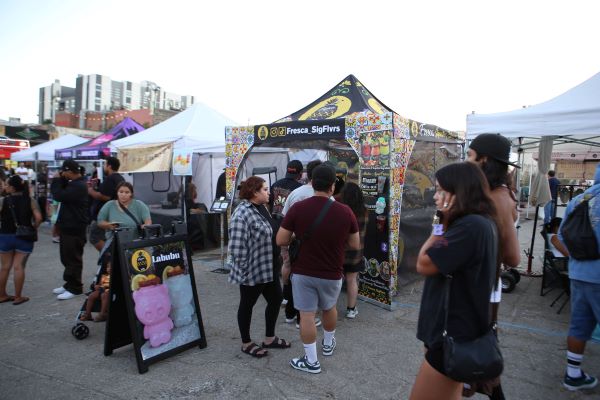
 Pictured is a scene from San Pedro’s first Night Market in August 2025. File photo
By Devonte Barr, Columnist
On a Saturday morning a couple of weeks ago, San Pedro artists gathered at Los Angeles Harbor Arts to debate whether they intend to survive.
Within minutes, we were talking about bylaws, budgets, contracted security response times, and how to make a room full of “heavy hitters” look you in the eye while you speak, which is to say: This wasn’t an arts committee meeting. It was a civics meeting that smelled like acrylic and lukewarm coffee.
Everyone in the room cared deeply about the same thing — bringing people back into galleries, rebuilding energy after COVID, protecting what’s left of an “organic” arts district that predates any marketing plan. But beneath the surface, the real conversation wasn’t about paint or programming. It was about power.
Specifically: who controls the money, who controls the brand, and who gets to decide what “culture” looks like downtown.
Coming off the heels of First Thursday this past month, when nearly 200 teenagers flooded the blocks near 6th and 7th streets. A self-promoting kickboxing instructor reportedly challenged the crowd. The sheer excitement gave way to the pitfalls of adolescence. Fights broke out. Several teens were detained by the police. Parents were called. For some in the room, it was just another example of what happens when an event becomes a magnet without a structure — when spectacle overtakes stewardship.
First Thursday, several artists argued, it no longer feels like it belongs to the artists. It feels like a product — marketed, monetized and managed by San Pedro’s Historic Waterfront Business Improvement District, also known as the PBID. Artists cited specific concerns: delayed security response times, limited hours and inconsistent sanitation. Yet artists have no seat at the table when those contracts are renewed. The PBID collects assessments from property owners and controls the contracting process for vendors. From the artists’ perspective, the event’s current chaos and exhaustion stem from decisions made without their input or consideration of their priorities.
That’s when the conversation shifted, almost accidentally, into governance.
The conversation moved into the mechanics: renewal cycles, service contracts, security, sanitation, marketing budgets and votes. Someone suggested organizing property owners. Someone else suggested documenting every failure. Another urged artists to physically stand in front of the board’s projection screen at PBID meetings, so they’d be forced to make eye contact.
It was a room full of people who could build entire worlds on canvas, struggling to build a shared Google Doc.
And I say that with love — as an artist myself. The irony is almost poetic: The same independence that makes artists powerful also makes them allergic to coordination. No one wants to be the boss. No one wants to be the treasurer. Everyone wants the doors open and the energy back.
Carol Hungerford, who operates in the Los Angeles Harbor Arts space, said something that felt honest and heavy: They haven’t recovered since COVID. Before the pandemic, First Thursday was a reliable funnel for discovery. The event has since returned, but several attendees described it as chaotic, diluted, or exhausting. They offered no attendance data, but they did offer something clearer: a shared sense that the engine driving reliable foot traffic has stalled.
But what I didn’t hear — not once — was a clear call to reach a younger generation. Early iterations of First Thursday thrived on discovery. It wasn’t just retirees making their rounds; it was young couples, creatives, people looking for something to do on a weeknight that didn’t involve a cover charge. That generational curiosity is what gave the event lift.
Second Saturday was described in the room as a response — a quieter correction, an attempt to bring the focus back to art itself. But if First Thursday once grew because it captured younger momentum, the absence of that conversation now feels conspicuous.
Young audiences exist. They drive up the 110 for museum shows. They wait in lines for gallery openings in Culver City and Downtown LA. They post, they return, they bring friends. The question isn’t whether they care about art — it’s whether San Pedro is speaking to them, or whether we’re still only speaking to the people who already know where the galleries are.
But the meeting didn’t go there. Instead, it got stuck.
App or website confusion. Missing social media posts. Trolley schedules. Evaporated cross-promotion commitments. The security contractor had failed to show up multiple times; his equipment had been stolen. These weren’t peripheral complaints. They were the operational failures that artists said were undermining the event.
Power, it turns out, is less about passion and more about process.
The most consequential moment came quietly, near the end: The PBID renewal date is December 2027. That’s the hinge. Miss it, and the PBID renews on its own terms for another five years. Show up organized with documented demands, and the artists have leverage to renegotiate contracts, demand representation and rewrite the rules.
That means the next few months aren’t about complaining — they’re about building something that can be negotiated. It requires a unified plan with documented demands.
The artists in that room don’t lack talent, heart, or ideas. What they lack — at least for now — is infrastructure.
Second Saturdays — the artist-led alternative — emerged as an organic response: open studios, flexible hours, minimal programming. A return to simplicity. Good instinct. But simplicity still requires structure. Someone has to own the list of participating spaces. Someone has to manage the hours. Someone has to define the route. Someone has to say, “Here is what we are doing, and here is why it matters.”
Otherwise, the structure renews itself by default.
San Pedro’s arts community has history on its side. It has authenticity on its side. What it needs now is discipline — not corporate discipline, not soulless branding, but the kind that turns energy into strategy.
And that starts with a document. Not a manifesto — a one-page list of demands. What services were promised and not delivered, and what specific changes do artists want before they vote to renew? Something concrete enough to hand to a property owner, a council member, or a PBID board member who’s used to artists showing up with feelings instead of facts.
Like this:
Like Loading…
Related