
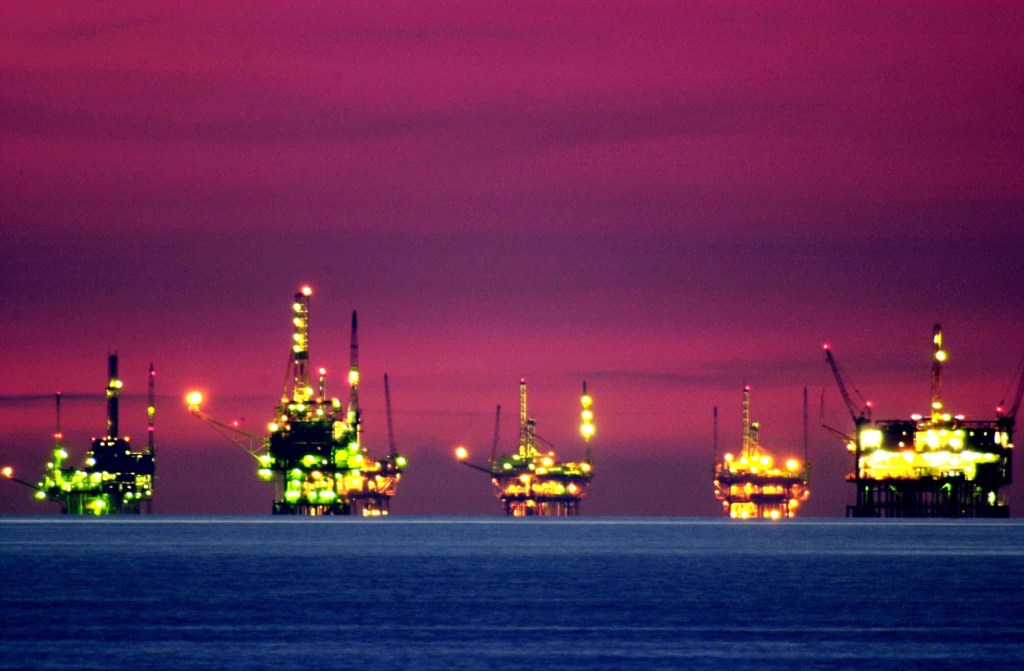
As the midterm campaign season just started heating up, the Trump administration further injected offshore oil and gas drilling into the California political equation.
The announcement on Feb. 26 that it will start preparing an analysis for expanding drilling in federal waters off Northern, Central and Southern California likely gave some Republican congressional members heartburn.
Even if they oppose further offshore drilling, like many Republicans in other coastal states such as Florida, having the issue advance in this election wouldn’t seem to be doing any favors for GOP candidates running in swing districts. California may be overwhelmingly Democratic, but the GOP likely needs to win some of those districts to hold on to its slim majority in the House.
But the U.S. attacks on Iran launched two days later could scramble the political dynamics of offshore drilling that seemed to give Democrats an obvious advantage. Oil and gas prices surged.
There’s no telling how the military strikes and the fallout will affect the oil market in the long term. That may depend on whether the conflict continues for weeks, months, all the way to November or beyond.
If prices remain high for some time, that could soften opposition to more offshore drilling as concerns rise over national security amid restricted foreign supply. Clearly, there would be other even larger consequences, political and otherwise, of an extended war.
Just under half of adult Americans supported offshore drilling, according to a poll released by the Pew Research Center in October. To no surprise, there was a partisan split, with more Democrats opposed, and presumably more widespread resistance in coastal states.
On the business end, unless there’s sustained higher oil prices projected years into the future, companies would be reluctant to sink big investments into offshore development, even if more leases became available, according to Rob Nikolewski of The San Diego Union-Tribune.
Thousands of approved leases are idle, particularly in the Gulf of Mexico, according to Grist, a climate and environment-focused website.
If approved, the first lease sales in Southern California and Central California are tentatively scheduled for 2027. That’s a big “if,” considering the legal hurdles California would throw up. Then there are the logistical and regulatory issues for needed facilities onshore, where the state has more control.
In other words, none of this might even be possible until Trump is out of office following the 2028 election. And who knows whether his successor, Republican or Democrat, would share Trump’s “drill, baby, drill” view, at least when it comes to coastal areas.
Regardless, there would be no relief on gas prices from the policy anytime soon.
Given that potential timeline, the idea of pushing back the California drilling analysis and laying low on the subject — granted, that’s not Trump’s style — might eventually seem like a good one in retrospect.
Opposition to offshore drilling is something of an article of faith in much of California, and not just along the coast. Though more than a half-century ago, the devastating oil spill off the coast of Santa Barbara in 1969 continues to haunt the state. Having said that, drilling in California-controlled waters approved long ago continues and has faced little effort to stop it.
No new oil and gas leases have been approved for federal waters off the coast of California since 1984, Nikolewski wrote.
The top contested California GOP districts generally don’t include shoreline, but some aren’t far from it, such as Republican Rep. Darrell Issa’s new 48th Congressional District, which now stretches west to Vista.
That once-Republican district now leans slightly Democratic thanks to the realignment of districts that occurred in response to the GOP move in Texas to wipe out a handful of Democratic districts.
Still, the gerrymandering in California doesn’t guarantee Democrats victories in a handful of GOP-held districts, such as Issa’s. But it vastly improves their chances — which conceivably could get a boost from more action on unpopular Trump policies such as offshore drilling.
Issa’s office did not respond to an email seeking his stand on Trump’s current drilling plan. Back in 2018, Issa was a vocal opponent of the first Trump administration’s proposal to open up more coastal drilling.
“It’s not the time to reopen California’s shoreline to new drilling,” he said then, when facing a tough re-election challenge. “. . . Californians have made themselves clear: They do not want new drilling off our coasts.”
More recently, he co-authored an “all of the above” energy development plan in 2023, though his announcement was silent on offshore drilling.
Democrat Rep. Mike Levin’s 49th District, once a top battleground, became more Democratic and still hugs the north San Diego-southern Orange County coast. Like other Democrats, he has adamantly opposed Trump’s latest expanded offshore drilling bid.
Levin’s likely top opponent, Republican San Diego County Supervisor Jim Desmond, joined the board’s three Democratic members in voting against the administration’s plan in December.
Overall, oil drilling in California is a more complex matter than some political rhetoric might suggest. Gov. Gavin Newsom and supporters have moved to phase out the state’s fossil fuel development in the coming years and transition to alternative energy sources — which the Trump administration has been trying to shut down across the country. The state’s crude oil production decline, meanwhile, has made California more dependent on imports, foreign and domestic.
Newsom tried to ease the transition, and in doing so was criticized by environmentalists, for signing legislation authorizing some 2,000 new well permits in Kern County through 2036. That decision came after two refineries in the state began the process of shutting down for good.
The high price of gas in California, resulting in large part from higher taxes and more regulation, has put the state’s leaders on the defensive for years. In criticizing Trump’s attack on Iran, Newsom has tried to pin higher gas prices on the president.
In November, Rich Goldberg, who had served as a senior counselor to the Trump administration’s National Energy Dominance Council, told Politico that oil and gas issues present a clear policy split between the Trump administration, which has gone all-in on oil and gas development, and California’s vision of a renewable energy future.
“This is really a core fight and the demonstration of two world views that come to have concrete results in one of our largest states,” Goldberg said. “So this is a fight worth taking on to have a very public demonstration of the contrast in policies and results.”
That sounds even bigger than the battle for Congress. But the administration’s “world view” on energy might depend on winning the other fight.