
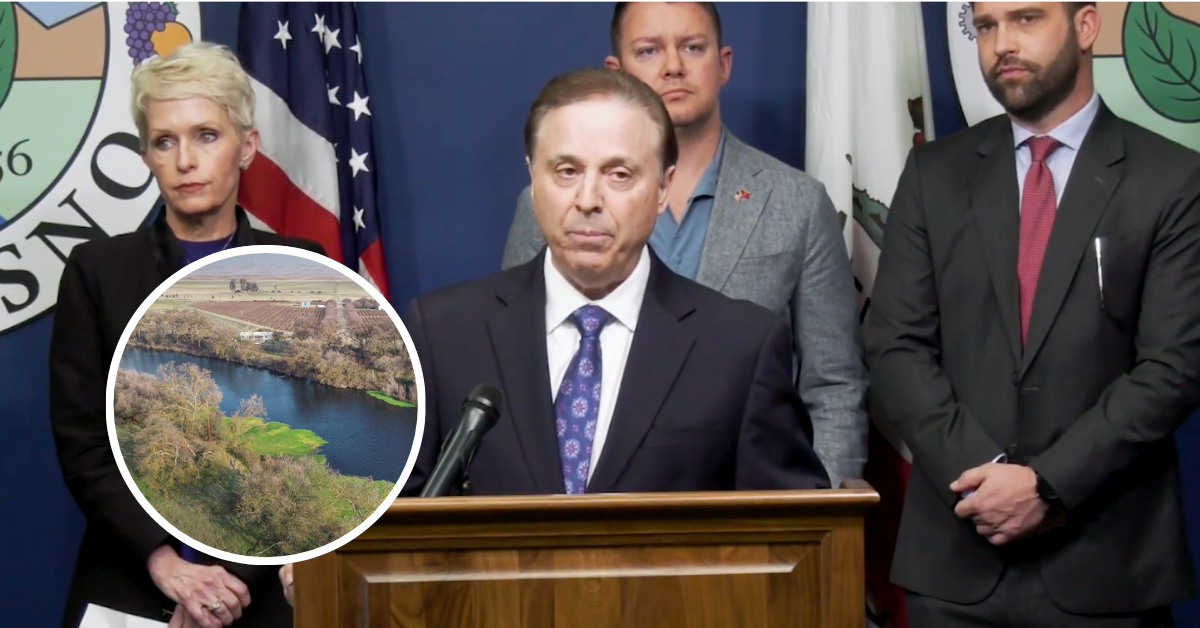
Fresno and Madera leaders are calling on the San Joaquin River Parkway Trust to stop spreading human compost into soil at Sumner Peck Ranch.
The big picture: The San Joaquin River Conservancy discovered that the San Joaquin River Parkway Trust – a nonprofit organization that is a separate entity from the Conservancy – discovered that the trust had an agreement with a Washington company to use human remains as compost at Sumner Peck Ranch.
Sumner Peck Ranch sits between the San Joaquin River and Solitary Cellars north of Fresno. The ranch offers “U-Pick” events on the weekends, where people come to pick fruit off of the trees in the orchard.
The Conservancy discovered that the Trust had an agreement with Earth Funeral, based in Washington, to spread human compost in the soil at Sumner Peck Ranch.
The Conservancy located one area where the human compost was spread, and officials said during a Thursday press conference that there could be other locations.
Zoom in: Fresno County sent a cease and desist letter to the Trust on Wednesday, noting that spreading composted human remains is currently against the law in California.
Fresno County Counsel Doug Sloan wrote in the letter that spreading human remains as compost at Sumner Peck Ranch has not been authorized by the California Wildlife Conservation Board, the San Joaquin River Conservancy or the county. It has also not received approval through the California Environmental Quality Act (CEQA).
Sumner Peck Ranch was funded by the Conservancy through a grant administered by the state.
The other side: The Trust’s Executive Director Sharon Weaver told GV Wire that she was assured by Earth Funeral that California does not regulate human composting, adding that the compost is free.
Bredefeld, who sits on the Conservancy, said the Conservancy met with Weaver on Wednesday to request that the gate to Sumner Peck Ranch be closed until the county health department can inspect. Weaver refused to comply.
Flashback: Four years ago, California lawmakers passed Assembly Bill 351 to legalize human composting, to be overseen by the Cemetery and Funeral Bureau.
AB 351 does not legalize human composting until Jan. 1, 2027.
The law also grants local governments the authority to pass their own legislation to prohibit human composting.
How it works: Earth Funeral takes deceased bodies and turns them into a cubic yard of soil over a process that takes 45 days.
Families can choose how much of the soil they would like to receive, with the rest donated to conservation projects for land restoration initiatives.
Corpses are placed inside a cylindrical vessel which uses carbon, nitrogen, oxygen, water and high temperatures to allow naturally occurring microbes to break down the body on a molecular level, according to Earth Funeral’s website.
Families can either collect the soil in person at one of Earth Funeral’s facilities or have it mailed through the United States Postal Service.
What we’re watching: Bredefeld and Madera County Supervisor Jordan Wamhoff said they both plan to propose legislation in their respective counties to prohibit using human compost on public land.
What they’re saying: “The stupidity and the lack of common sense is breathtaking,” Bredefeld said. “This public land is culturally significant and environmentally sensitive. People currently use this land to pick fruit from trees, and there are daily wine tasting events there. I personally, along with my colleagues, will not allow this insanity to be hidden from the public. They have every right to know this is how their tax dollars are being misused.”
Conservancy Chairwoman Kacey Austom-Tibbetts, Fresno City Councilman and Conservancy board member Nick Richardson and Wamhoff joined Bredefeld at Thursday’s press conference, which was held at the Fresno County Hall of Records. They discussed the need to make this information public.
“This is about decision making and transparency in a nutshell,” Wamhoff said. “Do we have all of the information? No, but we do know that there is composted human material that is being disked into the ground near or at Sumner Peck Ranch.”
Wamhoff added, “It is something that I would want to know as a parent, that when I go to pick some fruit at some type of event, I would want to know if they are disking decomposed human bodies into the soil. I would want to know that.
Bredefeld added, “I’m not an expert in this field, but this is human remains. This is not about ash and being cremated. This is human remains being turned into compost.”
Richardson said he toured the ranch, noting that the strip of composting land that he saw was around 50 to 60 feet long, around three feet high and around three to four feet in width. Richardson also touched the compost, not having been told what it was. “I know what it feels like,” Richardson said. “Unfortunately, I touched it.”
Auston-Tibbetts called for the Trust to collaborate with the conservancy.
“They have failed to collaborate,” Auston-Tibbetts said. “If we had known about this prior, we would never ever have agreed to this. And the fact, as my colleagues said on the board, is that they haven’t come forward and they weren’t fully transparent with us shows that they know in their gut that it was the wrong thing to do.”
Tribal response: The Picayune Rancheria of the Chukchansi Indians released a statement on Thursday excoriating the use of human compost on Yokut ancestral lands along the San Joaquin River.
“The Tribal Council of the Picayune Rancheria of the Chukchansi Indians strongly condemns the reported distribution of composted human remains on lands along the San Joaquin River that are part of the ancestral homeland of the Yokuts people and calls for an immediate halt to these activities,” the tribe said in a statement.
“For countless generations, these lands have held deep cultural, spiritual, and historical significance for the Native peoples of this region,” the tribe said. “The treatment of human remains is among the most sacred responsibilities in our traditions. The idea that composted human remains would be distributed across these lands where our ancestors lived, prayed, and were laid to rest there is deeply troubling and profoundly disrespectful.”
The tribe urged the Trust to immediately cease using human compost, saying, “Protecting the dignity of the deceased and preserving the cultural integrity of ancestral lands is not optional. It is a responsibility we all share.”