
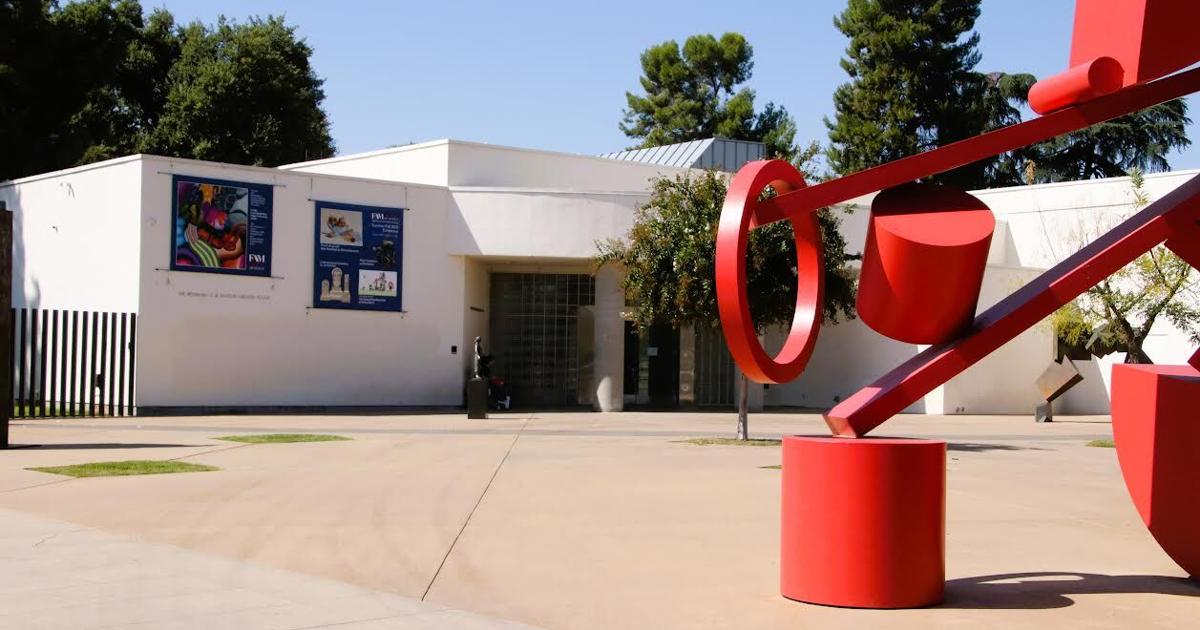
FRESNO – Fresno is famous for being a major agricultural hub in California’s Central Valley, earning it the nickname of being the “Raisin Capital of the World.” But the city has another claim to fame. That’s the Fresno Art Museum.
The museum is nationally recognized for exhibiting modern and contemporary art from California, art by famous women, works of art on paper, along with exhibitions that reflect visual arts traditions of ethnic groups that contribute to the diversity of the San Joaquin Valley.
Located at 2233 North First St., the museum welcomes, inspires and educates a diverse regional audience through significant exhibitions, thought-provoking programs and meaningful interactions with artists and the creative process.
Its story began in the 1940’s when a group of local artists formed the Fresno Art League to provide a facility to exhibit and critique each other’s work and share their enthusiasm for art.
The league gained support from the community and in 1949, the Fresno Art Center was incorporated. In1960, the Fresno Art Center building in Radio Park, at First Street and Clinton Ave, was dedicated. In 1985, the board of trustees changed the name to the Fresno Arts Center and Museum, and three years later, to the Fresno Art Museum.
From its original 10,000 square feet in1960, the center has grown to more than 27,000 square feet today. Additions have included several exhibition galleries, an impressive gift shop, the Bonner Auditorium, an expanded entrance and entry plaza, the Sculpture Garden and the vaults that house the permanent collection of 3,600 works.
The museum has five different types of exhibits. These include the present, past, future, Council of 100 and permanent collection. Representing the current selection are Linda Lomahaftewa, Hopi/Choctaw Artist. Her paintings include: The San Francisco Years, 1965 through1972 and Recent Works 2008 through 2024. (August 9,2025 to January 11, 2026). She’s notedfor her use of native iconography and abstract desert landscapes. She’s the 2025 recipient of the museum’s Council of 100 Distinguished Woman Artist. This award is given annually to a woman who has spent the past 30 or more years in the studio and has created a unique and prestigious body of work.
Jo Hanson, Crab Orchard Cemetery (August 9, 2025, to January11, 2026) This work is comprised of 32 Styrofoam tombstones, additional rubbings, background transparencies, audio files and supplementary material. It’s a re-creation of a pre- Civil War cemetery near the artist’s hometown of Carbondale, Ill.
Frank McEwan, Stone Sculpture of Zimbabwe (August 9, 2025, to January 11, 2026) The artist is credited with bringing international attention to Shona sculpture through a series of exhibitions in the 1960s and 1970s which traveled the world. Zimbabwe translates to “house of stone.” Stone carving has been practiced for centuries in Zimbabwe due to the rich and abundant stone deposits.
Ashley Spires, TheMost Magnificent Maker’s A to Z (August 9, 2025 to June 28, 2026) This is an alphabet book that features a little girl who loves to make and invent things. She has perseverance and vulnerability at the same time. She makes mistakes but grows from those mistakes. The little girl learns it’s OK to get frustrated when you’re trying to do something great and have a setback. The idiom “if at first you don’t succeed, try, try again” comes to mind as a mantra for this book. What message could be a better one for all of us. It;s a book that can inspire all children equally. The exhibition supports the 8,000 plus children that visit the museum throughout the year by introducing them to visual art that’s positively impactful, encouraging and relevant.
Eliana Saucedo, The Fruit of Life (August 9, 2025, to January 11, 2026) This is an exhibition of new works by local painter Eliana Saucedo. She has created paintings that celebrate the rich agricultural traditions of the Central Valley and her own family and culture. The primary focus of these works is fruit reminiscent of the depictions found in the celebrated still lives of the Dutch Golden Age (1588 to 1672). She also pays tribute to her family with several images, including one of her grandmother among a row of prickly cacti.
Art of the Ancient Americans, This exhibit includes 158 objects from ancient Mesoamericas and ancient Central Andes. They span 3,000 years and represent major artistic traditions of cultures in West Mexico, the Yucatan Peninsula and the Peruvian Andes. Many of the objects have never been viewed before.
Permanent Collection, The museum also has a collection that preserves and protects more than 3,600 works. The main focus of the permanent collection and exhibitions is on modern and contemporary artworks (painting, sculpture, prints, photographs, and other media) from the 20th and 21st centuries. It also has Mesoamerican works from Mexico and the Andes, and modern and folk art of Mexican origin. Staff selects several works from the collection to appear with the different exhibits. The collection includes works by Ansel Adams, Ruth Asawa. Salvador Dali, Patty Dixon, Pablo Picasso, Diego Rivera, Norman Rockwell, Patty Handley, Andy Warhol and others. The curator staff is currently working on a searchable database to include all the works in the collection. When it’s launched, there will be a public portal to review what’s in the permanent collection.
Art education has long been an important mission of the museum. In addition to lectures, trips to other museums, extensive label copy, docent tours and classes in the visual arts, the museum hosts nearly 8,000 school children annually for gallery tours and art experiences. For many of these students, this is often a first-time museum experience.
The museum is a busy place and holds popular events throughout the year. One of those is Trashiique. This is a fundraiser where local artists turn trash into artful garments and present them on a runway fashion show worthy of New York Fashion Week. According to Museum Director Michele Ellis Pravy, “This event is an act of love for our City and is a full year in the making. This is wearable art its finest and most creative.” The next Trashique will be held on October 24, 2026.
The Fresno Art Museum is open Thursday to Sunday from 10 a.m. to 4 p.m. It will be closed Thanksgiving Day, Black Friday, Christmas, and New Year’s Day. It’s also closed January 12 through February 6, 2026 to allow the staff to change the exhibits. Admission is $10 for adults 18 and older, $7 for youth 5 to 17, and free for children 4 and under. Veterans and active-duty military are free. For information, call 559-441-4221.
The museum offers a dynamic environment to share and appreciate art and does it well. Come check it out.