
This is a computer-generated transcript. While our team has reviewed it, there may be errors.
Ericka Cruz Guevarra [00:00:00] I’m Ericka Cruz-Gavara and welcome to The Bay, local news to keep you rooted. Bay Area transit agencies have drawn up nightmare scenarios if they can’t get enough money to help them close their budget deficits. Those nightmare scenarios include the elimination of the red and green BART lines, no BART or Muni after 9 p.m., and, if you can even imagine it, a San Francisco without cable cars.
Elize Manoukian [00:00:35] If that money isn’t raised, then we could see some really big changes to service in San Francisco.
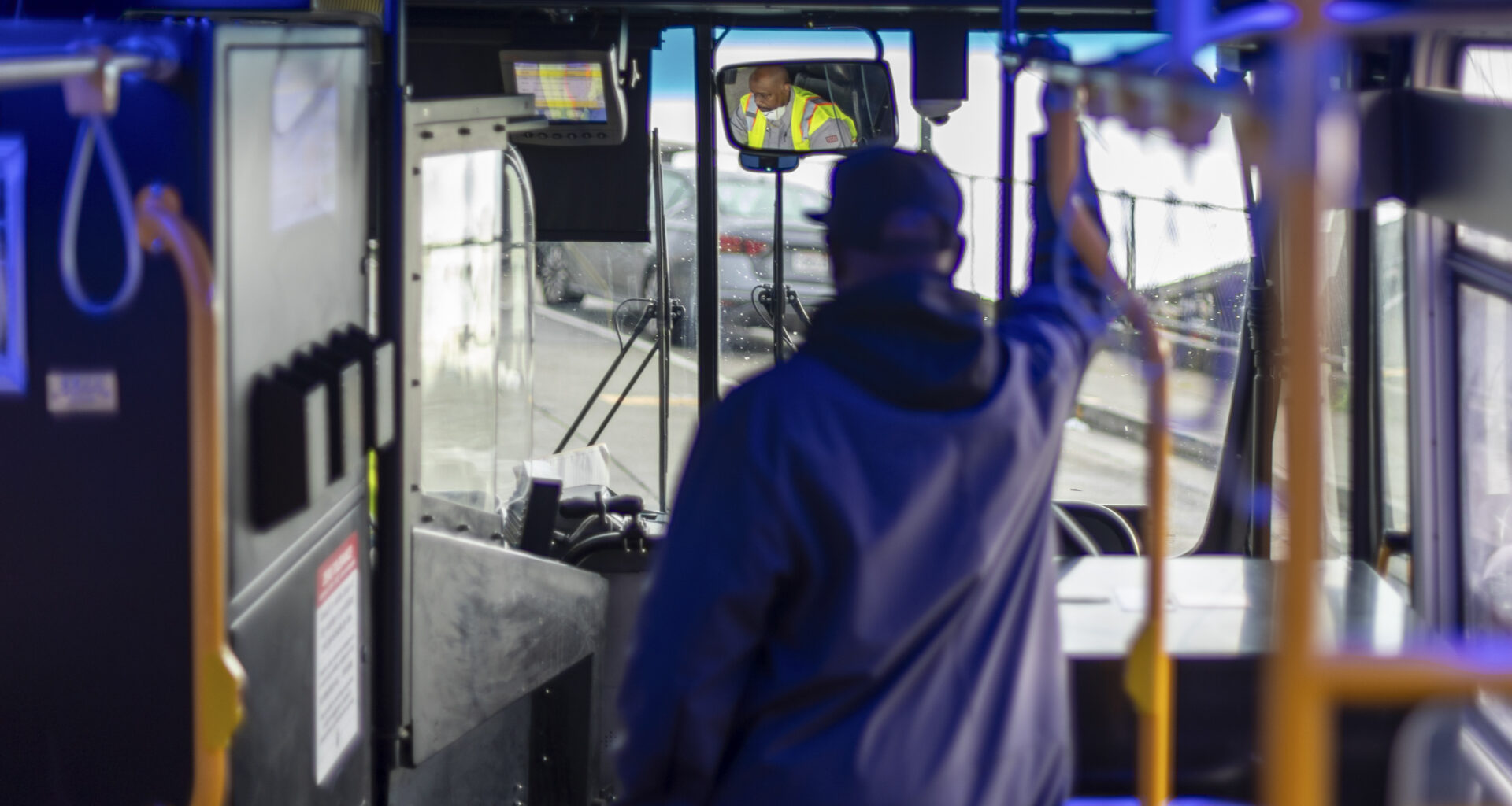
Ericka Cruz Guevarra [00:00:43] SFMTA, which is the agency that runs Muni, says it could cut entire bus lines if voters don’t approve ballot measures to fund transit this November. And even though some of those lines aren’t used by a ton of people, cutting them will impact entire neighborhoods. Today, we take you aboard one such bus line in San Francisco, Muni’s most delayed bus to meet the riders who rely on it every day.
Elize Manoukian [00:01:24] People actually call the 67 a rollercoaster because it goes over so many hills.
Ericka Cruz Guevarra [00:01:32] Elize Manoukian is a reporter for KQED.
Elize Manoukian [00:01:36] It starts at Alemany and then just climbs up to the top of Bernal Heights Park. Beautiful park, has a view of the whole bay and a great view of downtown San Francisco. And then it sort of snakes its way down to 24th Street Mission and then back again. You can ride the whole loop in 25 minutes. It’s also visually kind of funny, it’s only 30 feet long, like about half of a normal bus. It’s diesel powered, because they really have to be chugging up those hills. One of the passengers I talked to for this story, he told me that he puts his backpack on top of his knees so that in case he slides into the seat in front of him, he has a little cushion.
Ericka Cruz Guevarra [00:02:26] And who is riding this bus?
Elize Manoukian [00:02:28] It serves a pretty diverse swath of neighborhood residents, everyone from the people who live at the Alemany Apartments, which is a affordable housing complex. It also climbs up through the Bernal Heights hilly neighborhood, which has a lot of single-family homes, a lot of wealthier tech residents in the city. I see a lot of kids take it to school. It serves Paul Revere Elementary and a couple other schools in the mission in Bernal Heights. And then of course it serves the people who live in the Mission right by 24th Street.
Ericka Cruz Guevarra [00:03:06] And is it often like a crowded bus? Are people like standing on this roller coaster?
Elize Manoukian [00:03:11] Not really. It’s quite, it can get a little busy during the morning commute, but it only gets about 800 riders per day, which is down from half before the pandemic. That’s a pretty low volume route. You know, some of the busses, like the 38, will serve up to 25,000 people a day. It’s a smaller neighborhood route that connects people from neighborhood to neighborhood, as opposed to taking them straight to downtown.
Ericka Cruz Guevarra [00:03:40] And you are someone who frequently uses this bus, is that right?
Elize Manoukian [00:03:43] Yeah, I’m right off of Courtland Street, and so I take it to get to 24th Street BART all the time.
Ericka Cruz Guevarra [00:03:51] Just besides the fact that you ride it, what is so special about the 67? Why did you want to focus on this particular bus line in your reporting?
Elize Manoukian [00:04:00] Well, I agree. I think it is a very magical line, but yeah, it also is the most delayed bus in San Francisco, which I learned one day when I was trying to take it to BART so I could go see my friend in Oakland on Valentine’s Day. And it never came. And it made me wonder, like, is this a common experience? And I found out that one in 67’s will depart very late.
Gil Diaz [00:04:27] So if I miss one bus, I could be waiting 20, 30 minutes for the next one, maybe longer.
Elize Manoukian [00:04:33] I also talked to a guy named Gil Diaz. He also rides the 67 and he gets on at the same stop as me and he takes it to 24th Street and then goes to work from there.
Gil Diaz [00:04:44] I just noticed that there’s a gap between pickups. Yeah, I get that anxiety. Like, oh, every minute’s counting because it’s going to affect the next bus.
Elize Manoukian [00:04:54] You know, the bus runs every 20 minutes, so if one doesn’t come or one is very delayed, then you can be waiting like almost an hour for it to show up.
Ericka Cruz Guevarra [00:05:04] That’s the worst feeling.
Elize Manoukian [00:05:05] I know, especially on a cold San Francisco chilly day, you know?
Ericka Cruz Guevarra [00:05:08] Totally. And then what do you do if you miss the bus? Like what are your options?
Elize Manoukian [00:05:17] You know, there’s always another bus, luckily Muni is really well connected, but you can end up taking a completely different route, having to travel to different corners of the city to get to where you need to be.
Ericka Cruz Guevarra [00:05:28] Going up and down those hills on foot.
Elize Manoukian [00:05:30] That’s true, you can always take the “chevro-legs” and just climb up the hill, climb up to the top of Bernal Heights and climb down, which is really a workout.
Ericka Cruz Guevarra [00:05:41] I mean, why is this particular line the most delayed bus in San Francisco?
Elize Manoukian [00:05:48] So I asked SFMTA the same question, and it really does have to do with the steep grades of the route, the very sharp turns that it has to make as it snakes around the Bernal Heights Hill and around these very narrow streets and neighborhoods. I asked if it had to do with a Muni operator shortage or a vehicle shortage, and they told me that there wasn’t one at this time.
Ericka Cruz Guevarra [00:06:17] A lot of people still rely on the 67, it sounds like, but it could actually also go away, right? Can you explain the sort of looming threats to SFMTA and also lines like the 67?
Elize Manoukian [00:06:31] So like other transit agencies in the Bay, the SFMTA is in trouble. It’s facing a more than $300 million deficit starting in July. And that number is only projected to grow over the next couple of years because of things like rising costs and lower fare revenue since the pandemic. So the SFMTA, they’re looking at a lot of different scenarios to help them work through this. One of them is a parcel tax on the ballot in November. There’s also a second regional tax that people across the Bay Area can vote on. Part of the revenue raised by that sales tax will go to fund Muni.
Ericka Cruz Guevarra [00:07:16] As well as BART.
Elize Manoukian [00:07:19] Exactly. AC Transit, among others. But, you know, that’s all hypothetical at this point. If that money isn’t raised, then we could see some really big changes to service in San Francisco. And one of the proposed changes would be cutting the 67, which, yeah, like I said, serves a really hilly community and there is no parallel line and 11 other lines like it which also serve hilly neighborhoods, could also be impacted.
Ericka Cruz Guevarra [00:07:51] Is SFMTA doing to try and prove that it is still worth funding? I mean, with these ballot measures going before voters, I imagine they want to make a good case that they’re worth keeping around.
Elize Manoukian [00:08:07] Definitely. And I will say, the SFMTA actually just released its ridership survey for the year, and it got really, really high reviews from San Francisco residents. I think it was something like 78% said that they had good or excellent experiences with Muni. So I think that people are happy with the service that they’re getting for the most part. But they’re also trying some kind of interesting things, too, to improve their service, especially since the pandemic, when a lot of lines were cut pretty much overnight, but some people still needed to get around the city. So one thing that they did was switch their busier lines, like the 38, the 22, and the 1, they switched those busier lines over to a system that’s called headway. So instead of operating on traditional bus schedules, they switched to intervals. They really focused on making sure that busses were spaced out evenly instead of adhering to a strict schedule. So instead if your bus coming right at 3 p.m., your bus would come every 10 minutes or every five minutes for some of these busier lines. And they said that they were getting really positive feedback from that.
Brent Jones [00:09:26] The whole idea is to stay flexible and nimble and be able to adjust our service with the actual customer needs.
Elize Manoukian [00:09:34] Brent Jones is the director of transit for SFMTA. He’s been with the agency for nearly three decades. And he was there when they decided to make this switch over from a schedule-based system for the busier lines over to this thing that’s called headway.
Brent Jones [00:09:51] So what we found was that we had less issues with people being upset about their vehicle being late as opposed to, hey, but even if I see it pulling off, I know another one will be there within 10 minutes.
Ericka Cruz Guevarra [00:10:05] Yeah, I feel like that is something that would help me as someone who’s not really always interested in checking which bus I should take. It’s good to just show up to a bus stop and know that if there’s not one there, there will at least be one in 10 minutes or less, essentially.
Elize Manoukian [00:10:22] Yeah, you know that it’s going to come and that you’re not going to see like three busses bunched up and then one doesn’t come for half an hour. It’s going be more regular.
Ericka Cruz Guevarra [00:10:31] And so is this happening with the 67 as well?
Elize Manoukian [00:10:36] No, it’s not. Because the 67 is a smaller line and it comes every 20 minutes, it doesn’t make sense for the agency to make this change for all of its busses in circulation. So about half of them are still on schedules and then half of the have switched over to this kind of experimental system. Out of all of these lower volume routes, which are still on schedules, only 56% of them depart on time, which is still not great. But at least they’re trying the headway and it’s getting them some better results for the busier lines.
Ericka Cruz Guevarra [00:11:12] There are these efforts like this parcel tax in San Francisco, this region-wide ballot measure to try and prevent these worst-case scenarios where lines like the 67 go away completely. Do we know how helpful some of these efforts might actually be?
Elize Manoukian [00:11:30] I think they would be a game changer. I think collectively they would raise enough to be able to allow it to keep operating. And they would for sure stop it from having to make major reductions, not just to service, but also to staff and to some of their other projects, like improving bus stops across the city.
Ericka Cruz Guevarra [00:11:51] And saving the 67.
Elize Manoukian [00:11:52] And saving the 67.
Ericka Cruz Guevarra [00:11:55] I mean, if it went away, like, what would that mean for you and all the other folks who rely on it?
Elize Manoukian [00:12:03] For people who are trying to connect from these hilly neighborhoods to BART, their commutes are gonna be a lot more challenging. For the kids who are trying to get from the Alemany Apartments to their middle school across the street, it’s gonna be, a lot, it’s going to be a really long, difficult walk every morning. So, yeah, it would definitely throw a wrench in people’s mornings. I love the 67 community and I love the bus drivers on it. Shouts out to Hannibal Thompson, who’s one of my favorite drivers. And I hope that they stay, they stick around.
Ericka Cruz Guevarra [00:12:39] Hope it sticks around for you and all those kids. Thank you so much for joining me, Elize. I appreciate it.