
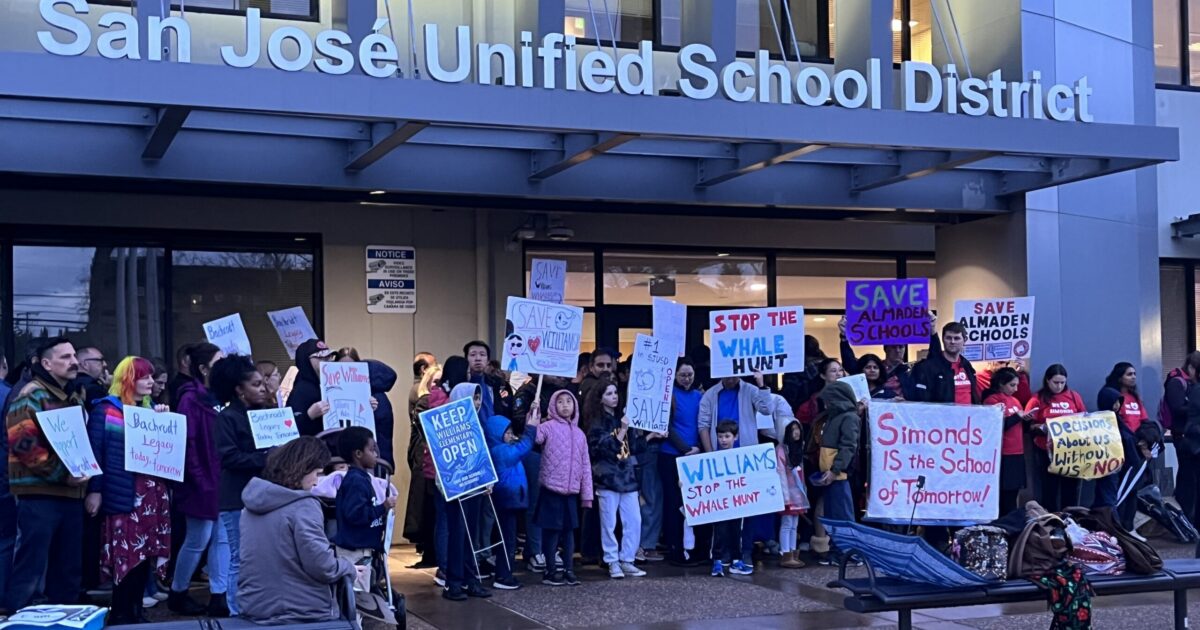
San Jose Unified School District’s “Schools of Tomorrow” initiative proposes closing up to nine elementary schools that act as community hubs for generations of San Jose residents.
As a district parent, I am following the initiative with concern and frustration. It is framed as a process to create ideal schools to develop “the thinkers, leaders, and creators of tomorrow,” but the link between the proposed school closures and this vision has not been communicated clearly nor substantiated by the district.
At recent Schools of Tomorrow Implementation Committee (STIC) meetings, parents, students and community members requested greater transparency. They expressed deep concerns about the impacts of these decisions and demanded policy decisions be guided by evidence.
As an education researcher seeking to bring more evidence into education decision-making, I was impressed by the clarity of the public’s demand. So far, the district has not responded or changed course.
At the March 3 STIC meeting, some members of STIC expressed concerns with the current options, but the process continues and a recommendation is expected to be issued within weeks.
SJUSD claims closures are necessary due to declining enrollment. As a basic aid district, property taxes — not per-student state allotments — drive the budget, making closures a choice, not a necessity. School closures can be associated with negative outcomes that persist for years, including academic achievement, postsecondary education and workforce outcomes.
The district needs to conduct a systematic review of research on school characteristics that impact students’ achievement, well-being, mental health and safety. This synthesis could be used to build a framework that identifies characteristics most likely to lead to improved student outcomes.
For instance, a quick review of research on school size calls into question the district’s preference to consolidate campuses and substantially increase the size of its elementary schools. Researchers have found that smaller elementary school class sizes and overall school sizes were positively correlated with student learning in literacy and mathematics and teachers’ belief in their ability to influence students’ learning outcomes. In a longitudinal study of high schools, researchers at MDRC observed that students enrolled in small schools in New York City experienced higher rates of postsecondary enrollment and degree attainment.
The district’s “Schools of Tomorrow” metrics are an attempt to bring data into the conversation, yet they are built on a shaky foundation. These metrics appear to be cherry-picked by staff to fit their narrative. Choices for metric inclusion are not guided by an evidence-informed framework, and public commenters have noted a lack of transparency and errors in the analyses.
Metrics and school characteristics are not sufficiently operationalized. For instance, the “ideal school” metric, as defined by a minimum — but problematically, not a maximum — number of classes per grade level, is silent about student-teacher ratios and optimal class sizes, two factors that are likely bigger contributors to what makes for an ideal school than the number of classrooms.
San Jose residents have recognized the arbitrariness of these metrics and have taken note that the district is ignoring the evidence on the characteristics of a school that foster social-emotional development, a sense of belonging and academic growth.
If SJUSD truly wants schools of tomorrow, the district should listen to its stakeholders and review the evidence that exists today. It is time for the school district board to pause and commit to developing a transparent, decision-making framework grounded in rigorous evidence and analysis, as the community has so powerfully demanded.
Erin Higgins is the co-founder of Align R&D, an organization building alignment between the needs of the education system and the priorities of the education research and development ecosystem. She spent more than a decade leading education research programs at the Institute of Education Sciences, the research arm of the U.S. Department of Education. She is a mother of two children who attend a San Jose Unified elementary school.