
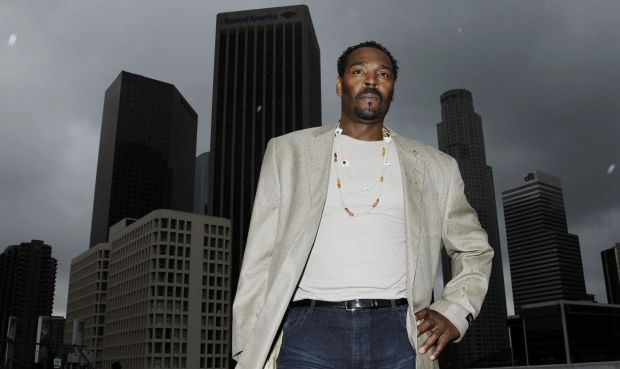
 On April 13, 2012, Rodney King poses for a portrait in Los Angeles. The acquittal of four police officers in the videotaped beating of King sparked rioting that spread across the city and into neighboring suburbs. Cars were demolished and homes and businesses were burned. Before order was restored, 55 people were dead, 2,300 injured and more than 1,500 buildings were damaged or destroyed.(AP Photo/Matt Sayles) On April 13, 2012, Rodney King poses for a portrait in Los Angeles. The acquittal of four police officers in the videotaped beating of King sparked rioting that spread across the city and into neighboring suburbs. Cars were demolished and homes and businesses were burned. Before order was restored, 55 people were dead, 2,300 injured and more than 1,500 buildings were damaged or destroyed.(AP Photo/Matt Sayles)
The Rodney King Foundation, My Tribe Rise and Altadena Rising will commemorate 35 years after King’s beating by Los Angeles police sparked demonstrations and riots nationwide.
King, who grew up in Altadena, will be remembered with a plaque unveiling from 2 to 5 p.m. Sunday, March 8, at 2530 Lincoln Ave., Altadena, the site of his former home, as well as in a standing home across the street where King raised his daughter Lora.
“We’ve been through so much in Altadena, so we want to use this moment to encourage our Black community members to resettle and build back better in a place with so much Black history we need to capture and cultivate,” said Heavenly Hughes, founder of My Tribe Rise. “We’re going to celebrate our resilience.”
Lora King, his daughter who leads the foundation that bears his name, will reflect on her father’s legacy and the meaning of his words, spoken on the third day of the Los Angeles riots: “Can we all get along?”
Community members who knew King, a graduate of John Muir High School in Pasadena, will also speak. My Tribe Rise co-founder Victor Hodgson worked with King after the riots and will also speak.
A replica plaque will be permanently installed on the Lincoln Avenue property, which burned in the Eaton fire. The property’s owner is hosting the event, meant to allow attendees to “reflect, remember, and recommit to the values his life calls us to uphold,” organizers said.
King was 25 when he was pulled over for speeding on the 210 freeway on March 3, 1991. The videotaped beating he suffered from four police officers, played repeatedly on TV. Communities across the Los Angeles area broke into riots when a jury failed to convict the police officers the next year, leaving more than 60 people dead and more than 2,000 injured.
The beating and riots sparked questions about police brutality, American justice and racial equality and transformed King’s life. He received a $3.8 million settlement from the city of Los Angeles and the police department and he later wrote a memoir “The Riot Within: My Journey from Rebellion to Redemption,” and participated in conversations on race, racist institutions, reconciliation and social justice.
In his book, he wrote about his Altadena childhood, his alcoholic father, his run-ins with the law and how his plaintive question has become a part of popular culture.
King died on June 17 at age 47.
“We continue to be at a place where we’re seeing violence, controversy, friction and tragedy in our community,” Hughes said. “We will discuss the history of what happened, how far we’ve come and what we need to address what’s happening now, a different era of police brutality.”
The event will also feature live performances, food and fellowship.