
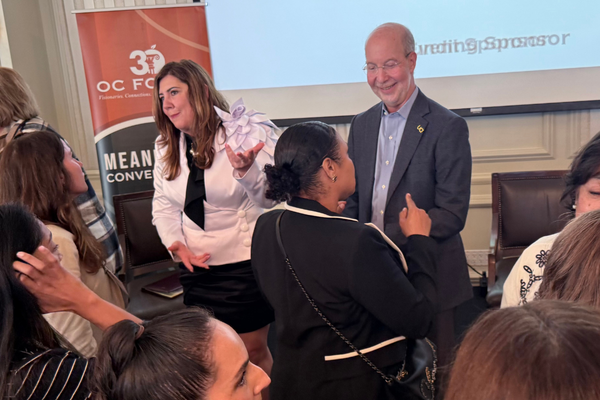
Pictured from left: Lucy Dunn, Mira Farka, Jon Gould and Cori Takkinen. Below photo: Farka and Gould take questions from the audience.
Dean Jon Gould paints nuanced Portrait of Orange County at “Outlook OC 2026”
At a panel discussion hosted by the OC Forum, UC Irvine School of Social Ecology Dean Jon Gould delivered a data-driven and at times sobering portrait of the county he studies — one defined by remarkable political balance, deep anxieties over affordability, and a younger generation struggling to believe in the American Dream.
The “Outlook OC 2026” event held March 3 in Newport Beach and moderated by Lucy Dunn, CEO emeritus of the Orange County Business Council, also featured economist Mira Farka of Cal State Fullerton and political strategist Cori Takkinen of Townsend Public Affairs.
“No One is Happy”
Gould, who directs the UCI-OC Poll, opened his remarks by outlining five major trends his polling research is tracking as the county heads toward the 2026 gubernatorial and federal elections.
The first and most striking: a sweeping, bipartisan dissatisfaction with government at virtually every level.
“When we ask the question, ‘is the federal government on the right track or wrong track?’ two-thirds say, ‘wrong track,’ ” Gould said. “State government? Two-thirds say, ‘wrong track.’ ”
The agreement ends there.
“That is 80 percent of Democrats saying the federal government is on the wrong track and 80 percent of Republicans saying the state is on the wrong track,” he said. “The only thing Democrats and Republicans agree on right now is that they think government is not doing the right thing. No one is happy.”
 The exception, Gould noted, was Orange County itself.
When asked whether the county is on the right track, a plurality of residents across party lines said yes, Gould said. “That is Democrat, Republican and Independent — the one area where people were in agreement.”
Affordability Anxiety
The second major trend Gould identified is anxiety over the cost of living.
“Our cost of living becomes the thing we hear over and over and over again in our polling,” he said.
The anxiety is not evenly distributed, however. About half of Orange County’s residents report that their own financial situation is good or very good. But among renters, the picture is starkly different.
“A quarter of Orange County residents are worried about being evicted,” Gould said.
Even residents who feel financially secure, he added, share the concern about affordability — particularly as it affects others. And, when Gould’s polling asks what residents actually mean by “affordable housing,” the answer is not what many policymakers assume.
“They are not talking about housing for the homeless,” he said. “They are talking about housing for their children.”
Purple County
Gould described Orange County as one of only three large counties in America, out of the 25 largest, that are genuinely “purple.” The other two are Maricopa County, Arizona, and Tarrant County, Texas.
That status, he argued, shows up in how residents think about issues.
“Whether you are Democrat, Republican, or Independent, when we ask you in polling, housing and cost of living is at the top of everybody’s list,” Gould said.
He noted surprising areas of cross-partisan agreement: a sense that ICE enforcement has gone too far, dissatisfaction with President Trump’s performance, and strong support for abortion rights — even among Trump voters.
“Indeed, a majority of Trump’s voters in 2024 in Orange County said that they were pro-choice,” he said.
Where the partisan divide sharpens, Gould pointed out, is in funding priorities.
“Housing is the No. 1 funding priority for Democrats and Independents, law enforcement is the No. 1 priority for Republicans,” he said.
Education consistently ranked third or fourth across all groups — while higher education and infrastructure came in at the bottom.
On immigration
Gould also addressed the politically charged question of immigration and enforcement.
He described a poll conducted before the current administration’s intensified ICE operations, in which Orange County residents were asked whether they preferred a path to permanent residency or deportation for undocumented immigrants.
“What we found was that 60 percent of Orange County residents wanted to see a path to residency,” he said.
Even at a moment when the President’s border policies might have been polling favorably, the county leaned toward a more expansive approach.
“Since the ICE enforcement, a number of polls in this state have been showing that the issue has gone against the President and the Republican Party,” he said.
The American Dream
Gould talked about a class he taught last fall quarter on California’s future. He asked his students a simple question: how many of you believe in the promise of the American Dream?
“I had about 50 students,” he said. “Only five, 10 percent, said they believed in the American Dream.”
When he asked his students why, three reasons emerged: they believed they could never afford a house in Orange County; they felt shut out of meaningful participation in government and business; and students from immigrant backgrounds felt they were being vilified rather than welcomed.
“I’m worried about where we’re headed,” Gould said.
Purple Solutions
Asked whether Orange County could serve as a national model for bringing divided communities together, Gould did not hesitate and announced the School of Social Ecology’s “Dialogue During a Time of Disruption” series. The next talk will center on immigration. It is being planned for May 5 and will be presented by the School in partnership with OC Forum.
“We are bringing speakers from around the country here on contentious issues, where they can actually talk to one another and provide an example of how to do that,” he said. “What we’re saying is: these are purple solutions for a divided America.”
Gould underscored the urgency of that mission with a cultural observation.
“If any of you has a college-age kid or younger, they don’t know the world in which people from the left and right can talk with one another. Sometimes they can’t even be in the same room with one another. That is not a recipe for an enduring Republic,” he said.
The dean closed out the panel discussion with a description of the county’s greatest strength: its purpleness.
“We are a third, a third, a third: Democrat, Republican, Independent. We are roughly a third white, a third Latino, a third Asian American,” Gould said. “When we picture what makes America work, it’s here. The fact that we have that kind of diversity means that we keep ourselves within the bumpers. We don’t go too far left, we don’t go too far right.”
As for the greatest threat, he said “our potential inability to hold people here once we’ve educated them, once we’ve gotten them started in jobs and they want to put down roots and continue to live here. We have to find a way for them to be able to afford to stay.”
The other panelists offered their expertise on the economy and politics.
Farka characterized the current economic moment as one of “resilient anxiety,” noting that while underlying fundamentals remain relatively sound, rising tariffs, now averaging 10%, up from 2.5% at the start of last year, combined with labor supply constraints from declining birth rates and reduced immigration, are creating meaningful headwinds for growth.
“The labor market has been weird for two reasons,” she said. “On the demand side, firms are very hesitant because of high uncertainty. On the supply side, we have an aging demographic, fewer births and significantly more deportations.”
Takkinen offered a brisk tour of the California electoral landscape, warning that a crowded Democratic field in the governor’s race — nine candidates with no clear frontrunner as of the March 6 filing deadline — could mathematically hand the top-two primary spots to Republicans.
“If more than three Democrats stay on the ballot, the two Republicans can be your top two,” she said.
— Mimi Ko Cruz