
At the end of public talks, performances, panels, all manner of cultural whatnot, I always want to leave when it becomes Question Time.
I usually do manage to leave, except when I happen to be the moderator myself, and I have to fight the urge even then. Say what you will about the Mainstream Media, and I know we are hated as a generic class almost as much as politicians are; we ask more interesting questions than the weird guy in the second row does.
But I hadn’t quite made it out the door when Question Time struck last Sunday after a talk at one of the exhibition sites for the most talked-about art installation at any museum or gallery in the nation right now, “MONUMENTS,” at MOCA and The Brick.
The great Los Angeles artist Alison Saar had been interviewed by Hamza Walker, the director of The Brick alternative art space in Koreatown, about the impact of the sculpture “Unmanned Drone” by (no relation) Kara Walker, in front of which the 100 or so of us had been sitting in the big high-ceilinged room
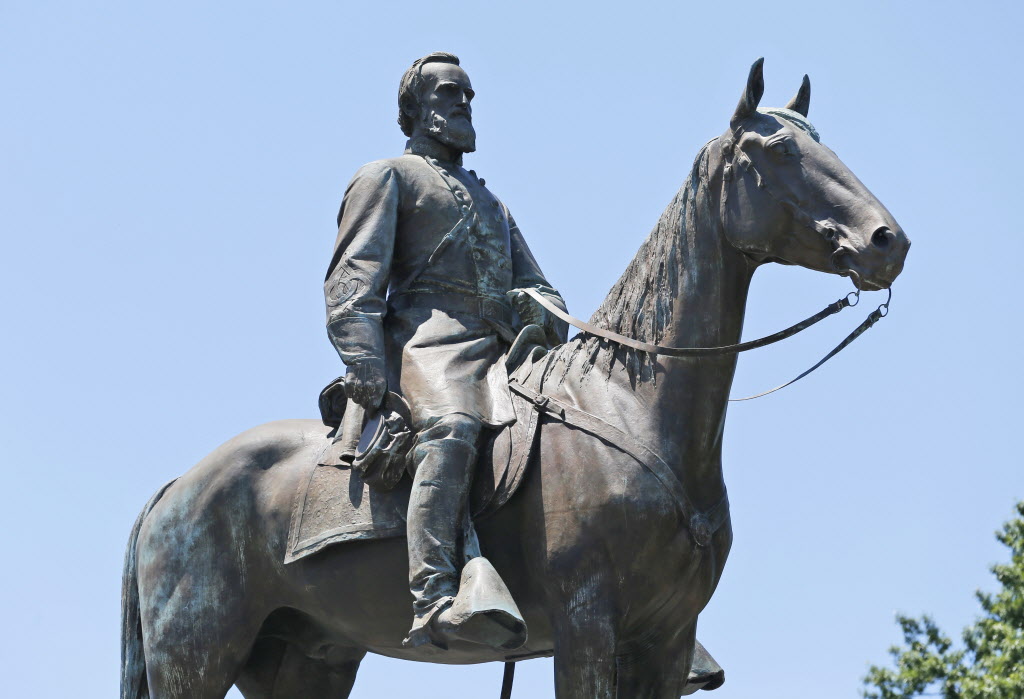
The sculpture is a complete deconstruction and reimagining of one of the grandest of the now-decommissioned Civil War monuments that dominated public plazas in so many cities of the old Confederacy until Americans got religion about what an awful Jim Crow insult they are to all of us.
These dozens of generals on horseback were not erected in the wake of the Civil War by loving family and friends who wanted to honor their service. Most of them were commissioned fully half a century later, in the 1920s, as part of the myth-making period in which the Confederate rebellion against the United States of America was being promoted as “The Lost Cause,” more about Southern gentility and tradition, see, than it was about maintaining the sin of slavery.
When Charlottesville, Va. decided it could no longer host the giant homage by Charles Keck to Gen. Thomas “Stonewall” Jackson and his lovely steed Little Sorrel in its town square — high school student Zyahna Bryant had gone to the City Council and said she just couldn’t abide having to walk by a celebration of slavery on her way to school every day — The Brick was chosen from among 14 applicants to cart the massive thing away, 13 feet high, 16 feet long, and an excellent piece of military propaganda it was.
The other bidders were groups such as the Sons of the Confederacy and the like, which would have kept the thing intact.
The Brick always intended to hand the bronze horse and rider over to Kara Walker, our finest artist in the realm of reminding us just how bad slavery really was.
“Now, with the aid of a plasma cutter,” writes critic Carolina Miranda in the New York Review of Books, “the artist has sliced up a monument that venerated Jackson and reassembled it into something ghastly. A cluster of horse legs supports a figure that … appears both human and not.”
It is a Frankenstein’s monster, and it is brilliant in its dissection and reconstruction. Walker studied French horse butchers’ texts for the right way to cut up an equine. As Miranda writes, the horse-and-rider statues “papered over the racist cornerstones of the Confederacy with romanticized stories about sacrifice and bravery.” As Walker says of slavery, “It was all horror. Why should it look like it was anything other than?”
And yet, during dreaded Question Time on Sunday, the weird woman in the first row just had to ask The Brick’s director, a seasoned curator who happens to be African American himself: “But aren’t you concerned that what you are doing here is destroying history?”
Would she ask the same thing of a Polish dissident who had toppled a statue of Stalin? Perhaps she would. I didn’t wait for the answer. I just walked out the door into the fresh bright air of Western Avenue.
Larry Wilson is on the Southern California News Group editorial board. lwilson@scng.com.