
At its February 26, 2026 meeting, the Emeryville Planning Commission reviewed the city’s 2025 General Plan Annual Progress Report and received updates on housing production under the 2023–2031 Housing Element. While the broader General Plan showed steady progress across multiple policy areas, housing production has gotten off to a slow start, reflecting regional market headwinds and financing challenges more than regulatory barriers according to staff.
Commissioners Henmi, Chafe, and Small were absent, though the remaining four members constituted a quorum.
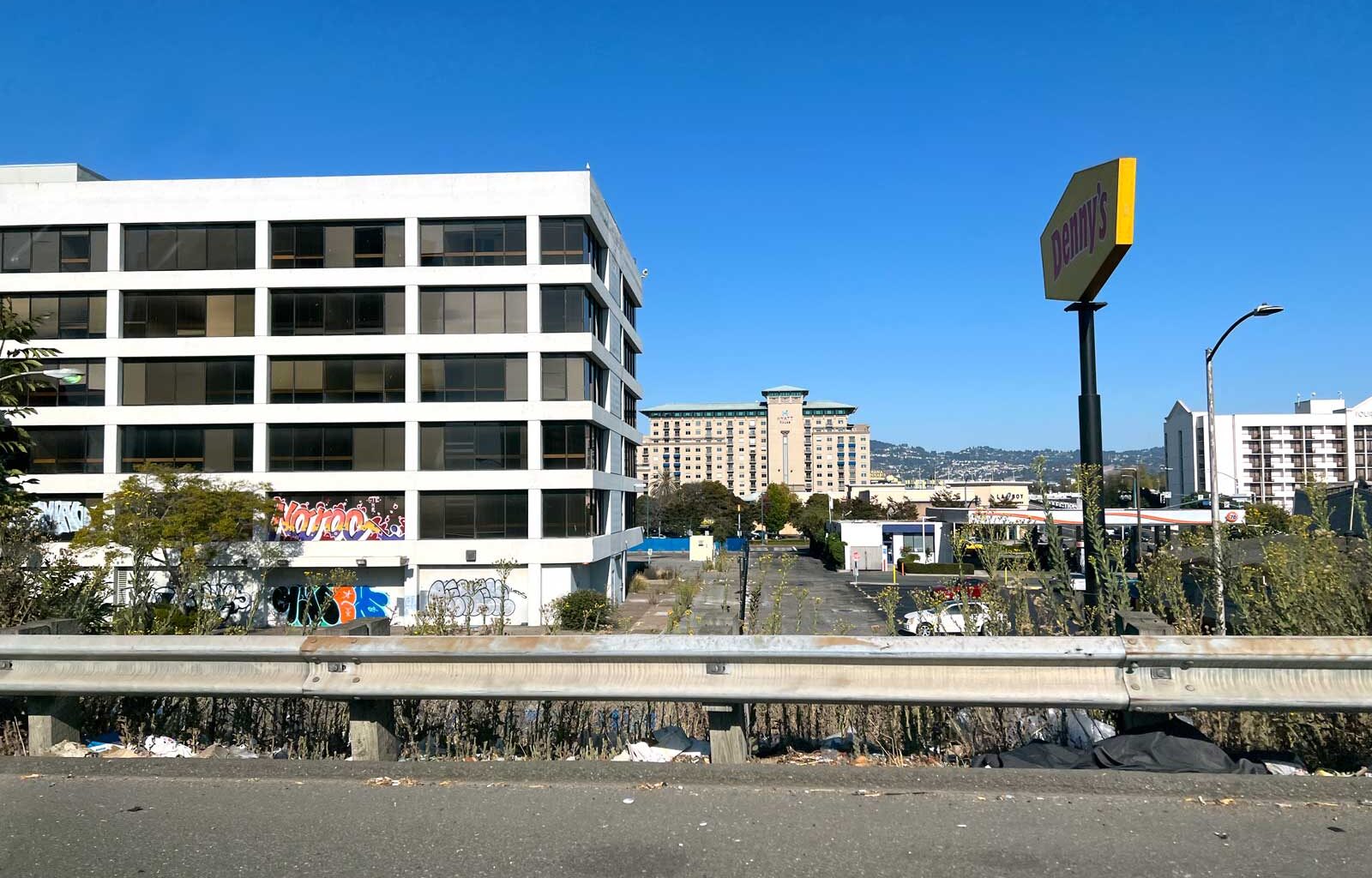
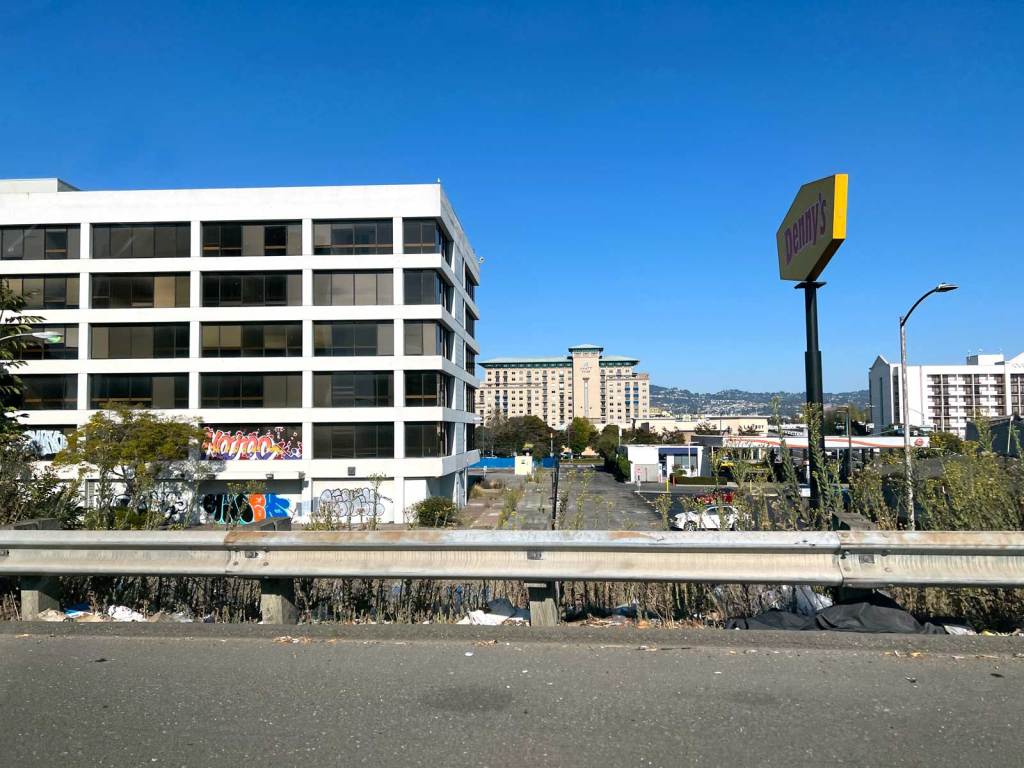 Several projects have been pitched for this vacant site at 5801 Christie.
Community Development Director’s Report [5:33]
Community Development Director Chad Smalley opened the meeting with updates on recent City Council actions related to planning and development.
Since the commission’s January meeting, the City Council approved first and second readings of Housing Element Program LL ordinance amendments and updates to bike parking regulations, both previously reviewed by the commission.
Council also extended its contract with ABG Art Group to continue managing the city’s Cultural District programs through 2026 and amended its agreement with Preservation Arts to maintain Emeryville’s public art collection.
During a February 20 strategic planning session, the City Council identified four top priorities for the year:
The 40th Street Multimodal Project
The Sutter Health development project
Evaluation of potential revenue measures
Advancement of the proposed Emeryville Art Center
General Plan Progress Report [11:40]
Senior Planner Navarre Oaks presented the city’s General Plan Annual Progress Report, which tracks implementation of Emeryville’s long-range planning policies.
Originally adopted in 2009 and periodically updated—including through the 2023 Active Transportation Plan—the General Plan guides the city’s policies on land use, mobility, sustainability, and economic development.
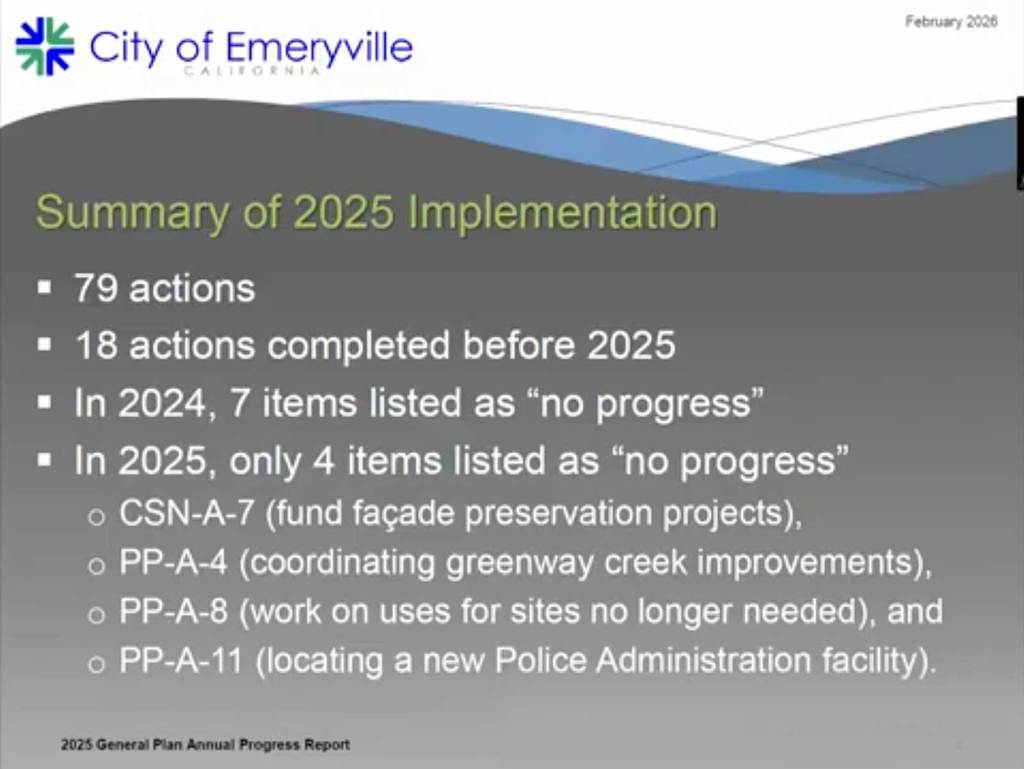
Staff reported that 54 of the plan’s 79 implementation actions are currently showing progress. Only four actions were categorized as “no progress” in 2025, down from seven the previous year.
Staff characterized the reduction as a sign of improved implementation across departments.
Among the highlights cited:
Continued zoning and regulatory updates tied to Housing Element compliance
Approval of a 362-unit affordable housing project on Christie Avenue under the state’s SB 35 streamlined review process
Completion and funding progress for the 40th Street Multimodal Project
Resumption of Community Emergency Response Team (CERT) training programs
Achievement of 100% compliance with the state’s Provision C.10 trash load reduction requirement
Ongoing environmental planning work, including Crescent access improvements and sea-level rise studies
No emergency ordinances were adopted during the year, and the city did not initiate any General Plan amendments in 2025.
Commissioners received the report with little discussion, expressing general encouragement about steady progress across a range of policy areas.
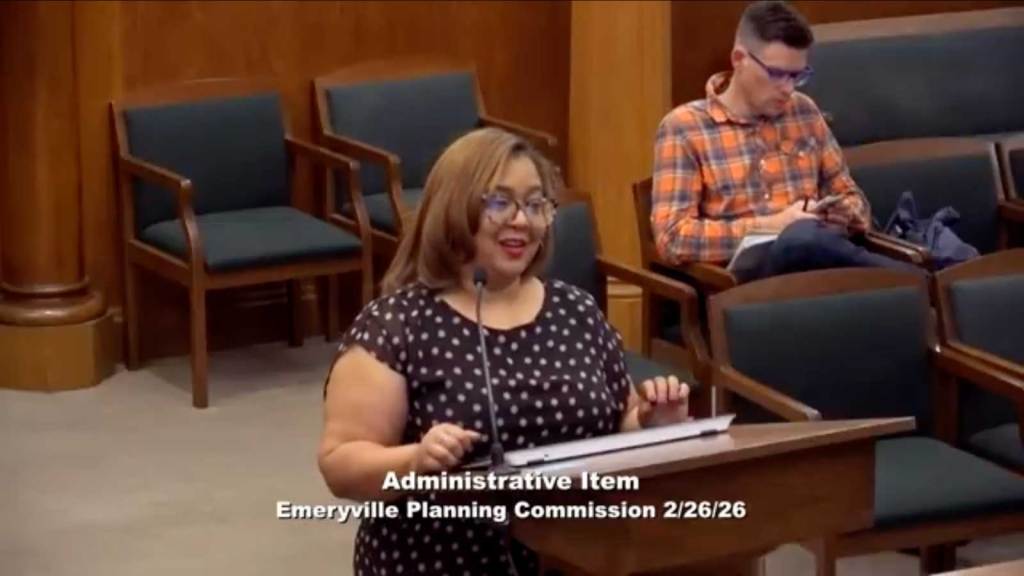 City of Emeryville Economic Development & Housing Manager Valerie Bernardo presented the report.
Housing Element Annual Report [18:40]
Economic Development and Housing Manager Valerie Bernardo then presented the city’s 2025 Housing Element Annual Report, which tracks housing production under the current Regional Housing Needs Allocation (RHNA) cycle.
Under state requirements, Emeryville must permit 1,815 housing units by 2031. Through its Housing Element planning process, the city also earned a state Prohousing designation by identifying sites and policies capable of accommodating roughly double that number.
So far, however, production has been limited.
As of the end of 2025—three years into the eight-year RHNA cycle—the city has permitted 150 units, representing about 8% of its required total.
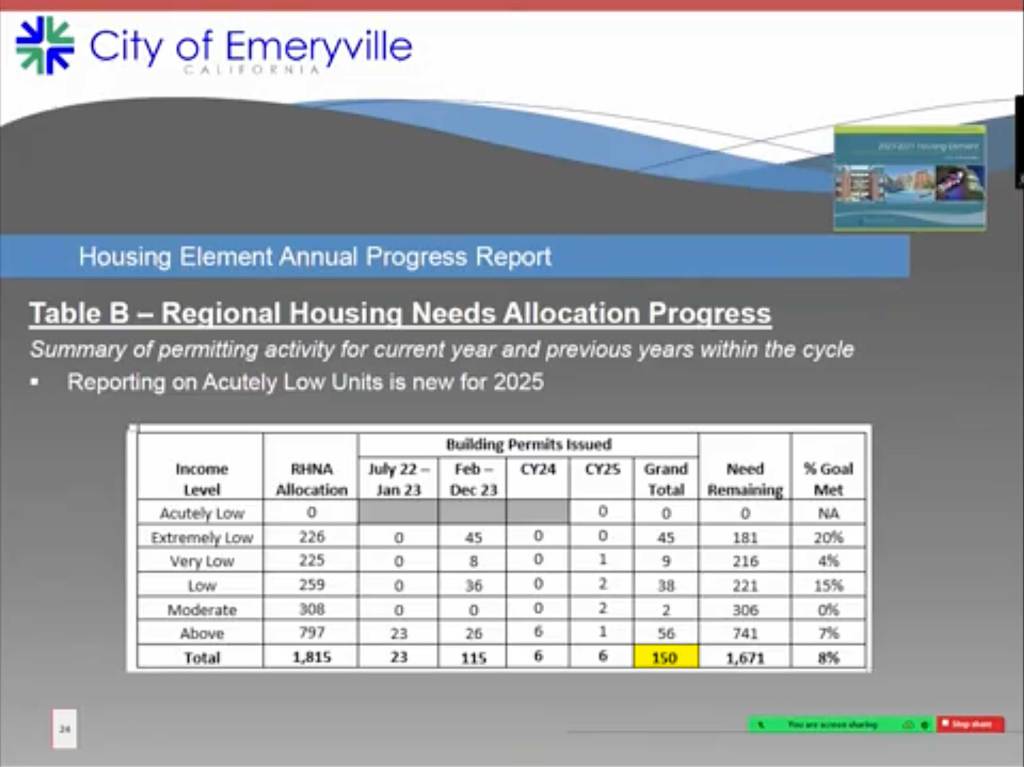 * Presentation slide has been updated to reflect error in totals.
Most of those units came from a single project. The Nellie Hannon Gateway development, permitted in 2023, accounted for 90 units. Over the past two years combined, the city has permitted only twelve additional units, primarily accessory dwelling units (ADUs).
Another major project—the city funded 362-unit Christie Avenue affordable housing development, known as The Perennial—has been approved through the state’s SB 35 streamlined review process but has not yet reached the permitting stage.
“That’s not where we would like to be. However, if you look at the state’s dashboard for the region, we are right there with the rest of the Bay Area.”
Economic Development and Housing Manager Valerie Bernardo
“That’s not where we would like to be,” Bernardo said. “However, if you look at the state’s dashboard for the region, we are right there with the rest of the Bay Area.”
State data suggests that Emeryville’s pace is broadly consistent with other cities. Oakland has permitted roughly 8% of its RHNA target, while Berkeley has reached about 18%.
To better understand potential policy adjustments, the city has hired a consultant to review Emeryville’s development regulations and assess whether changes could help advance housing production.
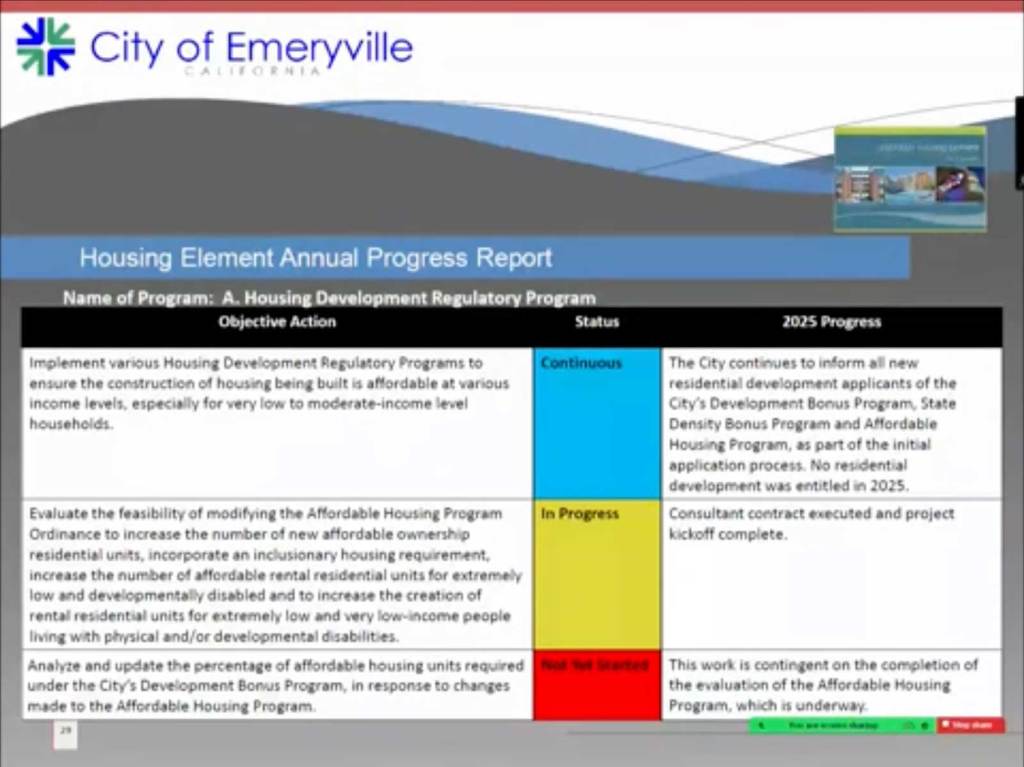
Several local ordinances require developer contributions to support community amenities and affordable housing. These include:
Art in Public Places Ordinance, requiring developments to contribute toward public art
Affordable Housing Program, which mandates inclusion of below-market-rate units or payment of in-lieu fees
Development Bonus System, allowing projects to exceed base zoning limits in exchange for community benefits
Family-Friendly Housing Guidelines, encouraging larger units and child-oriented amenities
While these policies help fund cultural programs, expand affordable housing, and encourage a more balanced housing mix, they can also add significant costs to a project that developers must account for when financing them.
The consultant study will examine whether the combined effect of these requirements could be affecting housing feasibility.
Commissioners Probe Slow Housing Production [35:07 – 45:45]
Following the presentation, commissioners asked staff why Emeryville’s housing production has lagged behind expectations during the early years of the RHNA cycle.
One commissioner noted that nearby Berkeley appears to be producing significantly more multifamily housing, prompting questions about whether Emeryville faces unique barriers.
Bernardo pointed to several factors, including limited development sites and a challenging financing environment.
She explained that Emeryville no longer qualifies for certain state housing funding advantages, including “opportunity area” designation and “difficult-to-develop” status. These classifications can provide bonus points or incentives when developers apply for competitive state affordable housing funding.
Without those advantages, Emeryville projects may have a harder time securing financing.
Bernardo also said the broader housing market—particularly for market-rate development—has cooled.
“For whatever reason, we’re not getting developers interested in building those project types here,” she said, noting that staff continues to monitor market conditions.
“For whatever reason, we’re not getting developers interested in building those project types here.”
To better understand whether local policies could be playing a role, the city has hired a consultant to evaluate its affordable housing requirements and compare them with policies in peer cities. The goal is to identify potential adjustments that could encourage housing production without discouraging development.
Commissioners also asked whether tools such as tax-increment financing districts or other funding mechanisms could help make projects more viable. Staff said those options have not yet been studied but could be explored.
Planning staff emphasized that zoning capacity is not the primary constraint. During the Housing Element process, Emeryville demonstrated that it has roughly twice the zoning capacity needed to meet its RHNA allocation, based largely on larger redevelopment sites.
Staff also noted that Emeryville’s progress is broadly consistent with regional trends. Across the Association of Bay Area Governments (ABAG) region, cities have collectively produced only about 8–11% of their required housing units, even though roughly a quarter of the RHNA cycle has already passed.
Public Hearing: Housing Element Implementation [45:45]
The commission concluded the meeting with a public hearing on zoning amendments designed to implement several Housing Element programs and align portions of the city’s planning code with state housing law.
Senior Planner Navarre Oaks explained that the changes are largely procedural, clarifying development standards and ensuring that qualifying housing projects can be approved “by right” where required under state law.
The amendments also update regulations affecting childcare facilities in residential areas, making it easier for small home-based providers to obtain permits.
One member of the public, a local daycare operator, spoke in support of the changes, saying they would allow her to expand services at her home.
Commissioners expressed general support for the amendments and the goal of simplifying approval processes while maintaining compliance with state housing requirements.
The commission ultimately voted unanimously to recommend approval to the City Council.
Adjournment [1:00:04]
The commission adjourned after setting its next regular meeting for March 26, 2026, though that meeting has since been canceled.
The full agenda and meeting materials are available on emeryville.org.
A comprehensive interactive map detailing active projects in the city can be viewed at evilleeye.com/planning.
Related

Was this story informative to you?
Please consider making a recurring contribution at any level you feel comfortable with to help sustain local news for the Emeryville community.
You have Successfully Subscribed!