

Six school districts in Sonoma County and one in Napa County have told the state they are in financial crisis. Despite their varying sizes and budgets, the root problem is the same for most: Amid declining enrollment, the districts are not taking in enough money to keep up with their rising expenses.
The half-dozen districts in Sonoma County that have certified their budgets in bad standing with the state leave Sonoma with a greater share of such districts than any other county in the state, according to a Press Democrat review.
That rate is driven, at least in part, by the county’s highly fragmented public school landscape, with 40 districts, more than all but four other counties — Los Angeles, San Diego, Kern and Tulare.
The depth of the crises in many districts is driven in part by declining enrollment, a wider demographic trend, especially in high-cost areas of California, that’s had a pronounced effect on school funding locally.
That’s the case especially for Santa Rosa City Schools, Sonoma County’s largest system, and one of two local districts that make up the seven statewide that have reported a “negative” budget status with the state, meaning they cannot afford their costs over the current and next two fiscal years without significant cuts. The other local district in that group is Rincon Valley Union, a K-8 feeder system in east Santa Rosa.
School districts in that most perilous category have typically depleted their reserves and in some cases are running out of money used to make payroll, a status that puts them on the brink of needing a state bailout and lapsing into receivership. In Santa Rosa’s case, a state finance expert earlier this year deemed the district’s cash shortage the worst of any public school system statewide.
But it is not alone. Two of Sonoma County’s other large districts — Cotati-Rohnert Park Unified and Petaluma City Schools — have alerted the state of their financial troubles, although less grave at this time. In that group also are two other smaller districts, Sebastopol Union Elementary and Oak Grove Union Elementary, both serving west county. Same goes for Howell Mountain Elementary district in Napa County.
All five of those districts registered a “qualified” budget status with the state, meaning they acknowledged they may not be able to afford costs for the next two fiscal years.
The situation in each school district is somewhat different, but many of the contributing factors are shared: declining enrollment, less funding coming in from state and federal sources and rising costs, largely in payroll, to educate students.
“As is the case around the state, Sonoma County districts are financially squeezed because of declining enrollment and the end of one-time money related to the COVID-19 pandemic,” said county Superintendent of Schools Amie Carter. “In many cases, these challenges arise from structural deficits that need to be addressed to avoid a cycle of financial crisis, followed by a brief recovery, followed by another crisis.”
She added that it is her office’s priority to connect districts with “reliable information and sound expertise” to aid district leaders in their fight to obtain long-term financial stability.
Santa Rosa City Schools
Beth Schlanker / The Press Democrat file
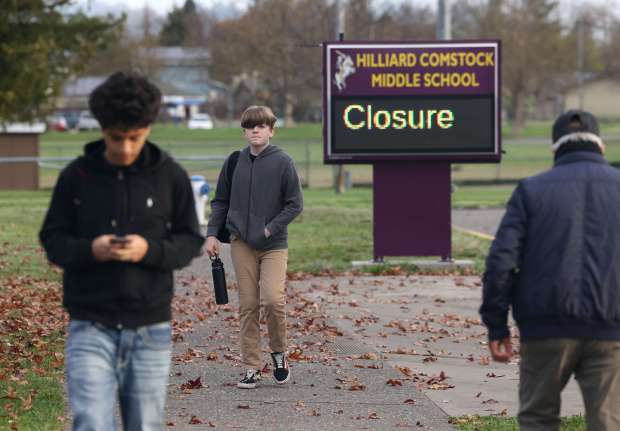
Students head into school Monday morning at Hilliard Comstock Middle School in Santa Rosa Monday, Feb. 24, 2025. (Beth Schlanker / The Press Democrat file)
Santa Rosa City Schools is at the crux of a yearslong financial crisis that became especially dire at the start of the current fiscal year.
The 12,000 student district has operated for years under a structural deficit — with costs outstripping revenues — and has now drained its reserves to the extent that it has jeopardized the cash supply it needs to make payroll. That’s what triggered its negative certification with the state in December — an official alarm bell that it is unable afford costs for the current and next two fiscal years without major reductions in spending.
Interim Superintendent Lisa August Hulme said the district may have staved off state takeover, at least until the fiscal year ends in June, with the budget stabilization plan approved by trustees in February.
That fiscal plan, with projected savings of $14.2 million year over year — just over 6% of the district’s total budget — set in motion about 100 layoffs that will eliminate whole groups of support staff at the elementary and secondary level. It comes on the heels of last year’s unprecedented restructuring, including the closure of six schools by the end of this academic year and about 150 staff layoffs last June.
A second part to the fiscal plan identified $19.9 million in one-time savings through redistributing money from grants and other funding sources to offset costs, for a total savings of $34.1 million.
Rincon Valley Union
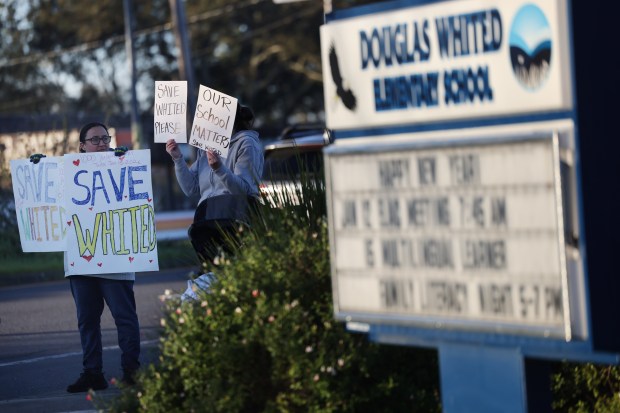 Parents hold signs in support of keeping Douglas Whited Elementary School open. Photo taken outside the school in Santa Rosa Tuesday, Jan. 13, 2026. (Beth Schlanker / The Press Democrat)
The 3,200-student district currently faces an $8.5 million deficit — roughly 8% of its budget — and needs to cut $4.5 million in the 2026-27 school year and another $4 million the following year.
Its negative certification came in January, after district leaders announced they had drained their reserves and had not yet identified ways to replenish that pool of funding.
District leaders have since earmarked about $3.5 million in savings through the February approval of 60 staff layoffs and one school closure. Labor talks are ongoing, in hopes to save another $585,000 through staff agreement to take up to five unpaid furlough days.
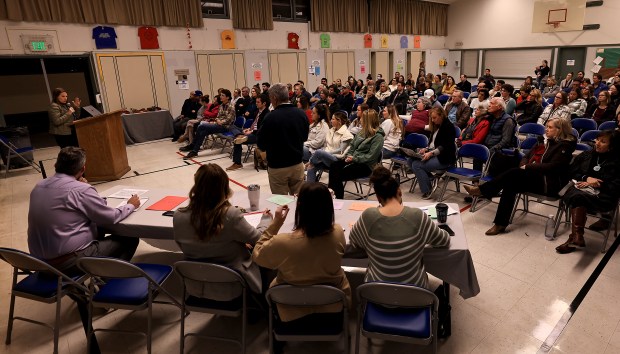 Rincon Valley Union School District holds a community forum about the district’s budget deficit and the options to address the issue, at Sequoia Elementary School, Wednesday, Dec. 3, 2025, in Santa Rosa. (Kent Porter / The Press Democrat)
Rincon Valley’s chief business official said the district hopes to certify their next budget as positive, meaning they alert the state they can afford costs for the next two fiscal years and have at least the state required 3% of their total budget in reserves. The next certification window is this month.
Cotati-Rohnert Park Unified
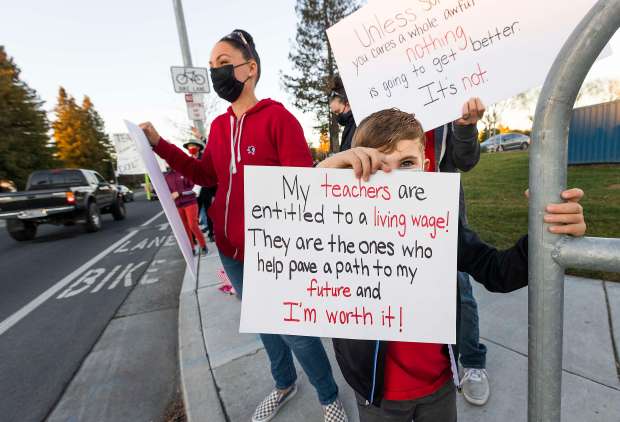
Photo by John Burgess/The Press Democrat
Parent Heather Bettencourt and her son protested with teachers over a wage increase outside of the Cotati-Rohnert Park Unified School District board meeting at Rancho Cotate High School on Tuesday, February, 15, 2022. (Photo by John Burgess/The Press Democrat)
Cotati-Rohnert Park Unified School District leaders certified their budget as qualified in December.
At the time, the district with about 6,300 students, was operating with a deficit of $10.4 million — about 10% of its total budget — and had the equivalent of only 1.9% of its overall budget set aside in reserves, short of the state’s mandated 3%, which would be about $4 million.
In the months since, the district has made inroads with its deficit, which is now closer to $9.1 million, and begun refilling its reserves, which now hold $2.6 million, or about 2.3% of the total budget.
About $500,000 was saved through eliminating vacant positions and an additional $5 million was saved through concessions reached with district administrators and three groups of staffers.
The largest of those groups, made up mostly of teachers, agreed to two furlough days and larger class sizes — the latter tied to teacher layoffs — and to increase employee contributions to dental, vision and life insurance from 10% to 20%, easing a cost burden on the district.
The local Service Employees International Union, made up mostly of in-class specialists and aides, agreed to 1.5 furlough days. The classified union, consisting of front office staff, groundskeepers and noon-aides, agreed to two furlough days.
In mid-February, the district approved layoffs affecting all three unions, plus unrepresented managers. Out of the 39 approved layoffs, the largest share, 24, were teachers.
Petaluma City Schools
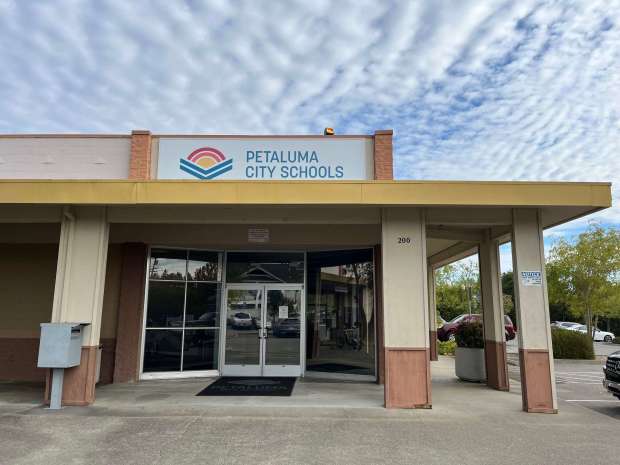
Don Frances / Argus-Courier Staff
The Petaluma City Schools district office, located at 200 Douglas St., Petaluma. (Don Frances / Argus-Courier Staff)
Petaluma City Schools, which jointly administers both the Petaluma Elementary and High School districts, was given a warning sign of sorts from the state in the first interim status report, signaling the district may not be able to meet its financial obligations in the current or next two fiscal years.
School officials projected enrollment to be at 7,476 students in the 2025-26 school year, down from the 7,657 initially projected when trustees adopted the budget in June 2025. In its filing, the district acknowledged the financial implications of that gap — that it had budgeted for more revenue than it was likely to ultimately receive.
For the 2025-26 fiscal year, Petaluma City schools reported a total budget of $138.9 million shared between both the middle and high school districts. When the budget was first adopted, the districts reported an unrestricted deficit of about $3.33 million but that shortfall grew to about $4.88 million — 3.5% of the district’s total budget.
Budget documents show the district has been able to maintain its reserves above the state-required 3% minimum, equivalent to about $5.8 million. District projections, however, show that ongoing deficit spending over the next two years could shrink that cushion to $4.2 million, reaching the state minimum by the 2027-28 school year.
Petaluma City Schools operates 14 TK-12 campuses, an adult education school and an independent study program.
In February, the school board approved a resolution to slash $6 million from its 2026-27 budget by eliminating 44 full-time certificated positions — largely teachers — and more than 16 full-time classified positions. Affected jobs include a school nurse, school psychologists, instructional assistants, library and technology support staff, some custodial staff and a licensed marriage and family therapist.
Oak Grove Union Elementary School District
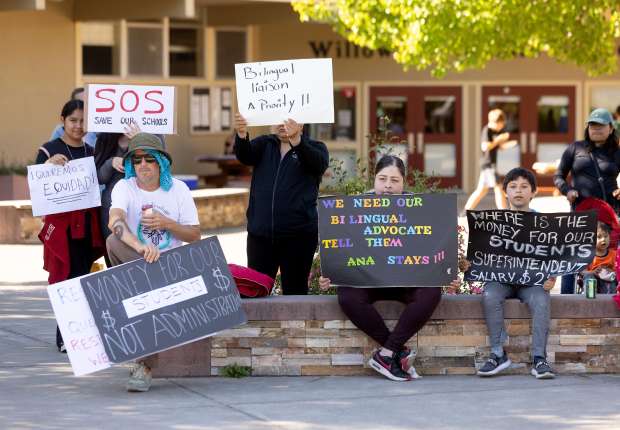
Photo by John Burgess/The Press Democrat
Oak Grove school district teachers and parents gathered before a board meeting at Willowside Middle School to protest the firing of the tiny districts only bilingual interpreter Wednesday, May 8, 2024. (Photo by John Burgess/The Press Democrat)
Oak Grove Union School District on Santa Rosa’s western outskirts serves about 840 students across two campuses: Oak Grove Elementary and Willowside Middle School. It, too, is facing budget woes driven by declining enrollment and rising costs.
The district’s current budget is based on about $14.5 million in revenue, while expenses are estimated to reach roughly $15.8 million — for a $1.36 million operational deficit, equivalent to about 9% of the district’s total budget.
Officials approved a fiscal stabilization plan in January 2024 aimed at reducing district spending. The plan outlines reductions totaling more than $470,000 in ongoing expenses, including staffing and program cuts.
Included in those cuts are two teaching positions, reduced instructional assistant staffing, the elimination of school-based psychologist services and reduced spending on instructional materials.
District leaders also have considered additional savings measures, including closing the Acorn Preschool program and reducing custodial services, which could achieve an estimated $143,000 in savings annually, district budget documents show.
The district still shows reserves above the state-required minimum in its adopted budget. Its $1.77 million reserves accounted for about 9.7% of the overall budget, but projections show that number could shrink to 4.3% in 2026-27 with a risk of dipping below the state minimum by 2027-28 if spending and revenue curves are not equalized.
Sebastopol Union Elementary School District
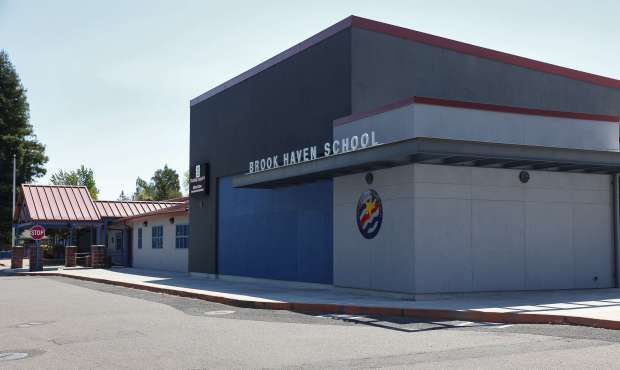
Christopher Chung / The Press Democrat
Brook Haven School in Sebastopol on Monday, Aug. 11, 2025. (Christopher Chung / The Press Democrat)
The story is the same farther west in the Sebastopol Union Elementary School District, serving roughly 500 students across its two campuses, Brook Haven and Park Side. Budget documents show the district is set to bring in about $10.9 million in revenue, while expenses are expected to reach around $11.6 million, leaving a deficit of about $700,000 — roughly 6% of the district’s total budget.
Despite the shortfall, the district has continued to maintain its reserves well above the state-required minimum, with $1.1 million in reserves and an additional $440,000 set aside for economic uncertainty. Compared to the other districts that made the list, Sebastopol Union has the highest reserves — 10% — relative to total budget.
Projections do show the reserves declining in future years as deficit spending continues. However, unlike its neighbors, the district expects to remain above the state minimum in its forecast period.
School officials have taken steps to limit spending by adjusting staffing levels and reducing some program expenditures, according to the adopted 2025-26 budget.
Howell Mountain Elementary School District
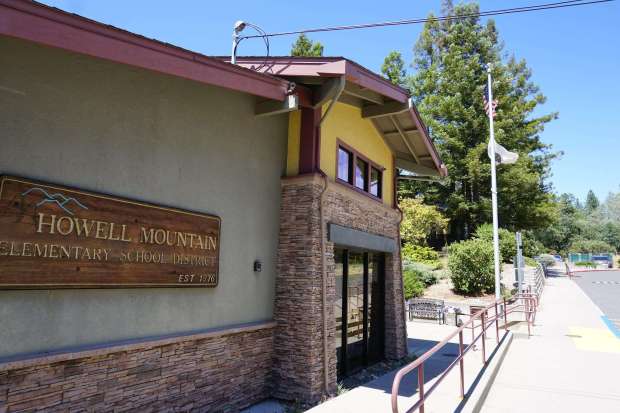
Howell Mountain Elementary Facebook Page
Howell Mountain Elementary in Napa County. (Howell Mountain Elementary Facebook Page)
For the first time in a decade, the Howell Mountain Elementary School District serving the Angwin community in Napa County certified its financial condition as qualified in December.
The 80-student, one-school district’s first interim financial report showed anticipated expenditures exceeding revenues this school year, eroding its reserves from nearly $1 million in 2024-25 to about $600,000 in 2025-26. If deficit spending continues, the K-8 district projected that reserves would fall to $200,000 in the 2026-27 school year.
Per state standards, reserves for a district with an average daily attendance of less than 300 students must not fall below 5% of its total annual expenditures, which equates to about $170,000 for Howell Mountain. While this condition was barely met in the projection for the 2026-27 school year, the district’s reserves are shown as depleted by 2027-28.
For Howell Mountain, the $300,000 deficit in its $3.2 million annual budget for 2025-26 stemmed from increased staffing and special education costs, district leaders said.
Under instruction by the Napa County Office of Education to prepare a fiscal stabilization plan, the school district announced in February that it would terminate a contract for student mental health services and cut three jobs to address its deficit.
With savings of more than $300,000 over the next two school years, those moves would allow the district to switch back to a “positive” certification in its next financial report this month, officials said.
Still, the district needs to cut another $700,000 over the next two years to eliminate its structural deficit. Over the next few months, Howell Mountain Elementary will prepare a detailed plan and timeline to implement additional cuts, a February board resolution said.
This story includes reporting by Petaluma Argus-Courier Staff Writer Amelia Richardson.
Report For America corps member Adriana Gutierrez covers education and child welfare issues for The Press Democrat. You can reach her at Adriana.Gutierrez@pressdemocrat.com.
You can reach Staff Writer Anna Armstrong at anna.armstrong@pressdemocrat.com. On X (Twitter) @annavarmstrongg.
You can reach Staff Writer Tarini Mehta at tarini.mehta@pressdemocrat.com.