
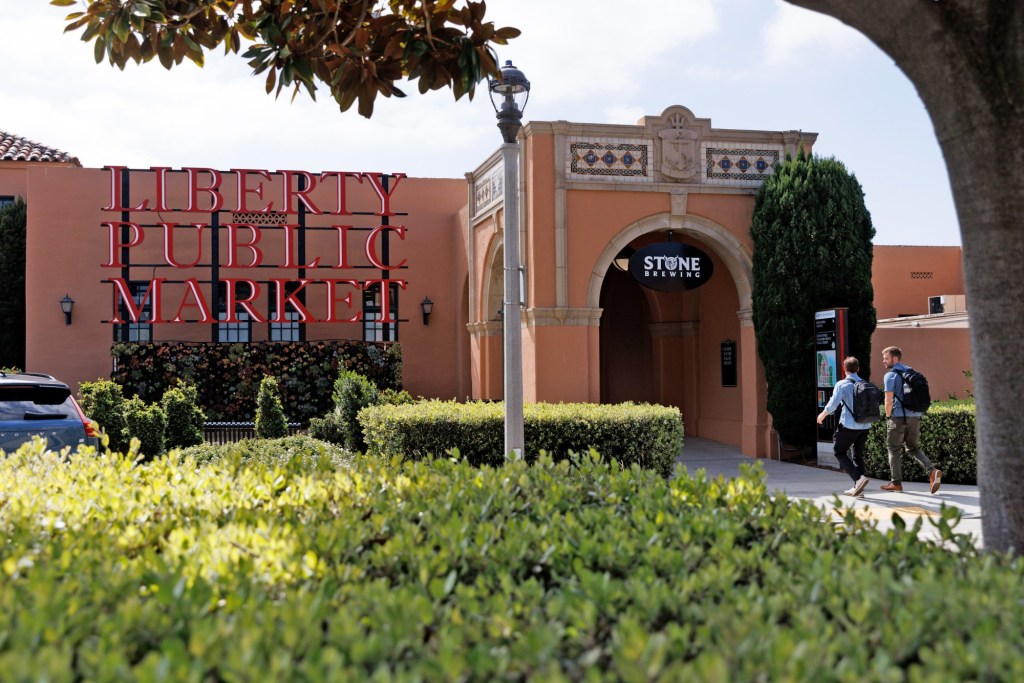
San Diego and a property management company continue to escalate their fight for long-term control of Liberty Station, a large mixed-use property in a strategic location near the planned sports arena and NAVWAR projects.
The City Council is scheduled to approve complex agreements Tuesday that aim to cement the city’s ownership and control of the sprawling 20-year-old development and keep it away from the management company.
The company, Seligman Properties, is stepping up its campaign to convince city officials to sell Liberty Station with a new purchase offer, plans for new appraisals and a new economic analysis.
Those efforts build on Seligman’s ongoing legal efforts to force a sale based on state law governing how cities handle properties they acquired from redevelopment agencies after California dissolved those agencies in 2012.
San Diego acquired Liberty Station from its redevelopment agency and then formally designated the area a “future development” site instead of a “liquidation” site, which has allowed the city to avoid selling it.
Seligman’s new economic analysis, put together by local real estate adviser Gary London, says the city’s insistence on maintaining ownership will cost it millions in tax revenue and lead to long-term deterioration of the site.
The analysis says that without ownership and long-term control, Seligman and the other leaseholders won’t invest in the property and won’t maintain it well during the later years of leases that run through 2070.
“The likely scenario is that the city will receive an asset that is not competitive in the market with high vacancy and lower rents — and is in need of costly repairs,” London says in his analysis.
Seligman also says the city is over-prioritizing ownership, contending the historical status of most Liberty Station buildings gives the city significant discretion over any changes or renovations no matter who the owner is.
City officials declined to directly address the new analysis, citing the ongoing litigation over Liberty Station, a leafy district of public parks, artist studios, restaurants and shops located just east of Point Loma.
But city officials reiterate in documents for Tuesday’s vote their suspicions that Seligman, a national property management company, is trying to force a fire sale that would allow it to reap many millions in profits.
The city says a sale in the near future would be particularly bad because Seligman has $1-per-year leases that last through 2070 on a large portion — 330,000 square feet — of Liberty Station’s commercial district.
City officials say those leases make buying Liberty Station a poor investment for any buyer except Seligman. They contend that a bidding war would be unlikely and that Seligman would ultimately get most of Liberty Station at a substantially deflated purchase price.
“Enriching Seligman to the likely tune of tens of millions of dollars, at the expense of taxpayers and the local and regional community who benefit greatly from continued use of Liberty Station as a community-serving public asset, would be a terrible public policy outcome,” the city says.
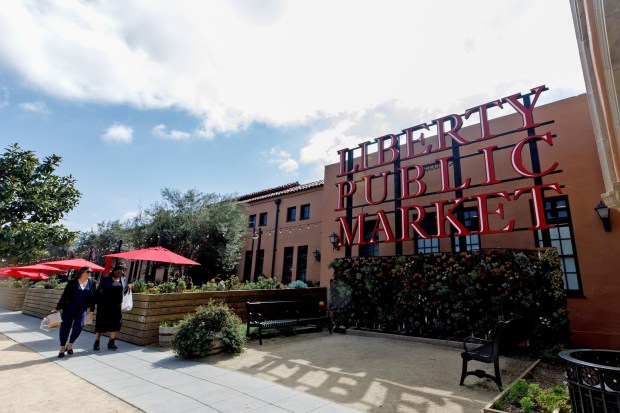 The facade of Liberty Public Market, which features multiple food stalls, as seen at Liberty Station on Wednesday, March 4, 2026. (Kristian Carreon / The San Diego Union-Tribune)
City officials stress that Seligman’s purchase offer for the site is just over $2 million, a tiny fraction of the $159 million Seligman paid in 2018 to acquire its Liberty Station leaseholds.
In response, Seligman notes that the cash-strapped city should consider its offer, because the offer is roughly six times as much as the land controlled by Seligman was valued at during an outside appraisal the city ordered last year as part of the ongoing litigation.
That appraisal valued at $1.8 million the entire 1.5 million square feet that make up Liberty Station, including the Seligman properties, other commercial properties, the Arts District, High Tech High, the Rock Church and some other areas.
The values are relatively low because of the long-term leaseholds that come with essentially no revenue for any potential buyer.
The properties controlled by Seligman were valued at $390,000, the company said. Those properties, which include 20 buildings that are not all connected geographically, include Vons, Trader Joe’s, several properties near Stone Brewing and some properties on Dewey Road.
Seligman says two other leaseholders have made separate offers that would bring the total purchase price to $2.7 million.
And Seligman is also ordering a new appraisal that will seek to determine the present-day value of the properties. The city appraisal sought to determine their value in 2011, just before redevelopment agencies were allowed.
While that’s what state law requires, Seligman says they’d like to know the present-day value and the value based on the best possible use of the properties.
Joe Haeussler, who works for Seligman’s Liberty Station partner Pendulum Properties, estimated the value could be roughly $13 million.
Despite the city’s well-publicized budget woes, officials haven’t indicated any interest in selling.
On Tuesday, the City Council is scheduled to take the key step of cementing city ownership by approving payouts to the county and some other local agencies — school districts, community college districts and health districts — that have a financial interest in Liberty Station.
Those compensation agreements are a key to resolving the ongoing litigation between Seligman and the city.
“Once a compensation agreement for the Liberty Station site is signed, Seligman will have run out of viable options to compel the city’s sale of its remnant fee title interest to Seligman at a price point beneficial only to Seligman,” city officials said in documents for Tuesday’s vote.
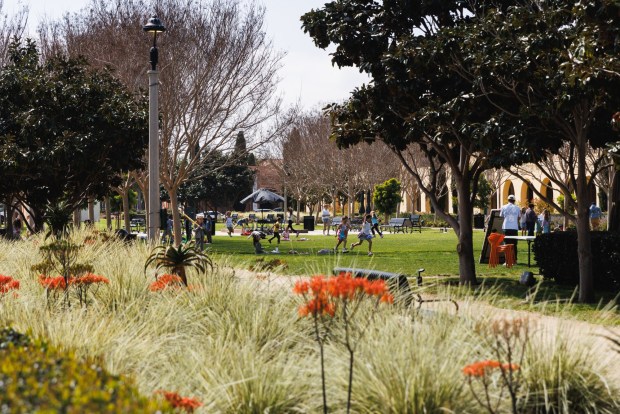 Children play on the grass area of the Arts District at Liberty Station on Wednesday, March 4, 2026. (Kristian Carreon / The San Diego Union-Tribune)
The litigation began in 2022, after the city refused a 2021 purchase offer from Seligman.
Seligman filed suit in Sacramento Superior Court saying the city’s designation of Liberty Station as a “future development” property is bogus because redevelopment at Liberty Station “had already been completed and there was no ‘future development’ planned or proposed.”
Judge Shelleyanne Chang issued a writ of mandate in October 2023 saying that the city doesn’t have to put Liberty Station up for sale as long as city officials continue to make meaningful progress on plans to further develop it and eight other properties on their “future development” list.
That ruling meant that after a decade of making essentially no progress on developing those nine sites, city officials had to spring into action to convince the judge they were making meaningful progress.
Two key things the city must do before a former redevelopment-agency site can be developed is get the site independently appraised and then negotiate compensation agreements.
The compensation agreements are with other public agencies, such as the county and local school districts, that would share in the proceeds should the city sell any of the properties to developers.
Multiple agencies share the proceeds when former redevelopment agency properties are sold, because redevelopment law forced those agencies to give up tax revenues they would have otherwise collected.
After the judge’s ruling, the city got appraisals for six of the nine “future development” sites and worked out compensation deals on two of those sites: downtown’s Balboa Theatre and the Skateworld site in Linda Vista.
The city then began work on the final three properties, which include Liberty Station. The other two are the former Walker Scott building at 1014 Fifth Ave. and the Chinese Historical Museum at 404 Third Ave.
The city got appraisals for all three last year and plans to approve compensation agreements Tuesday that will allow the city to take full ownership of each.
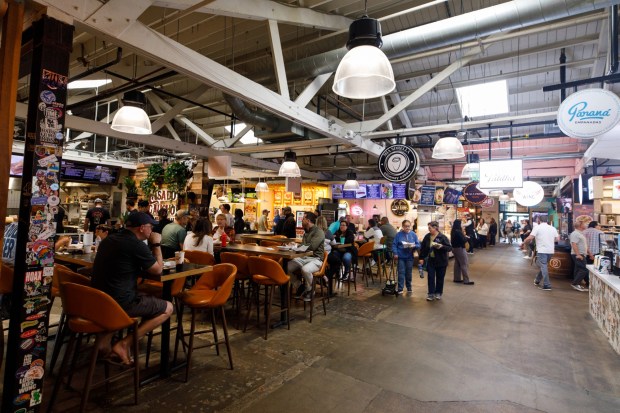 Liberty Public Market features multiple stalls for food and shopping, as seen at Liberty Station on Wednesday, March 4, 2026. (Kristian Carreon / The San Diego Union-Tribune)
The compensation agreements were approved unanimously last month by the council’s economic development committee with no debate and no presentation to the public.
After the vote, committee chair Councilmember Raul Campillo praised the city’s move.
“Today’s actions ensure we comply with state law while protecting valuable community assets,” he said. “The city made long-term redevelopment decisions decades ago that are functioning as intended.”
The county Board of Supervisors approved the compensation agreements in December. But they won’t become final until every affected government agency has approved them.
Liberty Station has become a more important property strategically with large housing and redevelopment projects planned for the nearby sports arena and NAVWAR sites.
City officials say it’s crucial for San Diego to retain control.
“Liberty Station is an important public asset that should remain in the city’s control for the long term,” officials said in documents for Tuesday’s hearing.