

The Abridged version:
When it comes to youth sports, some parents have decided that winning isn’t everything, and that sometimes there’s too much focus on competition.
Norway, whose athletes brought home more 2026 Winter Olympics medals than the United States, has a unique approach to youth sports, including no keeping score until kids reach 11 years old.
One area organization says parents should ask three questions before their kids play competitive sports.
Cassandra Opiela’s 12-year-old son, Spencer, loves sports. Every time his school PE class introduces something new to play, the Sacramento mom says he comes home and wants to give it a try. For years now, he’s played organized soccer and baseball, but — she says — both got so intense so fast, that he almost quit.
“I’m often having to course correct after a game or practice because (he’s) feeling this immense pressure from the coaches and parents around him,” she said. “He just wants to play with his friends. We talk all the time about how we can bring the intensity down.”
Opiela’s teenage daughter played volleyball in middle school just to give it a try. When she was asked to play on a competitive club team, “the conversation became all about how important and difficult it was to make the high school team,” Opiela said.
According to a 2024 study by the American Academy of Pediatrics, 70% of young athletes drop out of sports by age 13. Injury is one reason. But so is burnout.
This reality may prompt some parents to look at options for youth sports, including in Sacramento, in which competition is downplayed in favor of having fun.
It’s working in Norway
Americans, as it turns out, may have something to learn from Norway. Youth sports organizations across that country have banded together to abide by a doctrine known as Children’s Rights in Sports, which applies to all sporting activities for kids up to 12 years old.
In addition to the doctrine’s stated values of joy, community and health, it also dictates that kids shall not participate in any kind of national championship before age 13. Perhaps most notably, teams don’t keep score or publish rankings before age 11.
Norwegian athletes brought home more medals than Team USA did in the recent Winter Olympics. And some believe that Norway’s success was connected to its culture of emphasizing fun over competition in youth sports.
Positive environments encouraged
Positive Coaching Alliance, a nonprofit based in Northern California, aims to foster positive environments across youth sports throughout the United States. The organization acknowledges that the most commonly reported reason kids stop playing sports is that they’re no longer having fun.
“That’s a powerful signal,” spokesperson Ryan Durrett said. “We’ve seen a growing emphasis on early specialization, year-round play, travel teams, high participation costs and performance outcomes at younger and younger ages. That intensity can crowd out what research consistently tells us matters most: fun, development and relationships.”
Sign Up for the Morning Newsletter
The Abridged morning newsletter lands in your inbox every weekday morning with the latest news from the Sacramento region.
Sacramento programs reject scorekeeping
A handful of youth sports programs in the Sacramento region align with Norway’s approach to not keeping score.
The city of Sacramento’s Junior Giants baseball/softball program, for example, is a non-competitive approach for kids aged 5 to 18, geared entirely for beginners. A description about Junior Giants on the city’s website acknowledges that the rules are flexible and, in addition to no score being kept, games are self-officiated.
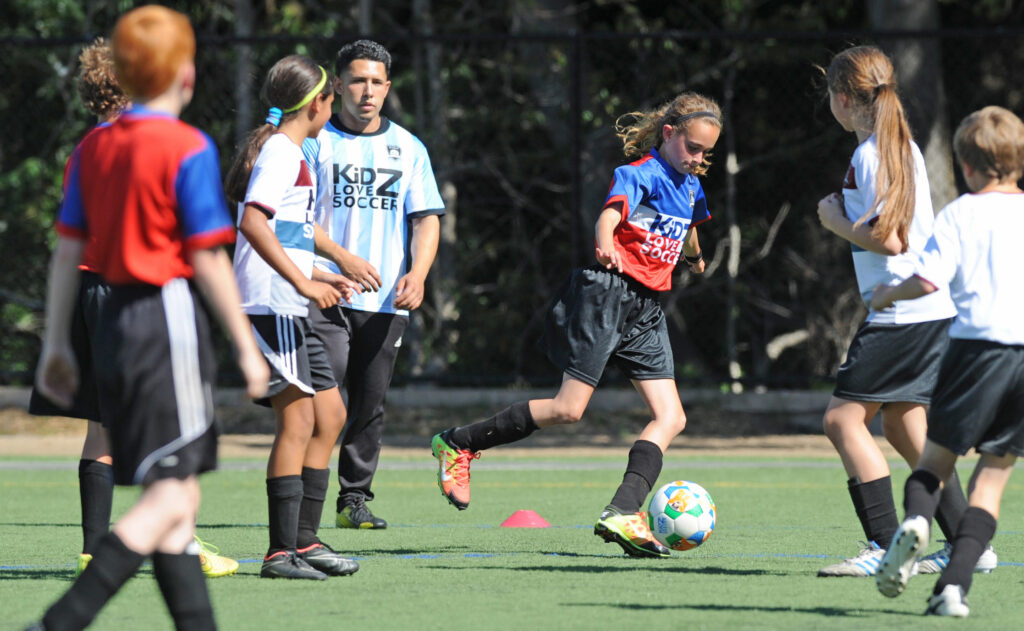 Kidz Love Soccer runs soccer programs that focus on learning over competition. (Kidz Love Soccer)
Similarly, Kidz Love Soccer — which runs soccer programs for ages 2 through 10 all over the Sacramento area — promotes effort and learning over competition. Its motto is “Kidz Love Soccer — where the score is always Fun to Fun.”
“I think the U.S. is losing sight of development in favor of the win-loss column,” said Olly Bayliss, who has worked for Kidz Love Soccer for about two decades. Bayliss, as a player and competitive coach himself, describes himself as someone who “lives for soccer.”
Participants say everyone celebrates a goal — no matter who scores. Activities focus on teaching fundamentals.
Bayliss describes Kidz Love Soccer as a soccer school — not a competitive program. “Our goal is (to see) these kids go on to play competitively somewhere,” after they’ve finished with Kidz Love Soccer, he says.
Three questions to ask
Positive Coaching Alliance suggests parents talk with their kids and ask three simple questions before committing to higher levels of competitive sports:
What are you hoping for this season?
What would make this season feel like a success to you?
How can I best support you?
Parent awareness is important, according to the alliance. Its website offers even more insights and steps for families to take.
“At its best, youth sports are one of the most powerful tools we have to help young people develop confidence, character and connection,” Durrett said. “When adults intentionally design sports experiences around those outcomes, competition becomes a vehicle for growth — not pressure — and kids are far more likely to stay in the game.”
“Changing the culture of youth sports is a job for all of us,” Opiela added. “As parents, we have to be willing to put a stop to the chatter and drama. As coaches and officials, people need to prioritize learning and fun. We need to teach the players how to win and lose with more grace and less intensity.”
Carolyn Becker is a regular contributor covering youth sports for Abridged in her feature Beyond the Bleachers. She’s lived in Northern California most of her life and worked in journalism and communications in Sacramento for more than 25 years. She and her husband are raising two boys, both of whom play competitive baseball.