
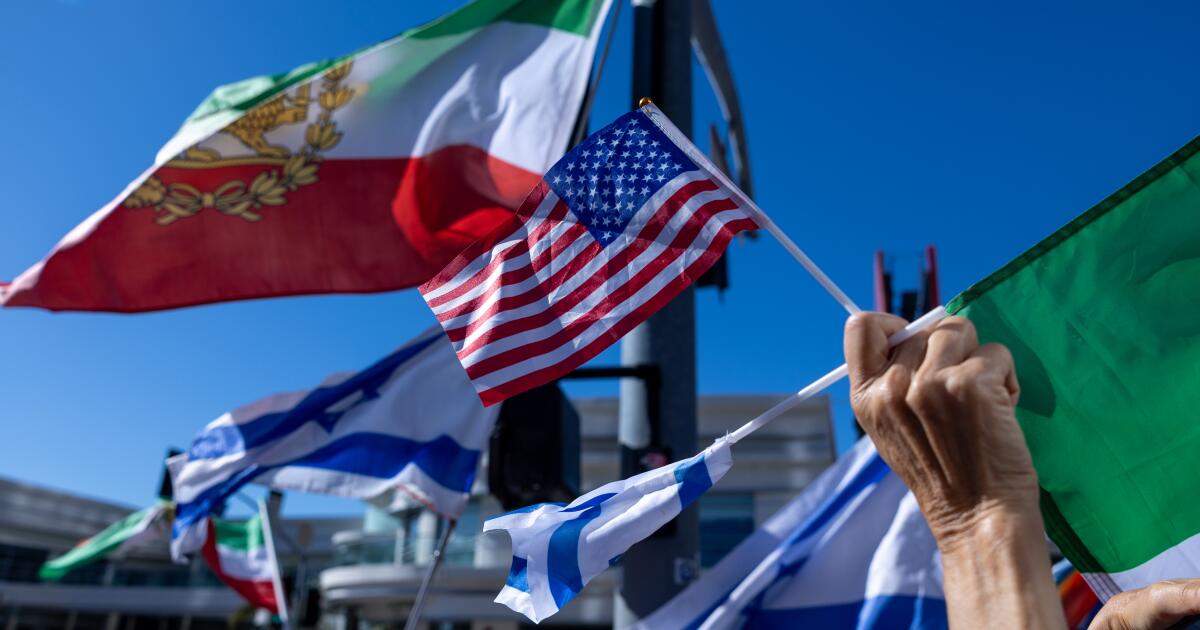
Members of the Iranian diaspora in Los Angeles rallied last week in Westwood, celebrating in the aftermath of the death of Iran’s supreme leader as U.S.-Israeli military operations intensified.
Demonstrators called for a “free Iran” and expressed hope that a change in government could bring freedom to their homeland.
Now, the tone of some conversations has become more sober as Iranian Americans fear their native country could descend into chaos, much like Iraq did after the 2003 American invasion, my colleague Jack Dolan writes.
You’re reading the Essential California newsletter
Casualties continue to grow, with the death toll in Iran rising to more than 1,300.
There is no clear path toward de-escalation, as President Trump said deploying American ground troops to the Middle East remained under consideration and Iran’s foreign minister rejected calls for a ceasefire.
Speaking to reporters Saturday on Air Force One, Trump said “there would have to be a very good reason” to send U.S. forces inside Iran.
Iran has said it is prepared to continue fighting the war despite sustaining heavy losses, and would be ready to fight American ground troops.
Now that the war is entering its 10th day, here is a look at its effects on oil flow to the world and, closer to home, how Californians are being impacted.
Iran threatens to burn ships
Iran warned last week that ships traversing the Strait of Hormuz would be “set ablaze,” alarming government and industrial leaders all over the world.
They have good reason to be alarmed, reports Nabih Bulos, The Times’ Middle East bureau chief. On any given day, a fleet of 80 tankers — carrying around 20% of the world’s crude oil and a large portion of its gas — traverses the strait, which is 100 miles long and has only two 2-mile-wide shipping lanes.
It has now turned into a parking lot, with an almost complete stoppage of ships going through, according to experts and marine traffic monitoring services. Tanker traffic has already fallen by around 90%, one expert told Nabih.
As part of the fallout, the price of gasoline across the U.S. is climbing.
Californians feel more pain at the pump
No other state is getting punched harder than California as the conflict with Iran pushes up gas prices, my colleague Iris Kwok reports.
The average cost of a gallon of regular gas in the state is the most expensive in the country at $4.91, up 6% from a week ago and 11% from a month ago, according to AAA. The nationwide average is $3.32 per gallon.
Prices are higher in the Golden State because of higher taxes and stricter requirements for cleaner, more expensive gas that pollutes less.
Plus recent refinery closures cut California’s production capacity by 20%, forcing reliance on gasoline from overseas, including 30% from the Middle East.
California military families fear another ‘forever war’
While prices at the pump are a serious concern for Californians, so is the fear of a so-called forever war, particularly among military families in the state.
The escalating Iran conflict has sent a chill through military communities across California, which is home to more than 157,000 active-duty military personnel.
A Californian was among the first American service members to die in the war.
Chief Warrant Officer 3 Robert M. Marzan, 54, of Sacramento was killed in Kuwait on March 1 in a retaliatory drone strike by Iran, according to the Pentagon and his family. He was among six U.S. Army Reserve soldiers killed in the attack on Port Shuaiba.
The U.S. military on Sunday announced that a seventh U.S. service member died Saturday night from injuries sustained in a March 1 Iranian attack in Saudi Arabia.
In Twentynine Palms — home to the largest Marine Corps base in the country — City Manager Stone James told The Times that local leaders were working to understand the potential needs of the Inland Empire community and its military families in the event of a mass deployment.
The mood, he said, is “upbeat, given the fact that we have just eliminated a regime that has slaughtered tens of thousands of their own people and repressed women’s rights and dignity and humanity.”
But around town, some locals said they were uneasy, and uncertain, about what the war could mean for their community and loved ones.
Here’s more coverage of the war in Iran:
What is Trump’s true objective in the Iran war? U.S. targets provide a clue
Iranians in L.A. turn to WhatsApp and Fox News for updates on loved ones
After week of war and political upheaval, Trump remains defiant as ever
Today’s top stories 
Runners pass by City Hall during the 41st Los Angeles Marathon on Sunday.
(Eric Thayer/Los Angeles Times)
A break from the summer-like heat is coming to SoCalAfter a windy, hot weekend, temperatures in the Southland are expected to drop on Monday by about 15 degrees.But not for long. Another warm and dry spell is expected later in the week.Even more intense heat — 90 degrees — is forecast for Thursday.Redistricting shakes up California congressional racesVoters in November overwhelmingly approved Proposition 50 to help Democrats win control of the House this November and put a meaningful check on the Trump administration.California’s congressional redistricting sends Rep. Robert Garcia, an outspoken Trump critic and gay lawmaker, to represent conservative Huntington Beach — a striking political reversal.Republican heavyweights Young Kim and Ken Calvert are set to battle in Orange County’s only safe GOP seat, a costly primary forced by redistricting.State Farm to keep 17% hike in home insurance ratesThe insurance company reached a deal with regulators to maintain the 17% average homeowners rate hike that took effect after January’s devastating Los Angeles wildfires.Under the settlement terms, it agrees to halt mass non-renewals in 2026 and face further rate review by 2027.Fire victims say the agreement fails to address State Farm’s disputed claims handling and complaints about low payouts and delays.What else is going onCommentary and opinionsPromising free college tuition is good politics — and a good idea — argues columnist George Skelton.The Epstein files are off the front page, but they’re far from yesterday’s news, writes columnist Robin Abcarian.Betty Yee is bumping along near the bottom in California’s race for governor. Still, she’s counting on straight talk to prevail over richer, flashier candidates, writes columnist Mark Z. Barabak.Some brave souls are stepping into the fray, taking to the streets to protest Trump’s war against Iran, columnist Steve Lopez writes.This morning’s must readOther must readsFor your downtime 
(Juliana Yamada/Los Angeles Times)
Going outStaying inAnd finally … your photo of the day 
American Nathan Martin slides past Kenya’s Michael Kimani Kamau on Sunday to win the men’s division of the L.A. Marathon.
(Ronaldo Bolanos / Los Angeles Times)
Today’s great photo is from Times photographer Ronaldo Bolanos at the L.A. Marathon, which featured the closest finish in race history.
Have a great day, from the Essential California team
Jim Rainey, staff reporter
Hugo Martín, assistant editor, Fast Break desk
Kevinisha Walker, multiplatform editor
Andrew Campa, weekend writer
Karim Doumar, head of newsletters
How can we make this newsletter more useful? Send comments to essentialcalifornia@latimes.com. Check our top stories, topics and the latest articles on latimes.com.