
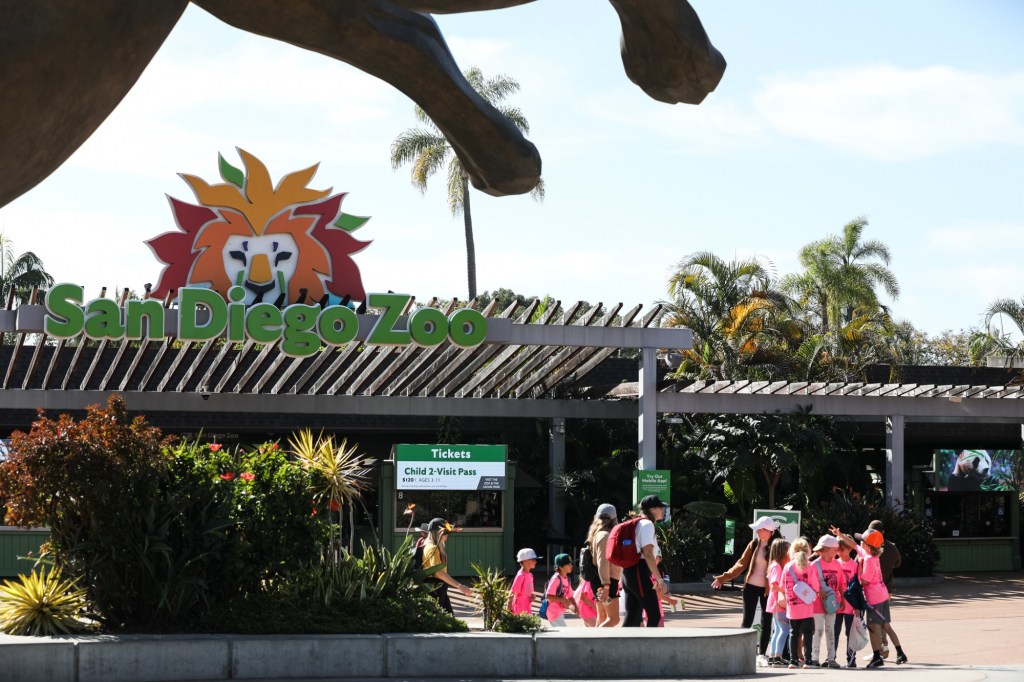
The San Diego City Council unanimously approved Monday a 52-year lease extension with the San Diego Zoo that includes a new $3 million annual payment to the city and an equal split of zoo parking revenue.
Zoo and city officials hailed the extension as a major step that gives zoo officials long-term certainty needed to make investments while allowing the city to secure a partnership with arguably its most important institution.
The extension, which moves the expiration date of the lease from 2034 to 2078, took eight months to complete and was prompted by the city’s decision to begin charging for parking elsewhere in Balboa Park.
That forced the zoo also to begin charging for parking in its lots, which prompted questions about possible revenue-sharing and requests from the zoo for a long-term lease extension.
“Those negotiations were certainly rigorous and took us eight months, which is a bit of time,” Adam Day, treasurer of the zoo’s board, told the council Monday. “I think they were very thorough.”
Councilmember Jennifer Campbell said the extension made sense for both sides.
“This amendment strengthens the city’s longstanding partnership with the zoo, providing stability for continued investment in the property and creating meaningful revenue to the city,” she said. “For more than a century, the zoo has been one of San Diego’s most treasured institutions and a major driver of our regional economy.”
The extension was previously approved by the board of the zoo, formally known as the San Diego Zoo Wildlife Alliance.
The compensation the city will receive is difficult to calculate, because the zoo only began charging for parking Jan. 5 and zoo officials have declined to reveal how much revenue they’ve generated.
The city’s independent budget analyst says the extension will yield an estimated $347.6 million between now and 2078. When translated to present-day value, the IBA says the extension is worth $98.5 million.
The $3 million annual payment to the city comes with an annual 3% escalator that would begin in 2030. The city would only receive revenue beyond that amount if the zoo generates annual parking revenue beyond $6 million.
Council President Joe LaCava said city officials shouldn’t count on anything beyond the annual base payment.
“I consider that to be frosting on the cake — something we should not plan our annual budget conversations on,” he said about any excess revenue-sharing money.
LaCava praised the zoo for spending $289 million between 2015 and 2024 on capital improvements, which he noted is an average of nearly $30 million per year.
Shawn Dixon, the zoo’s chief executive, said those projects have included Africa Rocks, Giant Pandas and Wildlife Explorers Basecamp.
But critics have questioned why the lease extension bypassed the council’s Economic Development Committee, and why no appraisal was done of the 124 acres the zoo controls in northwestern Balboa Park.
City officials stressed that appraisals are done when a tenant is going to pay rent or buy a city property, but that the zoo is doing neither.
The zoo has paid no rent to the city since it opened in 1916, and it will continue to pay no rent — city policy dictates that all of Balboa Park’s nonprofit tenants operate on zero-rent leases.
The $3 million annual payment to the city is a contingency based on the new paid parking at the zoo, officials said.
Councilmember Marni von Wilpert said criticism about the lack of an appraisal is misplaced.
“I don’t want the public to think that we are skirting our responsibility to get market rate when the zoo was never paying rent in the first place,” she said. “We are not giving the zoo a special deal. We are holding them to the same account.”
Other critics have suggested the nearly $22 million the zoo gets in tax revenue from the city each year should have been factored into how the lease was negotiated.
The IBA also suggested the city could have considered extending revenue-sharing beyond parking, possibly to include admission tickets, membership fees and concession sales.
Another concern raised by budget experts was the impact on parking revenue if the zoo follows through on long-term plans to build an underground parking garage so it can expand its exhibit space into areas now used for parking.
The lease extension requires the zoo to start paying prevailing wages on large construction projects and to make climate-friendly any new or significantly renovated buildings.
No such policies were in place when the existing lease was signed in 1979.
The deal anticipates scenarios where the city eliminates or modifies controversial paid parking elsewhere in Balboa Park, which has faced backlash since it began in January.
If the City Council were to eliminate paid parking, the city would no longer get the $3 million annual payment. If paid parking were scaled back by one day a week, the $3 million would shrink by one-seventh to just under $2.6 million. Other rollbacks would come with similar pro-rated reductions.
In addition to the 3% escalator of the zoo’s initial $3 million annual payment, the proposed extension spells out how the revenue split would work: It would be an equal division of net revenue after deducting expenses to operate and maintain paid parking at the zoo.
Those expenses would be covered jointly by the zoo and city, but the city’s annual contribution would be capped at $700,000. So if those expenses surpassed $1.4 million in a particular year, the zoo would pay more.
But the city would only get money beyond the base annual payment if the total parking revenue generated by the zoo that year is more than double that amount — $6 million before the escalators kick in.
The proposed extension stipulates that the zoo would be required to cover all infrastructure upgrades and capital improvements related to its three parking lots, which contain roughly 3,000 parking spaces.
The San Diego Zoo Safari Park, a separate park operated by the zoo in the San Pasqual Valley, has a separate city lease that is due for renegotiation.