
Routine inspections by California Department of Food and Agriculture (CDFA) officials led to the discovery of a citrus disease in Ramona, resulting in a quarantine.
Officials detected the fatal citrus-greening disease, known as Huanglongbing, or HLB, on March 2. The disease was found in two citrus trees in a residential area.
The finding marks the first HLB quarantine in Ramona, adding to the existing HLB quarantines in Rancho Bernardo, Valley Center, Fallbrook and Oceanside.
“The disease doesn’t affect people or animals,” said Garrett Cooper, deputy director for San Diego County Agriculture, Weights and Measures Department. “If your tree gets sick, the fruit won’t come out very well.”
The disease causes bitter, misshapen fruit unsuitable for sale or eating; infected trees eventually die, according to the CDFA.
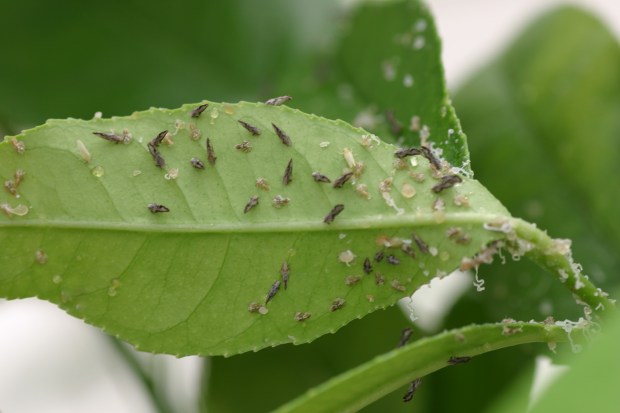 Adult and immature Asian Citrus Psyllid latch onto citrus tree leaves. The insects can infect leaves and stems with Huanglongbing, a citrus disease that kills trees and the fruit on them. (Courtesy of the United States Department of Agriculture.)
HLB is one of the most destructive citrus diseases in the world, officials said. A bacterial disease, HLB is spread by an insect, the Asian Citrus Psyllid.
Citrus is one of San Diego County’s most valuable crops, worth nearly $140 million, according to the 2024 Crop Report.
More than 100 businesses may be affected by the new quarantine, including growers with approximately 10 acres of commercial citrus, two commercial nurseries and local farmers markets, officials said.
The quarantine restricts the movement of citrus plants, plant parts and fruit inside and out of the quarantine boundaries, with the only exceptions for agricultural businesses that must follow strict requirements for treatment, cleaning and packing before transporting fruit.
“Growers will still be able to sell fruit that has been through a stringent process,” Cooper said. “Commercial groves moving big shipments have to sign compliance agreements.”
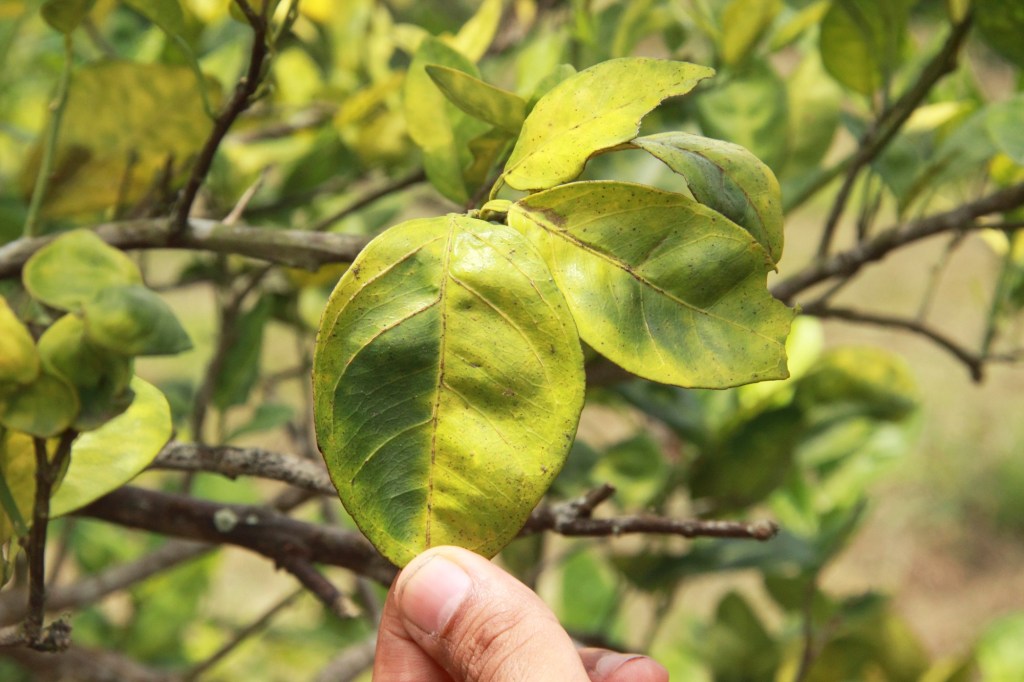
Symptoms of the disease can include mottled yellow leaves appearing in asymmetrical patterns.
Cooper said the biggest concern with HLB isn’t the fruit, but the leaves and stems of the plants, which should be removed.
Cooper and other officials are urging residents and growers to help stop the spread of the disease.
One of the most effective methods to slow HLB is to remove infected trees and treat nearby trees for the Asian Citrus Psyllid. The pest can be treated with commonly found home and garden products, officials stated.
CDFA is working with residents to coordinate treating and removing the infected trees, if needed.
In the coming weeks, Cooper said official surveying will increase. County officials are also proactively notifying local citrus growers, plant nurseries and other related businesses.
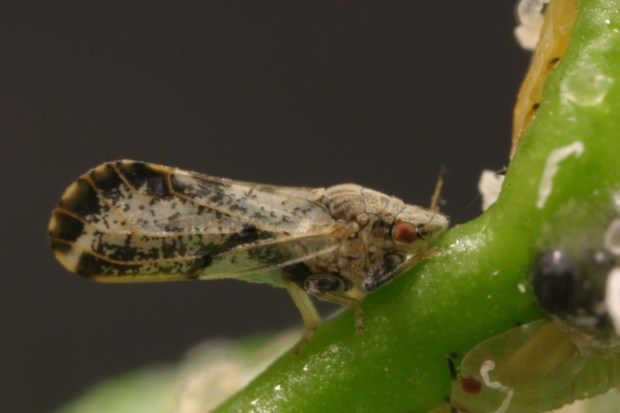 An adult Asian Citrus Psyllid feeds on a citrus tree. The insects are responsible for the spread of Huanglongbing (HLB), an incurable citrus tree disease. (Courtesy of the California Department of Food and Agriculture, 2022).
“The biggest thing residents can do is work cooperatively with officials to prevent the spread of the disease,” Cooper said.
Officials will knock on the door before entering a property, they will have identification on them and will be driving marked cars.
“They will go into detail as to why they are there, which is just to look at the citrus trees and possibly take samples,” he said.
There are several things residents can do to help protect their citrus trees, such as not moving citrus plants, leaves or foliage into or out of the quarantine area.
All leaves and stems should be removed and backyard citrus should be washed before being moved from where it was grown; plant clippings should be dry or double-bagged prior to disposal, and unmaintained citrus trees should be removed by a professional service to prevent hosting the pests or disease.
Officials also recommend only purchasing citrus trees from reputable local nurseries.
Sick-looking or declining citrus trees can be reported through the CDFA’s Pest Hotline at 800-491-1899 or by visiting: cdfa.ca.gov/plant/acp.
To learn if you live in or near a quarantine zone, visit the County’s Citrus Quarantine Program at: sandiegocounty.gov/AWM/CQP, call 858-614-7770 or email sdcawm@sdcounty.ca.gov.