
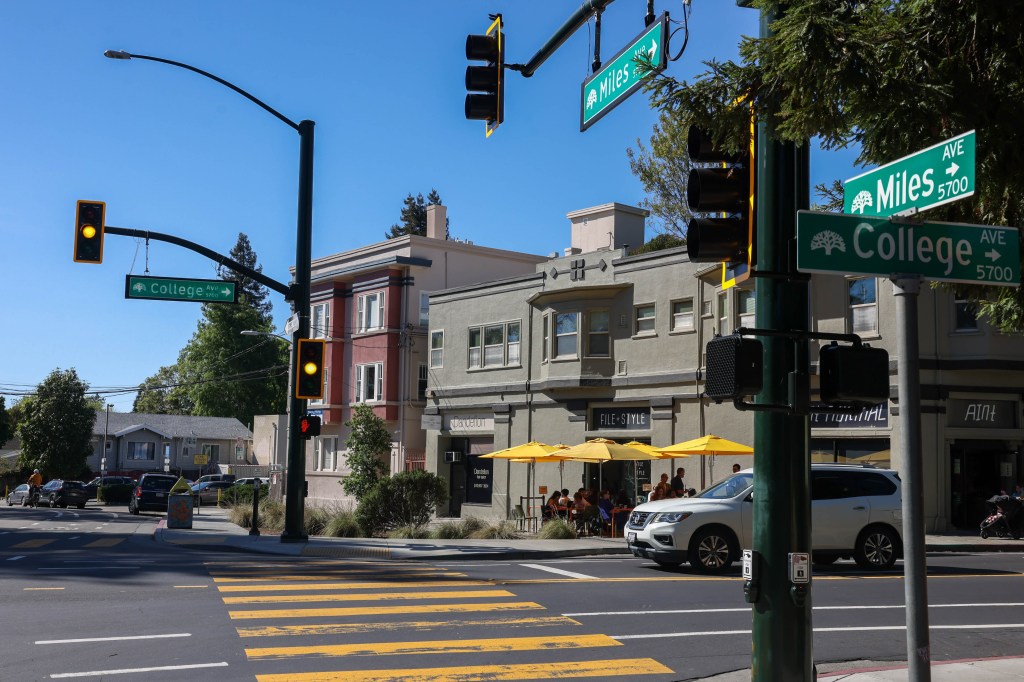
OAKLAND — Rockridge has long been among Oakland’s most idyllic and priciest areas, exactly the kind of neighborhood that is often resistant to the taller, more populous density housing the city is now planning for it.
“Yet many of the old-timers and young tech workers who live here seem to have accepted the coming changes as an unavoidable reality of California’s deepening housing crisis.
“I don’t like it, because it might cut off all the views of the area,” said Alex Chung, a young professional who moved to Rockridge last year from San Francisco. “And I think that’s really sad, when high complexes come into areas with a lower footprint.”
But if it’s going to bring more housing,” she added, “then I think we can accept that.”
Cozy suburban homes, including historic Craftsman bungalows, surround the village-y coffee shops, bookstores and upscale restaurants that line College Avenue, where Chung and her dog, Mia, were out for a sunny afternoon stroll last week.
Soon, that quarter-mile area encircling the Rockridge BART Station may be forced to welcome apartment complexes as tall as 75 feet, or roughly seven stories — more than double the 35-foot limit that the city currently allows.
Last week, the Oakland City Council voted to embrace the new state law SB 79 — beyond even the recommendations of the council’s staff — setting the stage for Rockridge to be transformed into a more bustling community.
Signed into law by Gov. Gavin Newsom last October, SB 79 raises development caps to 75-foot-tall buildings and 120 housing-units-per-acre in the quarter-mile around a BART station, plus 65-feet and 100-unit caps in the next quarter-mile beyond that.
 Alex Chung, with her dog Mia, shares her point of view on the City of Oakland’s proposal to build new housing units near the Rockridge BART station in Oakland, Calif., on Friday, March 6, 2026. A new California housing law allows homes to be built near public transit hubs. (Ray Chavez/Bay Area News Group)
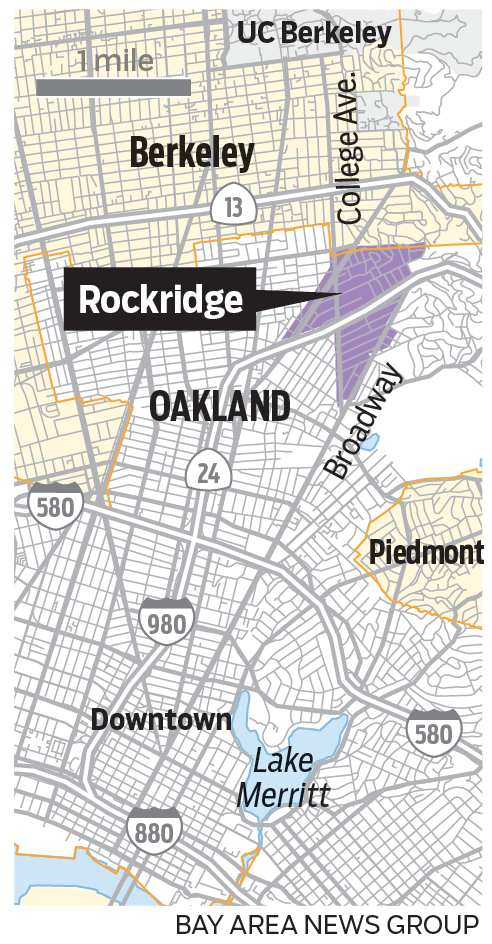 Because Rockridge is designated under state law as a “high resource area,” where Zillow reports the typical home value as $1.6 million, as a “high-resource area,” it could not be temporarily shielded from the law’s reach.
City staff had advised delaying the neighborhood’s planned “upzoning” — that is, allowing more homes to be built at greater density — until 2032, to buy the council time to develop its own alternate plan.
Councilmember Zac Unger, whose North Oakland district includes Rockridge, bluntly rejected the recommendation, pushing instead to accept an earlier 6-0 vote by the city Planning Commission to adopt SB 79 more fully.
“Love it or hate it, we are bound to understand that it is our new reality,” Unger said of SB 79. “People are writing us to say, ‘Don’t allow high-rises along College Avenue.’ And that, respectfully, is not a decision we get to make. The ship has sailed on that, and the state has set that ship afloat.”
Unger also successfully sought to remove the MacArthur and Ashby BART stations from the city’s exclusions, while Councilmember Charlene Wang did the same for the Lake Merritt station and International Boulevard bus stops in her district.
It is in Rockridge, though, where debates over new housing have raged for years. Pro-housing advocates have long pushed to upzone the neighborhood, arguing it would help ease displacement pressure in lower-income parts of the city.
Skeptical homeowners in the area, however, have helped slow the community’s growth, noting that taller buildings resembling Oakland’s downtown apartment towers would fundamentally alter Rockridge’s down-to-earth feel.
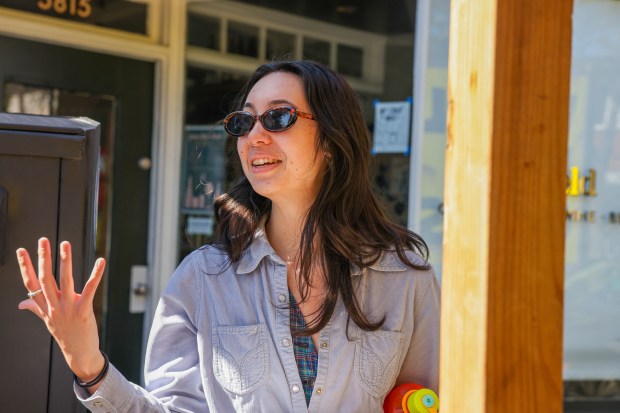 Zoe Quon shares her point of view on the City of Oakland’s proposal to build new housing units near the Rockridge BART station in Oakland, Calif., on Friday, March 6, 2026. A new California housing law allows homes to be built near public transit hubs. (Ray Chavez/Bay Area News Group)
Some younger residents, meanwhile, are more wary of what kind of housing is built, and for whom.
“It is very jarring to see big developers come in and take over these smaller homes that have been in the community for a long time,” said Zoë Quon, a 24-year-old West Oakland resident who works at a Rockridge dance studio. “‘Affordable housing’ can be such a loaded term.”
The demographics in Rockridge — where, by the last Census count, 69% of residents are white, compared to 29% of Oakland as a whole — can be traced back to a history of racial exclusion.
Early 20th-century deed covenants explicitly barred Black, Chinese, or Japanese residents from buying or renting homes in the neighborhood.
When such restrictions were ruled unenforceable by the U.S. Supreme Court in 1948, these local rules gave way to single-family zoning requirements that have defined modern suburbs.
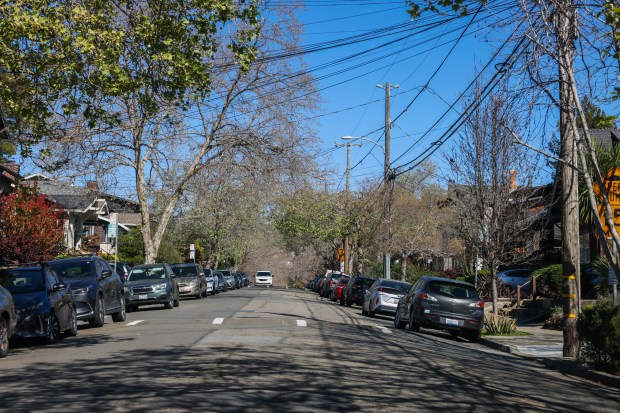 View of the Lawton Avenue, just two blocks away from the Rockridge BART station in Oakland, Calif., on Friday, March 6, 2026. The city of Oakland is considering building new housing units after a new California housing law permits homes to be built near public transit hubs. (Ray Chavez/Bay Area News Group)
“Rockridge went through a series of downzonings in the ’70s and ’80s that essentially froze it in time,” said David Garcia, a Rockridge resident who serves as deputy policy director at the Terner Center for Housing Innovation at UC Berkeley.
The tide is turning, however. More recent housing developments around College Avenue have offered double-digit housing units apiece. Garcia notes that because these buildings are designed to look more like vintage Rockridge, they have blended in seamlessly with the neighborhood.
The area was also set to welcome 448 new homes at the former California College of the Arts campus on Broadway, though a recent purchase of the site by Vanderbilt University may shift the future of the site back toward academia.
Real-estate development has slowed to a crawl amid President Donald Trump’s tariffs and other macroeconomic forces, requiring a slow build-back that may keep Rockridge’s current form intact well into the future.
But along College Avenue, the thought of new housing may not sound as controversial as it once did.
“The vibe would change around here with a lot of big buildings, but I think that’s part of living in a city,” said Dillon Braud, a civil engineer and a renter in Rockridge of nine years. “Cities grow, everything expands… It should be just a matter of time until places change.”
Shomik Mukherjee is a reporter covering Oakland. Call or text him at 510-905-5495 or email him at shomik@bayareanewsgroup.com.
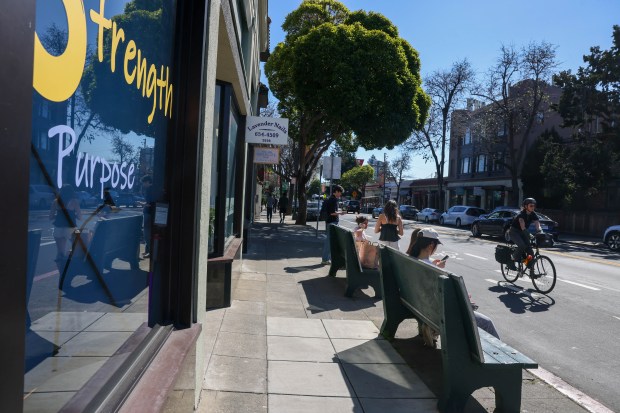 A bicyclist rides along College Avenue as passengers wait for a bus at a stop near the Rockridge BART station in Oakland, Calif., on Friday, March 6, 2026. The city of Oakland is considering building new housing units after a new California housing law permits homes to be built near public transit hubs. (Ray Chavez/Bay Area News Group)