
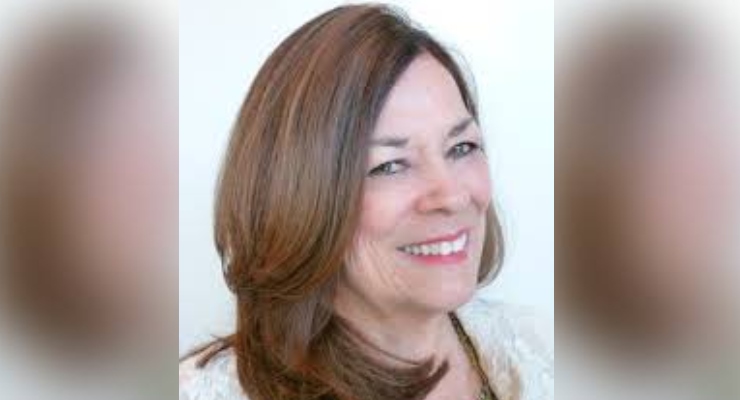
 Phyllis Hansen [photo credit: LA City]The cast iron bells that hang from curved green guideposts along California’s highways — familiar to generations of drivers, mysterious to most of them — were the creation of a South Pasadena woman who designed them, founded a company to manufacture them, and oversaw their installation across 700 miles of road.
California historian Phyllis Hansen will bring the story of that woman, Harrye Rebecca Piper Forbes, to the Pasadena Rotary Club’s weekly luncheon at noon Wednesday, March 11, at the University Club of Pasadena, 175 N. Oakland Ave. Hansen’s presentation is titled “The Bell Lady, Mrs. A.S.C. ‘Harrye’ Forbes,” according to information provided by the Rotary Club.
The effort to mark El Camino Real — the route connecting California’s 21 Spanish missions from San Diego to Sonoma — began in Pasadena. In 1892, Anna Pitcher, director of the Pasadena Art Exhibition Association, first proposed installing markers along the old highway, according to the LA Almanac and multiple historical sources. Her proposal initially gained little traction.
When Pitcher fell ill in 1902, she entrusted the project to Forbes, who was then living in the Pasadena area, according to Calisphere, the digital library of the University of California. Forbes took the idea and transformed it. She designed a cast iron bell, weighing approximately 90 pounds, to hang from an 11-foot bent guidepost shaped like a shepherd’s crook — a form meant to evoke the walking stick of the Franciscan missionaries, according to the San Francisco City Guides newsletter. Forbes patented the design and founded the California Bell Company in 1906 to manufacture the bells, according to a historical account published by the Redwood City Woman’s Club.
The first bell was installed in August 1906 in front of the Plaza Church in downtown Los Angeles. By 1913, more than 450 bells lined the route, according to the California Department of Transportation. Civic organizations and city governments purchased the bells at $25 each and donated them to the El Camino Real Association for installation, with a committee chaired first by Forbes’s husband, Armitage S.C. Forbes, and later by Forbes herself.
Forbes was far more than a bell designer. She served for years as director of the Historical Society of Southern California, authored the 1903 book “California Missions and Landmarks, El Camino Real,” and was among the first women appointed to the board of directors of a camera club in Southern California, according to the LAPL Photo Friends research project. She also discovered the original copy of the Treaty of Cahuenga after it had been missing for more than 70 years, locating it in the Bancroft Library at UC Berkeley.
Hansen, who serves as a board member of the Campo de Cahuenga Historical Memorial Association, has presented on Forbes at multiple venues, including a July 2025 event at the Rancho Camulos National Historic Landmark. A press release for that event described Forbes as “a true Renaissance woman who, as an author, historian, designer, businesswoman, foundry-founder, activist and legendary photographer, was almost larger than life.” Hansen also shares artifacts from the Forbes estate during her presentations, according to the Rancho Camulos announcement.
The bells fell into disrepair after the El Camino Real Association fragmented in the 1920s. The California State Automobile Association assumed maintenance responsibilities from 1926 to 1931, and the state took over in 1933, according to Caltrans. By 1960, fewer than 80 of the original bells remained. In 2000, John Kolstad purchased the remnants of the California Bell Company and, using the original 1906 molds, began producing new bells. Caltrans received nearly $2 million in federal grants to restore the marker system, and today approximately 585 bells mark El Camino Real and its branches, according to the California Bell Company.
In recent years, some California Indigenous groups have called for removal of the bells, viewing them as symbols of the suffering their ancestors endured under the mission system. The Amah Mutsun Tribal Band worked with the city of Santa Cruz to remove bells there, and a bell was removed from the UC Santa Cruz campus in 2019, according to BenitoLink.
The Pasadena Rotary Club meets Wednesdays at noon at the University Club of Pasadena, 175 N. Oakland Ave. The public is welcome. A buffet lunch is available for $33 and complimentary valet parking is provided. For more information, call 626-683-8243 or email office@pasadenarotary.com.
“There are all these connections woven through — women’s history, American history, Native American and Mexican history,” Hansen has said of her work in California history, in a 2022 interview published by the News of America.
 Get our daily Pasadena newspaper in your email box. Free.
Get all the latest Pasadena news, more than 10 fresh stories daily, 7 days a week at 7 a.m.