
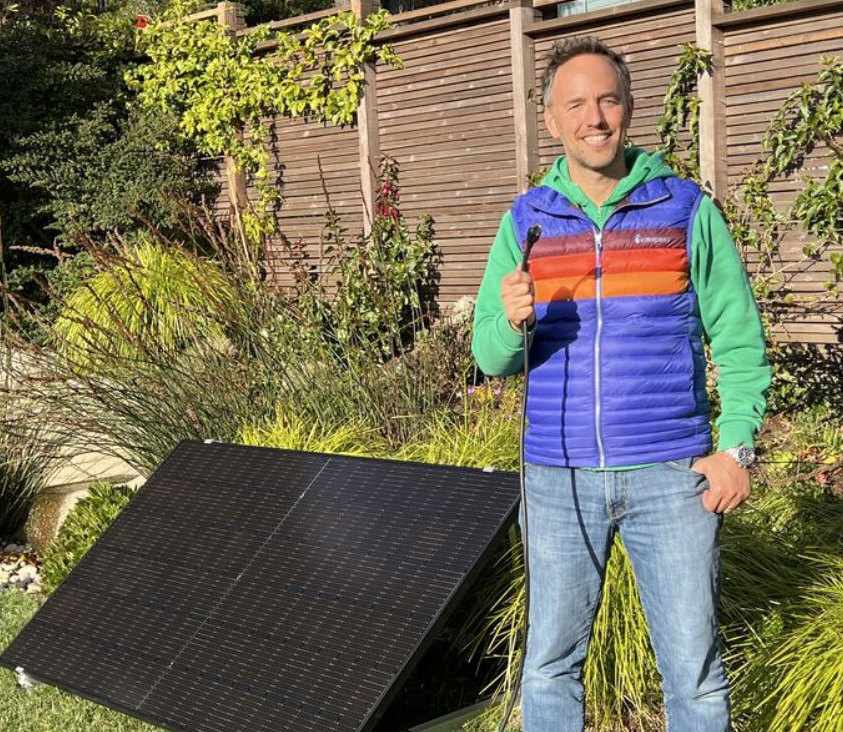
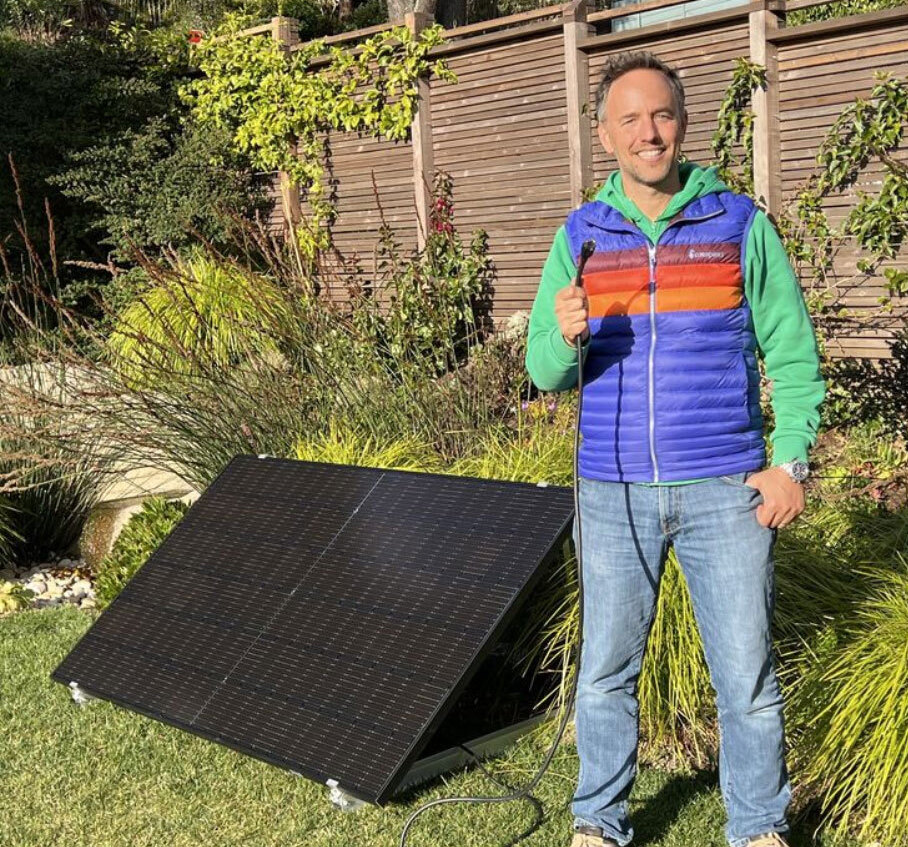
 Rupert Mayer, EMBA 26, cofounded Bright Saver to make backyard solar affordable to renters and homeowners.
Rupert Mayer’s Bay Area house doubles as his playground: a technical lab for testing solar panels of all shapes and sizes.
“I demonstrate them for anyone who wants to stop by,” said Mayer, who is technical director and co-founder of the nonprofit backyard solar startup Bright Saver.
Mayer started Bright Saver last year with fellow entrepreneur Kevin Chou, BS 02, who is founding CEO of the mobile gaming firm Kabam, a former venture investor, a UC Berkeley board trustee, and the namesake for the Haas School’s Chou Hall.
It’s Mayer’s job to perfect products that are being piloted among “solar curious” renters and homeowners across California. There are two offerings so far: a backyard or balcony battery-powered plug-in solar kit that provides renters and homeowners with a low-cost way to generate and store solar energy, and a net metering expansion system for people who are already using rooftop solar to boost their clean energy generation.
We interviewed Mayer, EMBA 26, a successful software entrepreneur, about his midlife career pivot, his passion for the environment, and his surprise decision to apply to the Haas MBA for Executives program.
How did you meet Kevin Chou?
I got to know Kevin through a Climate Vine fellowship. Having just started at Haas, I was very intrigued about working with the guy whose name is on the building in which I was going to class. He’s incredibly smart, incredibly strategic, but also very humble and approachable. Kevin really got me excited about small solar panel systems, which I had not necessarily thought would be the game changer in fighting climate change. He convinced me that there are so many ancillary benefits of getting this technology into consumer’s hands and changing their hearts and minds on renewable energy. I then met Cora Stryker at a Haas admissions panel where I was a speaker and she became our third co-founder. She has a strong nonprofit background and runs our advocacy arm.
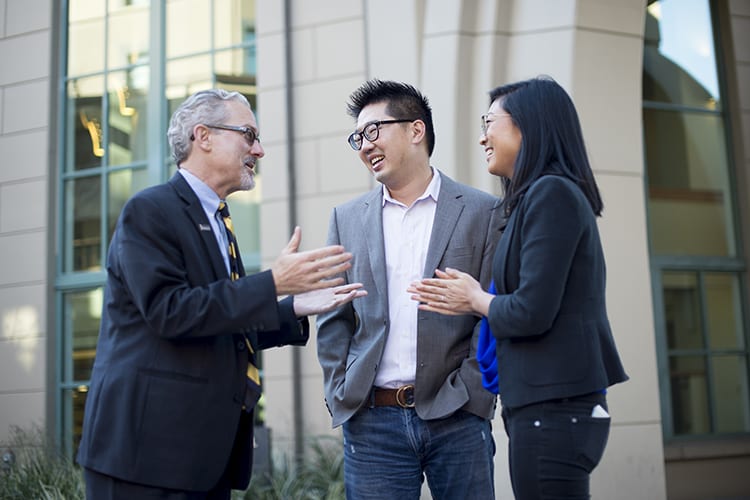 UC Chancellor and former Haas Dean Rich Lyons greets Kevin Chou, BS 02, with UC Chancellor and Connie Chen, naming donors for the Haas school’s new academic building. Mayer cofounded Bright Saver with Chou. Photo by Noah Berger.
Can you tell us a bit about your background?
I grew up in Austria and in Europe, and I always liked building things: sand castles, LEGOs and tree houses. Later, I worked on my bicycles and mopeds and cars. I studied mechanical engineering because I want to turn that into a career of building things. But then, like many people in my generation, I stumbled into software. A lot of opportunities were in software, and I ended up having what I call my first career in software. That brought me from Vienna to Munich, Germany, where I met my wife, and further west to California, where we’ve been for 15 years now.
You had quite a career as an entrepreneur in the intellectual property software space before coming to Haas. How many startups have you been involved in?
I guess this is my fifth now. I’ve always been a startup person… maybe risk-seeking, opportunity-seeking, always wanting to build, being willing to push the envelope a little bit on what’s possible. I stumbled into the intellectual property world by interning at a patent law firm while I was still doing my master’s degree in engineering. That led to making software for running the law firm, which led to making software for the patent departments within companies. I started as a solo entrepreneur and after a couple of years joined forces with a company in Austria that made intellectual property (IP) management software for Europe’s largest companies. After moving to the U.S., I realized no one wanted our somewhat clunky European enterprise software here. So I had to create something new.
What came next?
Cloud computing was the big wave of the 2010’s. So I created IPfolio as a sexier, more modern, cloud-based version of that good old IP management software. It was the right thing at the right time, in the right place, with early adopters like Dropbox, Square, and then GoPro, Tesla, Facebook, Google, Airbnb, Uber becoming our customers. I sold the company in 2019 to a strategic partner, which subsequently got acquired by the market leader, which then merged with a publicly traded company. I went from running a 40-people organization to being part of a 12,000-people global organization in less than two years. After making sure that my product and team ended up in a good place through all that change, I decided it was time to find something new that I would be even more passionate about.
You made a big jump from IP software to climate tech. Why… and how did that happen?
It was very deliberate. I had enjoyed building the software, building the teams, building my skills and reputation, and building these customer relationships. But I was never deeply passionate about the impact of the product I was building. It was ultimately just a piece of enterprise software to optimize some piece of corporate process. So for my second act, I wanted to work on something that I’m truly passionate about.
You already hold a master’s in mechanical engineering. Why did you decide to do an MBA?
There’s this saying among entrepreneurs that entrepreneurship is the real MBA, and that was kind of my mindset. But the more I looked into the program at Haas specifically, I thought, ‘OK, this might actually be exactly the right thing: meeting a lot of interesting new people, expanding my horizon and finding new opportunities.’ I just thought it would be a very interesting and enriching experience. And it certainly has been.
What do you take away from the EMBA program that you apply to your job so far?
The program is about understanding the world better. To me it’s more of an overall experience than some very specific knowledge or formulas that you would apply to solve a specific problem. It’s about opening your eyes to how the world works on many levels and showing you how relationships work. I think I’ve grown in countless ways, such as becoming a better communicator and more empathic leader. And I’ve made amazing lifelong friends.
Can you discuss the challenges Bright Saver faces now, particularly when the U.S. is retreating from climate policy nationally?
To get millions of balconies and backyards outfitted with solar, a lot of regulation has to change. You also need the right products that consumers will actually want to buy at the right price point. Cora (Stryker) took the lead on the advocacy side, getting these laws in motion and partnering with other nonprofits and building coalitions and educating lawmakers. And I’m running the product side. At the moment, that’s a little bit of a gray area, and it’s really a product for early adopters. But once this regulation/deregulation happens, it will become a true consumer mass market product.
A year from now, what would success look like for Bright Saver?
Success will be if this small backyard solar movement starts to gain real momentum. Let’s say 10 or 15 states pass a plug-in solar friendly law, making it simple and straightforward for consumers to buy these devices. The manufacturers of these solar kits, which are almost without exception Chinese companies, start to take the U.S. market seriously and develop products for it. In a year from now, we could see real momentum. We would be trending toward maybe ten thousand plug-in solar kits having been sold and installed nationwide. Squinting at the horizon, 100,000 systems could be sold in 2027.