
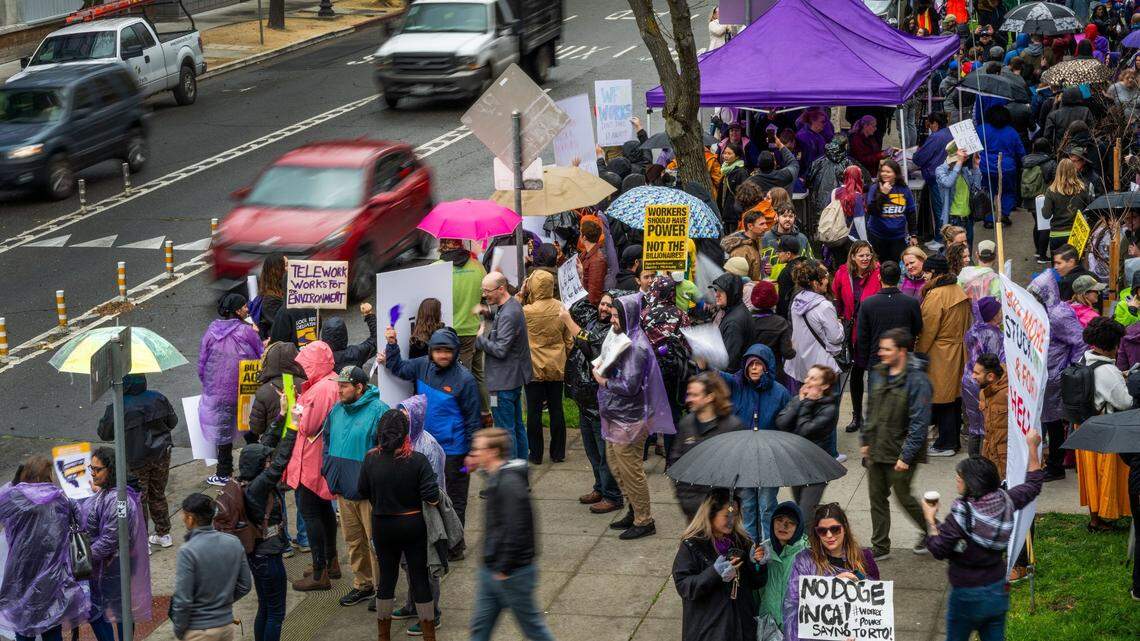
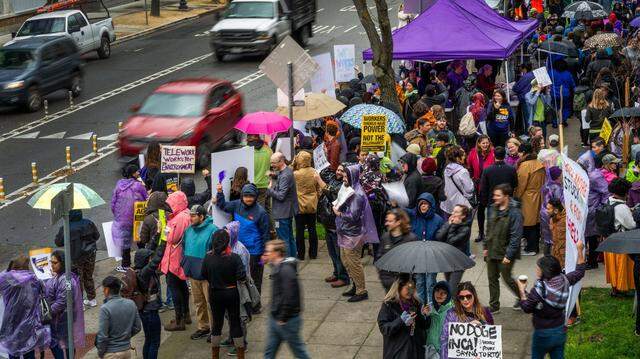
Hundreds of state workers hold signs outside the CalHR offices in Sacramento on Wednesday, March 12, 2025, to protest Gov. Gavin Newsom’s order directing them to return to their offices four days a week.
RENÉE C. BYER
rbyer@sacbee.com
State worker unions are meeting this month with California’s labor negotiators to discuss the impending return-to-office order scheduled to go into effect in July.
Gov. Gavin Newsom’s 2025 directive, which required state employees to work from government offices four days a week, was paused one year as a result of last-minute negotiation. As part of that deal, unions and the state agreed to come back to the bargaining table to meet and confer over the rollout of the return-to-office directive.
One union, the state’s largest representative of government workers, is making significant demands: full-time telework for eligible workers and free parking for employees who are required to be in person.
“The current administration’s attempt to incrementally force civil service workers back into office buildings four days a week after years of successful remote-work arrangements has energized our membership to fight back like no other issue has in recent memory,” Susan Rodriguez, SEIU Local 1000’s chief negotiator, said in a statement.
Angela Musallam, a spokesperson for the California Department of Human Resources, said in a statement that the department does not comment on ongoing negotiations. “CalHR looks forward to bargaining in good faith with SEIU in the weeks ahead,” Musallam said.
For those who the state deems are unable to perform their job fully remotely, SEIU Local 1000 proposed several monetary benefits for employees required to work in person, including a $500 monthly “high-crime worksite” stipend and a $25 daily commuter stipend. The cost of parking, and parking tickets, has long been a frustration for state workers who commute to downtown Sacramento. The state offers parking to a limited number of employees, but those workers have to pay a monthly fee.
The union also proposed a $25 daily “downtown investment” stipend. Last year, Newsom said that part of the reason he was calling state workers back to offices was to support downtown businesses that were suffering from a lack of foot traffic.
SEIU Local 1000’s proposal for fully remote working conditions will likely face an uphill battle with the Newsom administration. The governor has maintained his support of in-person work — which he has said is necessary to improve collaboration and mentorship among state workers — since 2024, when he issued his first return-to-office directive after the COVID-19 pandemic forced many employees to work from home.
Asked about the ambitious nature of SEIU Local 1000’s proposals, Rodriguez said winning a strong agreement depends on member participation and the union has seen momentum from workers on the issue of telework.
“Our focus right now is on negotiating in good faith and using the bargaining process to reach an agreement that works for state workers and the people of California,” Rodriguez said in a statement. “Telework has clear benefits for workers, taxpayers and the state, and that’s why we’re pushing to make those policies stronger and more permanent.”
Last year, unions staged large protests against the directive and sued the Newsom administration over the governor’s executive order. Ultimately, the state delayed the return-to-office for one year in exchange for unions agreeing to a personal leave program that helped California to reduce its compensation costs.
SEIU Local 1000’s proposal would increase those compensation costs if the state agrees to the new in-person work stipends. The union recently began negotiations with the state for a new contract, covering several bargaining units which represent nearly 100,000 California state workers.
This legislative session, unions are also backing a bill that would allow state departments to set individual telework policies, instead of being subject to one directive by the governor’s office. Notably, that legislation does not require agencies to allow fully remote work, instead departments would need to provide explanation for why in-person work is needed.
Related Stories from Sacramento Bee

The Sacramento Bee
William Melhado is the State Worker reporter for The Sacramento Bee’s Capitol Bureau. Previously, he reported from Texas and New Mexico. Before that, he taught high school chemistry in New York and Tanzania.