
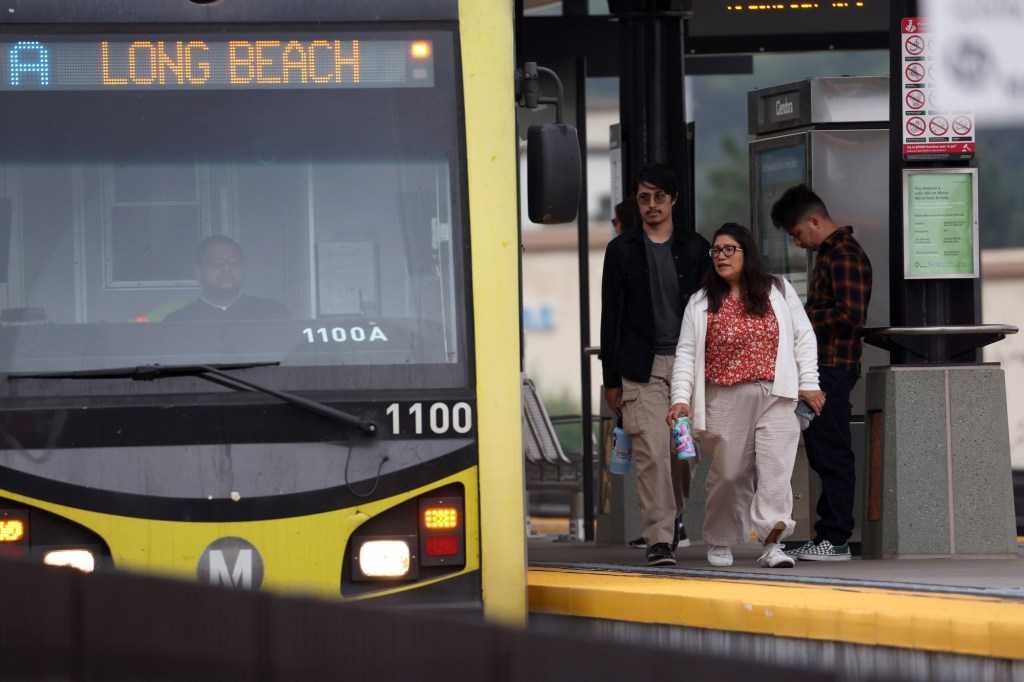
After just four months, figures show the A Line, the latest train line extension in Los Angeles County, experiencing a double-digit ridership bump, with the increase rippling through the 58-mile long line, the longest light-rail line in the world, according to LA Metro.
New statistics released Feb. 26 by the transit agency show daily ridership on the A Line has grown overall by 11.5% in January over last January’s numbers, ever since the 9.1-mile extension opened in eastern LA County on Sept. 19 that added new stations in Glendora, San Dimas, La Verna and Pomona North.
While adding new stations usually adds more riders, the early numbers show the foothill extension ridership is spreading across the lengthy line, which runs from Long Beach to South Los Angeles, into downtown Los Angeles, Chinatown, Northeast LA, Pasadena and the foothill cities of Arcadia, Monrovia, Duarte, Irwindale, Azusa and extends to the eastern terminus in North Pomona.
Daily ridership increased by about 5% from Long Beach to Grand Avenue in DTLA on the A Line southern end as compared to January 2025, said LA Metro CEO Stephanie Wiggins.
In the northern foothill portion, where the light-rail line runs roughly between Chinatown and Pomona, Wiggins reported nearly a 13% increase in January 2026 over last January.
“Meaning, the four new stations are not only new travel markets in eastern LA County, they are also helping increase ridership on other parts of the A Line,” Wiggins said.
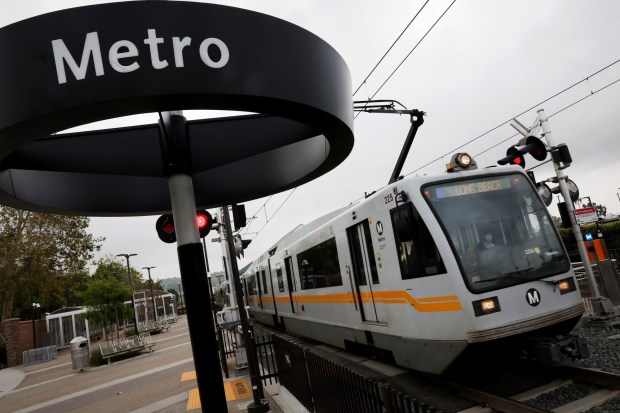 The Metro A Line light-rail leaves the Glendora Station heading westbound in Glendora on Tuesday, March 10, 2026. (Photo by Trevor Stamp, Contributing Photographer)
Glendora Mayor David Fredendall said he’s noticed about 50 to 70 cars parked at the Glendora Station lot every weekday, signaling a good portion of the riders are commuters parking and taking the train southwest toward Long Beach into workplace-heavy spots like Pasadena and Downtown L.A.
“That means primarily commuters,” he said on Monday, March 9. He’s talked to riders who said they are going to workplaces in Arcadia, Pasadena and downtown Los Angeles, where the A Line stops. He also said some commuters get dropped off at the Glendora station.
Glendora resident Sylvia C., who did not give her full name, was waiting for the southwest bound train at the Glendora Station Tuesday morning, after parking her car in the lot. She works for an accounting firm in Pasadena and takes the A Line train to and from her workplace.
“I love it,” she said. “It is stress-free. You just sit and read and in about 20 minutes or so you are at work,” she said.
Another train-riding commuter, Calvin, who did not give his last name, lives in Covina but drives the short distance to the Glendora Station parking lot. Parking costs $3 a day but he pays monthly and gets a discount. The LA Metro base fare is $1.75, with discounts for seniors, disabled, students and low-income riders who can sign up for LA Metro’s LIFE program (Low-Income Fare is Easy).
He works as a chemist analyzing food samples at a laboratory in Pasadena.
“This is my daily commute,” he said at the train platform in Glendora. Before the new stations were built, he’d drive to the APU/Citrus College Station and ride the train from there to his work in Pasadena. Having the station much closer is more convenient, he said.
When people learn he commutes by train, he said they are often jealous. “They say, ‘It must be nice — you ride a train about 30 minutes to work instead of sitting in freeway traffic for an hour.’ “
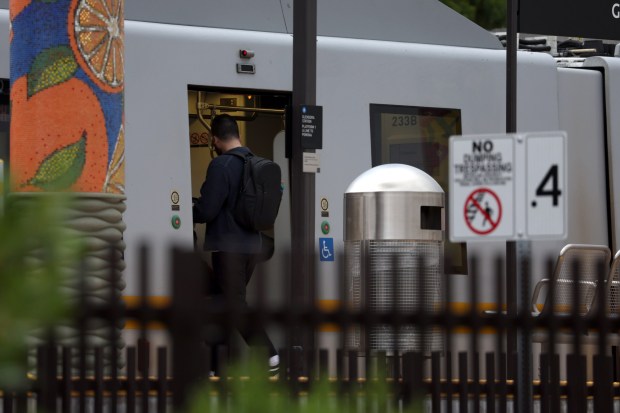 A Metro A Line rider boards the light-rail at the Glendora Station in Glendora on Tuesday, March 10, 2026. (Photo by Trevor Stamp, Contributing Photographer)
Pomona Mayor Tim Sandoval, an LA Metro board member, who has been waiting for the A Line to reach his city for years, noted that the Pomona North A Line Station also has a station for the San Bernardino-to-LA Metrolink heavy rail passenger line. Many take Metrolink from the Inland Empire, then change to the A Line.
“Without question, people who are trying to get to work are utilizing the system,” Sandoval said on Monday. “It is faster than when they were on the 210 Freeway and traffic is backing up.”
Early ridership numbers show the new extension stations have not reached capacity. Both mayors are supportive of a new 909 Open Market which puts on festivals every third Saturday at the Pomona North Station. Last Saturday evening, a 909 Market was held at the Glendora Station.
“I saw hundreds of people there, plus small businesses and a band playing music from the ’80s,” said Sandoval regarding the Pomona event. “It exposes people to the system.”
Getting people to ditch their cars and ride a train goes against the LA-car-centric mode. Just making people aware of the new stations in the eastern LA County suburbs is a tall order. But that may be an easier lift with gas prices rising due to the Iran War.
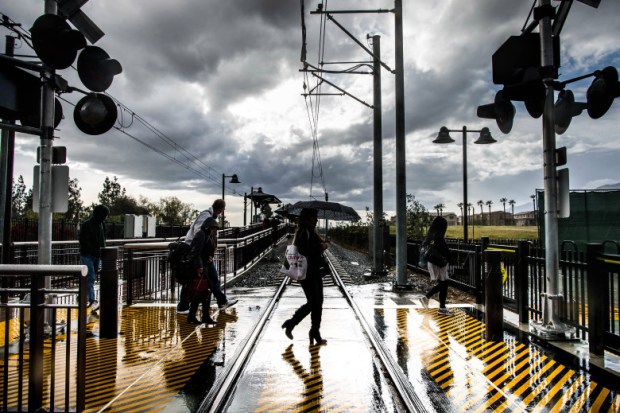 Evening commuters approach to the parking structure after arriving at the APU/Citrus College Gold Line station in Azusa on Monday, March 7, 2016. (Photo by Watchara Phomicinda/ San Gabriel Valley Tribune)
One group that may be using the A Line and new stations more often are students, since the line is described by LA Metro as “rich in colleges.” Taking the A Line, students can reach Pasadena City College, Caltech, Citrus College, Azusa Pacific University, Cal Poly Pomona, Mt. San Antonio College, University of La Verne, Art Center College of Design and the Claremont Colleges. Some require a connecting bus or shuttle, as the line doesn’t directly connect to every college or university listed.
“I know students from Pomona attend Citrus College,” said Sandoval. “Some are attending colleges downtown like USC.”
Fredendall said riders from Glendora also includes students attending classes at Citrus College and PCC.
While neither mayor reports problems with loitering or crime at the two stations, Fredendall has heard reports from some riders that the trains are not always clean.
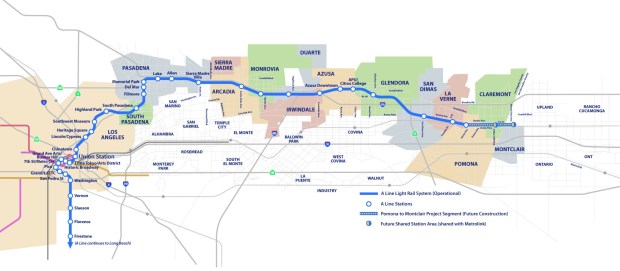 A broad look showing the long, A Line light-rail, including the future station in Claremont, on the eastern edge of Los Angeles County. (image courtesy of the Foothill Gold Line Construction Authority).
Wiggins said LA Metro has responded by adding more cleaning crews at the line’s midpoint at Union Station in L.A. “During the stop at Union Station, service attendants sweep trash and mop up spills,” she said. Wiggins reported on the L.A. portion of the line from Pico Station to Highland Park Station, reports to staff or on their transit watch app of dirty train cars have dropped 63%.
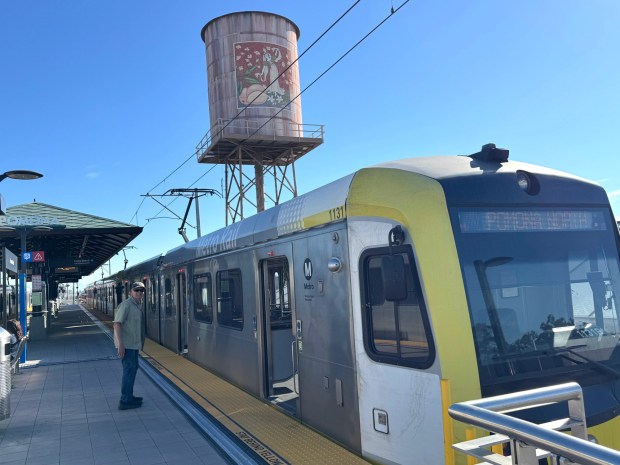 A Line light rail now runs between Pomona and Long Beach after the service was extended through Glendora, San Dimas, La Verne and Pomona last fall. Here a train awaits passengers on Monday morning at the Pomona North station. (Photo by David Allen, Inland Valley Daily Bulletin/SCNG)
The Pomona North Station has a feature that requires riders to tap as you board, but also as you leave the platform. The tap-to-exit program usually requires Metro Transit Officers to hand out citations for those who can’t exit because they never tapped or paid to enter.
Fredendall wants to see that activated at the Glendora Station.
City managers from Glendora, San Dimas, Pomona and La Verne are discussing the issues with Metro. Sandoval said studies are being conducted on the need for tap-to-exit at these stations. He also said there is an added cost.
The program aims to stop riders, often homeless or drug users, from riding the trains without paying and either sleeping on the trains or committing crimes. “A less than quality ridership comes from people getting on at 4 a.m. and homesteading it the whole day,” he said.
At the San Dimas Station Tuesday, a man with a satchel of snacks and lunchable boxes was handing out some to riders; he said they were gratis. But when an L.A. County Sheriff deputy asked him to drop the large bag, he refused, saying he had done nothing wrong. He was handcuffed and placed into a squad car.
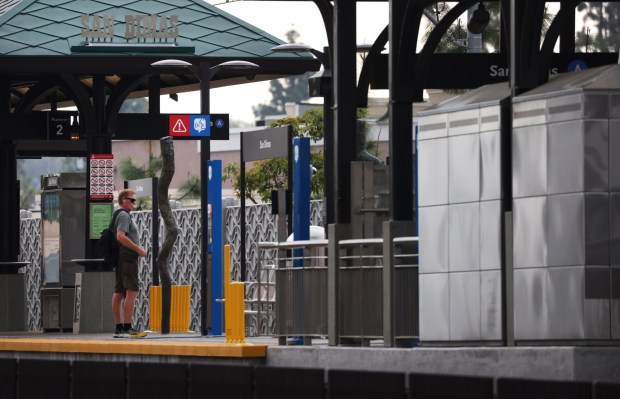 A Metro A Line rider waits to board the light-rail at the San Dimas station in San Dimas on Tuesday, March 10, 2026. (Photo by Trevor Stamp, Contributing Photographer)
Calvin, the regular A Line rider, said he believes the safety and cleanliness of trains have improved in the past year or so.
“I tell people I don’t think they should be scared of riding public transportation,” he said. He does come across what appears to be unhoused people on the trains or platforms. “The general consensus is if they don’t bother me, I don’t bother them,” he said.
He uses the Metro Transit Watch App to report any incident. One time he reported a problem to a Metro Transit Security Officer.
Fredendall said Glendorans are still getting used to the traffic signals and at-grade crossing gates when the train comes by. He said Metro has adjusted traffic signals whenever there was a problem. Glendora’s last passenger train left the city 74 years ago — that was the defunct Pacific Electric Railway or “Red Cars.”
What does he think of the newest electric-powered passenger train in his city?
“So far, it is a positive,” Fredendall said.