
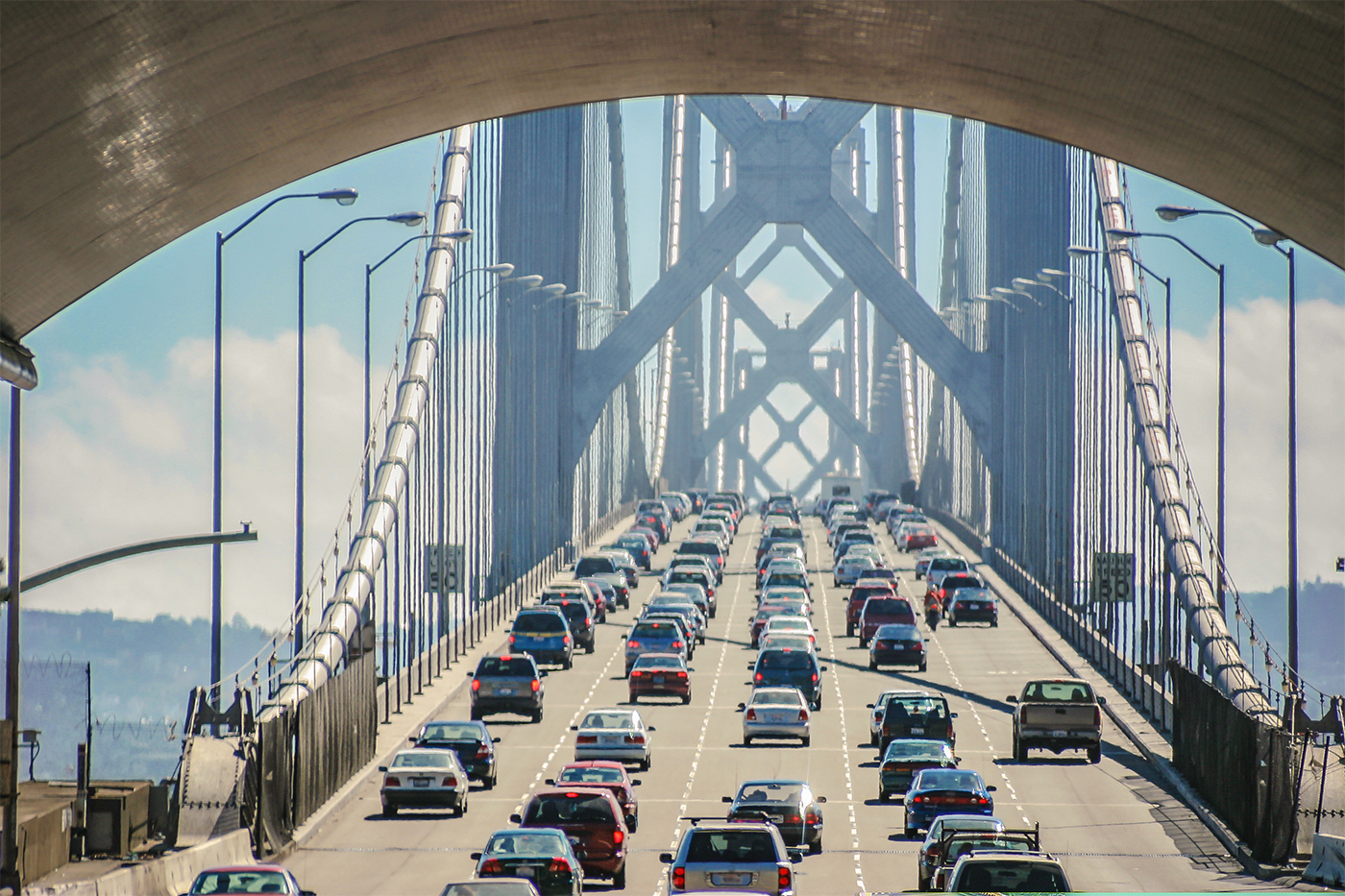
When California passed landmark climate legislation in 2008 to tackle climate change by targeting the way its residents drive and use other forms of transportation, it was the most ambitious such plan in the country.
In the nearly two decades since the Sustainable Communities and Climate Protection Act was passed, researchers, policymakers and others have been able to draw many lessons from what hasn’t worked, such as an increasing number of people driving and creating more pollution, but also what might be worth emulating in other parts of the country.
New research from Northeastern University studies how state, regional and local officials in California work together toward emissions and other climate-focused targets. The research concludes that ambitious climate goals alone are not enough to reduce traffic-related emissions, and better collaboration between different levels of government is essential to reduce pollution.
Serena Alexander, an associate professor of public policy and urban affairs as well as civil and environmental engineering who co-authored the study, says that “California is a good example because it represents one of the most ambitious multi-level climate governance experiments” in the US, especially when it comes to traffic mitigation to reduce greenhouse gases.
 01/23/24 – BOSTON, MA. – Serena Alexander, associate professor with a joint appointment in the schools of Civil and Environmental Engineering and Public Policy and Urban Affairs, poses for a portrait on Jan. 23, 2024. Photo by Matthew Modoono/Northeastern University
Specifically, the study analyzed five regional metropolitan areas made up of 25 local communities — five per regional area, to explore the kinds of collaboration at play between organizations of different scales, between the local communities and the regional planning bodies.
The MPOs make up one of three levels of political decision-making, Alexander says, with the state, which sets the broadest action plans and goals, and local communities, which include cities and towns of every size, making up the other two decision-making entities. Ideally, all three levels interact with each other toward shared goals.
But given differences between metropolitan areas — and their corresponding planning organizations — this collaboration is not always smooth or possible. Alexander says that during the team’s research, several barriers appeared that inhibited collaboration between the regional planning bodies and the local cities and towns.
As an example, Southern California’s MPO contains just one massive city: Los Angeles. The city houses nearly 4 million people while dozens of smaller communities depend on the city for funding. These smaller communities also, however, maintain their own autonomy from their huge neighbor, occasionally making it difficult for officials in L.A. to coordinate with those in the surrounding communities.
In contrast, the Bay Area group has three very large cities — Oakland, San Francisco and San Jose — that have managed to work in concert with one another to develop interlocking traffic reduction strategies. In that region, Alexander notes, it has been easier to create strategies that cross municipal boundaries because the three large cities largely work in concert and provide a model for other, smaller communities to follow.
When the team dug deeper into the five regional areas of their study, they found that perhaps the biggest block is the fact that while regional plans are often sweeping and provide large-scale goals, those regions can’t enforce the cooperation of local communities, Alexander says. If a suburb doesn’t want to participate in the wider region’s program, it doesn’t have to. She notes that the state and regional planning groups can do little more than provide incentives.
That said, local community plans can sometimes be more ambitious than the regional plans. Local governments can better tailor their plans to their community, Alexander says. While the wider regions develop plans around “things like modeling, forecasting, sharing best practices, focusing on big infrastructure investment,” local communities are the ones ultimately putting the work into practice, she says.
For instance,the city of Santa Monica, in the Southern California region, has created dynamic parking rates “to reshape how residents and developers think about driving,” while Fremont, in the Bay Area, incorporated electric vehicle chargers into its zoning codes, according to the study.
Another barrier that emerged was that while regional plans often provide technical models and multi-year infrastructure improvements, local-level governments often operate on shorter timelines due to shorter political cycles and the shifting, immediate concerns of their constituency.
But there aren’t only obstacles, Alexander says. She and her co-author also identified some of the strategies that have been successful within California’s five metropolitan regions. Things work best, she says, when the regional planners and local communities double down on what they’re best at, like managing data, providing an all-encompassing climate action vision “and making sure that the smaller jurisdictions within the region have the capacity, have the know-how, to actually develop and implement climate action plans.”
Smaller communities especially need this additional support from the larger regional bodies, she says, which can come in the form of funding, incentives or simply aid in developing local implementation strategies.
All of this complexity plays into the necessity for regional coordination. For instance, Alexander notes, “you can’t plan for transit locally.” Because public transit crosses municipal borders, those cities have to cooperate. Regional planning that wants to create large public transit corridors needs to accommodate a diverse array of local groups’ interests.
“I think the most important take away is that decarbonizing transportation requires both coordination and autonomy and innovation,” but no one single strategy will provide a silver bullet, Alexander says. Neither bike lanes, electric vehicles or increased walking paths necessarily mean a reduction in traffic and greenhouse gases. It’s the alignment of all these efforts, she says, that could really drive transformative change.
Noah Lloyd is the assistant editor for research at Northeastern Global News and NGN Research. Email him at n.lloyd@northeastern.edu. Follow him on X/Twitter at @noahghola.