
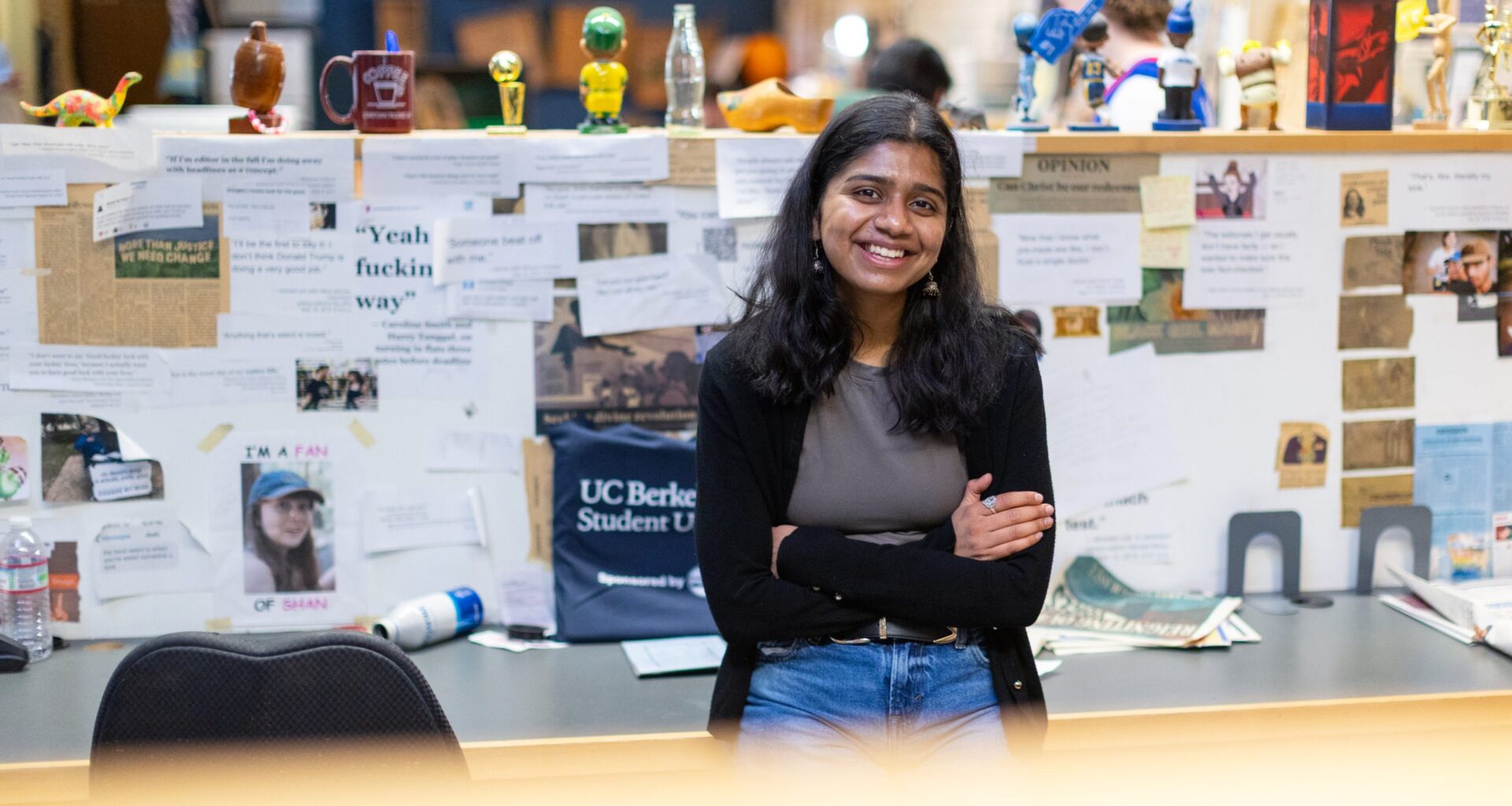
 Ananya Rupanagunta, editor-in-chief of The Daily Californian, poses for a portrait at The Daily Cal’s office on Friday, March 6, 2026. Credit: Estefany Gonzalez for Berkeleyside
Scrolling through Instagram last fall, a reporter for UC Berkeley’s student newspaper, The Daily Californian, noticed something interesting. Some members of the campus community had received letters indicating the university had released their personal information to the Trump administration as part of federal investigations into alleged campus antisemitism, according to a student organization’s post. The paper dug deeper, and published a story reporting that about 160 students, faculty and alumni had been affected.
Local and national media outlets followed the story, touching off one of the biggest controversies at UC Berkeley since Trump took office for the second time. It was a major scoop, but it was also just another day in the life of a newspaper that has long been a powerhouse among student news outlets.
Unlike some student newspapers, the Daily Cal is financially and editorially independent from both the campus and student government. It officially separated from the university in 1971, after administrators fired three of its editors over an editorial inviting readers to protest at People’s Park. It’s also old-school, continuing to publish a weekly print edition while many student publications have either gone fully digital or relegated print to occasional special issues.
Over its 150-plus-year history, the Daily Cal has sometimes found itself at the center of the news itself. In the late 1990s, someone stole more than 20,000 copies of the paper from newsracks after the editorial board endorsed Proposition 209, the ballot measure that ended affirmative action at California’s public colleges. A few years later, the then-newly-elected Berkeley mayor Tom Bates paid a $100 fine after admitting that he trashed copies of an edition that had endorsed his opponent.
This school year, the Daily Cal has faced perhaps one of its biggest challenges yet — how to cover a campus that finds itself in the crosshairs of a Trump administration eager to reshape higher education according to its political ideology.
Since May 2025, the paper’s editor-in-chief has been senior Ananya Rupanagunta, a somewhat-accidental journalist who plans to attend medical school after graduation. Rupanagunta and the paper’s 400 student staffers — about half of whom are reporters — have been scrambling to understand the implications of the investigations and lawsuits unfolding at the federal level, while keeping up with the normal drumbeat of new research and curriculum, campus protests, sports and cultural events. In the process, they have broken several important stories, helping to shape the national conversation about one of the country’s most prestigious universities.
While other publications — including Berkeleyside — also cover UC Berkeley, the Daily Cal leverages its army of undergraduate reporters to provide more frequent and often in-depth coverage of issues especially relevant to a student audience. Besides covering campus, it assigns reporters to city government and areas, such as the debate over student housing at People’s Park, where the two intersect.
This spring, the paper is campaigning for an April referendum that would extend for another five years the student fee that provides the bulk of its roughly $500,000 annual budget, increasing it slightly to $8.50 per semester beginning in 2027. (The paper also earns advertising income, and shares rent-free office space with the Investigative Reporting Program at UC Berkeley in a building purchased with a gift from an alumna.) Rupanagunta says the paper would likely have to make major cuts — including potentially ceasing its print edition and not being able to pay staff — if Cal students don’t vote to approve the fee.
In a sign of the complex campus politics that reporters must navigate, when Rupanagunta presented the proposal at a student senate meeting last week, students responded with both praise for the paper’s role in elevating marginalized voices and criticism for a commentary piece about Iran that had dismayed some Iranian students.
Berkeleyside spoke with Rupanagunta last week about steering the Daily Cal through a tumultuous time. Her comments have been lightly edited for length and clarity.
How did you decide to become a student journalist?
The Daily Cal has a high school summer internship program. I knew I was going to come to Berkeley anyway, so I was like, might as well do something fun. I actually was not that committed to staying at the Daily Cal for as long as I have. I studied neuroscience and history and I’m planning to go to medical school after. So this was sort of, like, totally out of my ballpark. [But] Roe v. Wade got overturned and there was just a lot going on and I was feeling really frustrated.And so I applied to the news department [and] after that [as an undergraduate], I moved up into the editor- level positions in the news department. And, you know, it’s just been like a really quiet time for higher education, right? [Laughs]
What’s been the most challenging thing about leading the newsroom this year?
A lot of students don’t want to speak on the record because they fear retaliation. We want to hear from international students, for example, about how all these intimidation tactics have affected them, but then they don’t want to have their name on our socials and on the public record because then what if they get their visa revoked?
How do you handle that?
We want to hear student voices. And so, part of allowing that to happen is being a little bit more lenient when it comes to offering anonymity.
One of the most important things about student newsrooms that make them unique to other local newsrooms is the fact that we are also students, and I think we know the politics of our campus, we know what our student body cares about, and how to navigate that and talk to student leaders and organizations. And being part of that community allows us to find people who can talk about their experience.
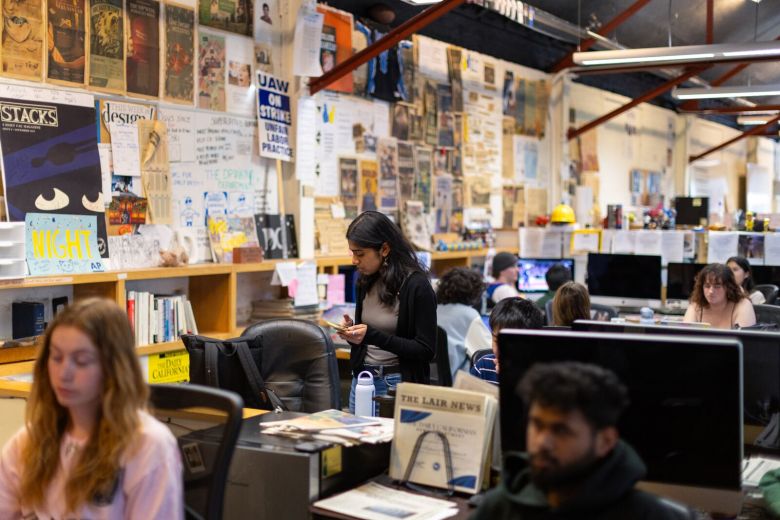 Members of the student-run newspaper The Daily Californian co-work at the newspaper’s office on Friday, March 6, 2026. Credit: Estefany Gonzalez for Berkeleyside
How much do you think the campus climate around free speech has changed over the last couple years?
For certain communities, there’s always been a kind of hesitancy to talk to the press. I think it’s just definitely increased and become more obvious in the post-Trump era.
I think a lot changed after the spring pro-Palestinian [protest] encampments [in 2024] because of this sort of direct student retaliation that was happening. You’d see headlines of these students being targeted, and then as a student, that makes you obviously think about whether you should be speaking up about issues you care about.
That being said, though, it’s never an impossibility. We still have a lot of student organizations who are speaking up and they put public statements on Instagram, which we can draw from if nobody wants to speak as an individual.
[Speaking] as a student, as opposed to [as] a journalist, people are talking more honestly, people are angry with Trump, and more involved in politics now than I remember in my classes and discussions in the past.
So am I hearing you right that you think there’s maybe more reluctance for people to comment and be named on the record, but that overall, there’s actually more of an interest in politics and activism?
Yeah. There is a lot of anger about what’s happening. And so people are wanting to talk about it, do something about it. But whether that means commenting on the public record is, I think, difficult.
Someone had mentioned to me that the Daily Cal had increased concerns about the safety of its staff, or that you were getting more angry messages these days.
I feel like we’ve always been getting angry messages. Before, you know, the spring encampments, there was this whole concern about doxxing in which there were trucks driving around Berkeley with names of [pro-Palestinian] students. And so we were covering that. And obviously, because of the sensitivity of that issue, we got a lot of blowback.
And I think that’s kind of the nature of news. You’re always going to get people who disagree or think that the coverage could be better. And my personal opinion is that’s how it should be. There’s no such thing as absolute truth. I think we’re all kidding ourselves as journalists if we think that. And I think the reasons why things like op-eds and letters to the editor exist in the first place is to be like, you can disagree with our coverage and that is okay. Like, that is part of free speech and free press in the first place, right?
If nobody’s pissed off, you’re not doing your job as a journalist.
100%. It’s just about making sure that we’re sticking to producing factual news. That’s the mission. The mission is not to make everybody happy.
During your tenure as editor-in-chief, the Daily Cal broke the story of UC Berkeley’s administration sharing personal information about people named in campus antisemitism investigations with the Trump administration. What other stories has the paper done this year that you’re especially proud of?
Another thing I’m really proud of is how we covered the Turning Point USA protests at Berkeley. It was such a big deal for UC Berkeley to host Turning Point, so going into it we were really intentional with how we wanted to cover it. We did a full before, during, and after of what was going on at the event itself and the protest [outside]. Because we’re a student paper, this is a big deal, it’s the central news for us as opposed to just peripheral news for an outlet like the San Francisco Chronicle. We put a lot of work into it to make sure we were getting all angles, that we were able to get photos and videos as well as written content.
There’s a lot that’s challenging with covering protests. You have to keep in mind the safety of reporters and make sure we’re able to get all events accurately. We send a team of reporters so they can share the work. We make sure their press passes are clear and visible and that they know their rights as journalists.
We have a really strong data and investigative team and they’ve done some really cool projects over the last year. They traced Wikipedia article edits relating to UC and UC Berkeley. That’s an example of a really cool investigative story into something that’s incredibly niche.
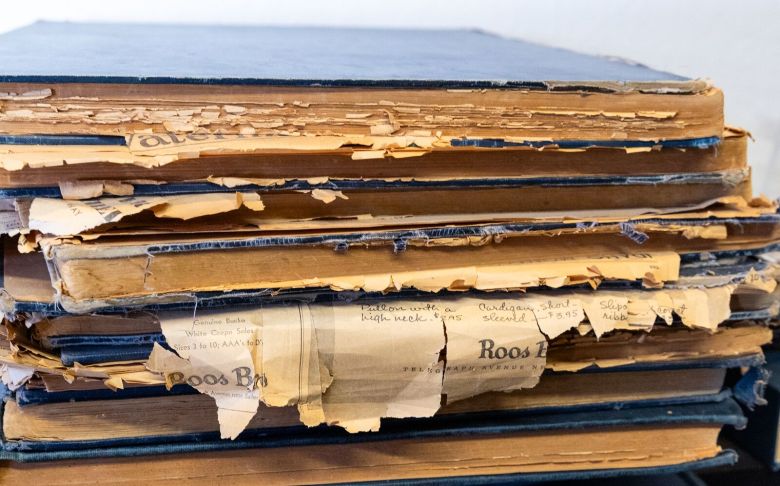 A stack of archival copies of The Daily Californian from the 1920’s are kept at newspaper’s office. Credit: Estefany Gonzalez for Berkeleyside
What’s your relationship like with the UC Berkeley administration? Are they responsive to you? Do you feel like they respect you as a news outlet?
At the end of the day, the spokespeople are doing their job and we are doing ours and sometimes that leads to a little bit of conflict. But I think that there is a common understanding that their job is to be cagey and protective of the university, and then our job is to probe. And I think that allows us to have a good, consistent relationship with them.
You guys are different from some of the other student papers that take money directly from either the student government or the university.
I think financial independence is becoming more of a trend. [It’s] important for us to not have to rely on the UC because if they decide that there needs to be some kind of cut in funding, then that means we have to compromise our staff and our coverage and I don’t want that to ever happen. The [UCLA] Daily Bruin is independent from their university as well. So, yeah, there are papers that are still reliant on their universities. Over the next couple of years, I personally foresee that changing.
The Daily Cal has a race and equity editor, which not every student newspaper has. You held that position before becoming editor-in-chief. Can you talk a little bit about the importance of that position, and how it came about?
One of the great benefits of being a student journalist is that we are part of the community, but on that same note, if you don’t have journalists that come out of marginalized communities, then your coverage of those communities, in my opinion, is always going to be somewhat incomplete. And I think that was the goal of creating a manager-level position to see how we can address this gap in our content and then also in our hiring.
My main goal with that was, how can we make journalism more accessible? So we started a DeCal, essentially a student-run class [led by Daily Cal journalists]. And the goal was for it to be an entry point for people who don’t have journalism experience. Because what we noticed in our hiring cycles is that we oftentimes get a lot of people who’ve been, you know, editors on their high-school papers. And so the goal was like, how can we open this opportunity up to people who don’t have any experience and still have them come in and look at the Daily Cal as a training ground for anybody who wants to go into the field?
The Daily Cal has a reputation as being an especially strong student paper journalistically. What do you think makes the difference?
[Our staff], they’re just incredibly scrappy and willing to sit, like, 45 to 50 hours per week in the newsroom, trying to uncover shit and file a thousand [public records requests] and do the really dirty work. I’m almost never the last person to leave the office. Like, everybody is just so into this. And they’re so committed to making sure that we’re able to push out important news and hold our school accountable, that I think that’s kind of the fuel that runs the paper.
Is there anything during your time at the paper where you feel like, “Oh, we really missed the mark on this. I wish we had handled this better as a paper”?
The unfortunate thing about working in a time of intimidation is we’ve been struggling to get op eds and community submissions. It’s a difficult problem to tackle, and I think we have to figure out a way to do that, and we haven’t necessarily done that yet.
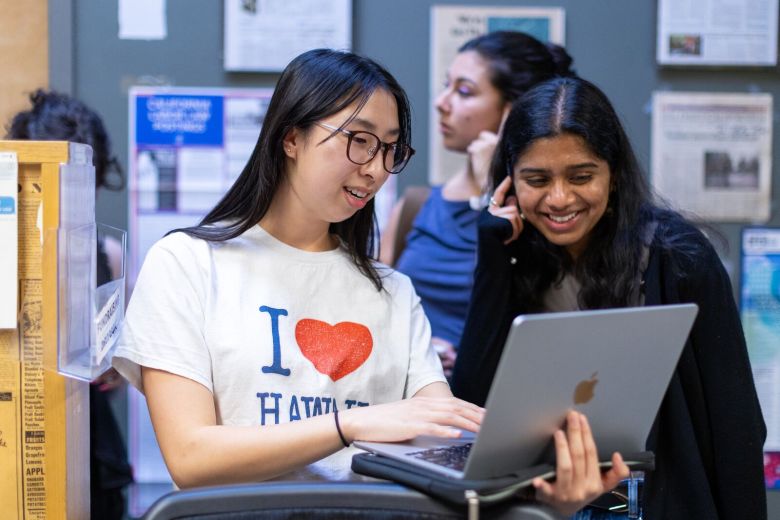 Daily Californian Opinion Editor Josalyn Hung, left, and Editor-in-Chief Ananya Rupanagunta work together on a project at The Daily Californian office on Friday, March 6, 2026. Credit: Estefany Gonzalez for Berkeleyside
If somebody said, here’s a million additional dollars for your newsroom budget, what would you do that you don’t currently have the resources to do?
I think growing investigations, being able to put more money into the creative departments. And then equipment — sorry, these are boring answers! At the end of the day, that’s the stuff that makes our reporters passionate to do their work.
We used to print every day and then it came down to four days and then it’s come down to one day. And while it is true that print isn’t the way that a lot of people consume news, I think there’s still something to be said about the value of having a physical public record. And so making sure that we’re able to sustain and grow our print distribution would also be a priority.
We’re all students, so at the end of the day, most people here see this as something that they’re incredibly passionate about – we’re not doing it for the money at all. But still being able to support and compensate staffers is something that I would like to see us able to do. We have editorial scholarships for staffers, who on a need basis can apply. If we expect people to put in these hours, and obviously they want to, but they also need to eat food and pay their bills, then we become not an option for them. So it’s definitely an equity issue.
In the course of all this time at the Daily Cal, have you rethought your medical school decision? Have you ever thought, I want to be a journalist instead? Or are you like, no, peace out, I’m going to be a doctor?
I’m still planning to go to medical school, but I do think I want to continue writing, you know, medical journalism. I think the medical system in the U.S. is incredibly flawed. So there’s a lot of room for accountability journalism in medicine. Something that personally I’m passionate about is physician advocacy — how do you practice medicine, but also stand up for your patients and communities that are grossly underserved in the healthcare system?
I think international events right now are a great example of why public health reporting is really important. How do you measure things like the effects of war on a population and the destruction of healthcare infrastructure? It’s really important to have professionals on the ground talking about what happens when you wipe out hospitals and what that can lead to for the long-term health of a population.
What’s the pitch you want to make to students about why they should support a fee to fund the newspaper?
Number one, we need it to exist as a student paper. We’re one of a few papers, on the West Coast at least, that still prints once a week and all our special issues. We launched a magazine as well, and also make sure that we can publish stuff daily on our website. So operationally, it’s incredibly important for us to live.
And why we should live is because of what we’ve seen in the post-Trump era, that having journalists who are students, who know their campus and know their communities is incredibly important to making sure people get information. They understand the impact of something that’s happening on the federal level in their lives. I think we can all agree that news is important, that information is important and people should know what’s happening around them. And I really hope that the UC Berkeley students see that and support us.
Berkeleyside partners with the nonprofit newsroom Open Campus on higher education coverage.
Related stories
“*” indicates required fields