
Last fall, the city council unanimously approved a new contract with San José’s police union with wage increases of 7%, 5% and 3%, which will cost an estimated $14.3 million in the upcoming fiscal year, according to the city’s director of human resources.
The forecast also pointed to the cost of the city’s interim housing program, which has rapidly expanded during Mahan’s time as mayor to include nearly 2,200 shelter spots across a network of tiny homes, converted motels and RV parking lots.
The vast majority of interim housing costs are covered using money in a voter-approved homeless fund — the result of previous budget debates during Mahan’s tenure. But operating costs for the shelters are currently projected to outstrip that Measure E funding, requiring a projected $15 million infusion from the general fund in the upcoming budget year and $29 million in 2027-28.
“We have essentially shifted all of that money to [interim housing], and it is still not enough,” Councilmember Pamela Campos said in an interview. “It is unsustainable to be addressing our homelessness crisis at a level that is so focused on one faction of the issue.”
Mahan has described those forecasts as “pessimistic” and is promising to drive down interim housing costs by re-bidding contracts, obtaining funding from the state government and Santa Clara County and exploring the idea of charging interim housing residents a fee for their stay or having them assume maintenance tasks at the properties.
“As we complete this phase of shelter expansion, we are shifting focus to system optimization: building on our progress by lowering operating costs without compromising outcomes,” Mahan wrote.
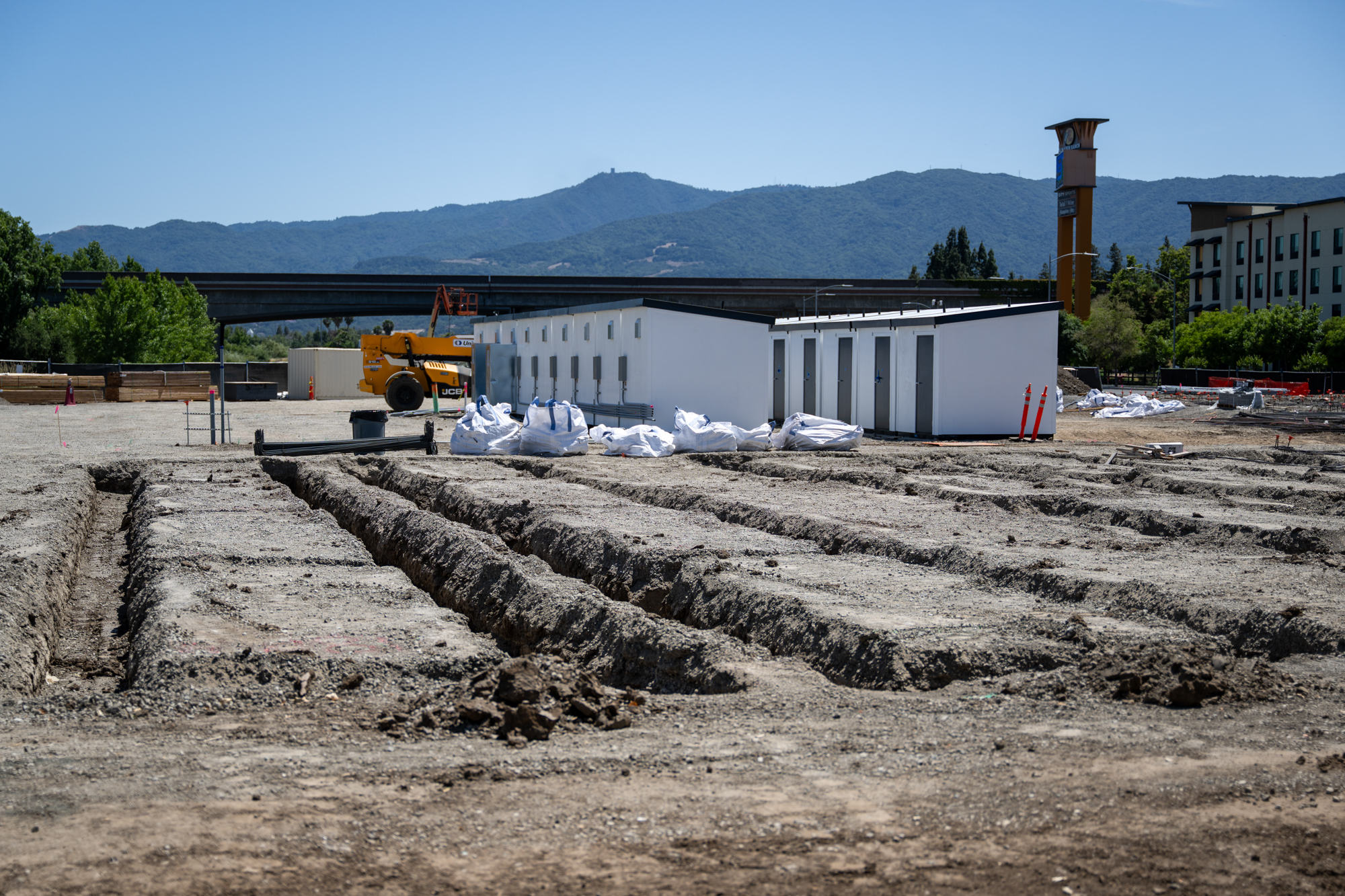 An interim housing site is built near an unhoused community along the Guadalupe River in San José on May 29, 2025. (Beth LaBerge/KQED)
City budget analysts are projecting that this year’s shortfall will be followed by smaller deficits of $26.8 million in 2027-28 and $11.8 million in 2028-29, before expected surpluses at the end of the decade.
Retirement costs, the subject of bitter political fights last decade, are expected to decrease in future budget years — from $405.1 million in 2026-27 to $382.6 million in 2030-31.
Still, labor relations remain a volatile political issue in California’s third-largest city.