
The old axiom holds that “power corrupts and absolute power corrupts absolutely.”
Indeed, history is awash with once-humble figures who became tyrants once given the slightest control over others. Yet, there’s a strong counter-argument that power doesn’t corrupt a person, but merely lays bare their ethics or lack thereof.
Does status bankrupt someone of morals, or is it merely a tool for someone whose moral compass is already set?
Bay Area playwright Patricia Milton’s answer to that may fall somewhere in the middle. In fact,
one could argue that her new play “After Happy,” being presented through March 29 by Central Works in Berkeley, almost borders on pure fantasy in its depiction of ethical oligarchs.
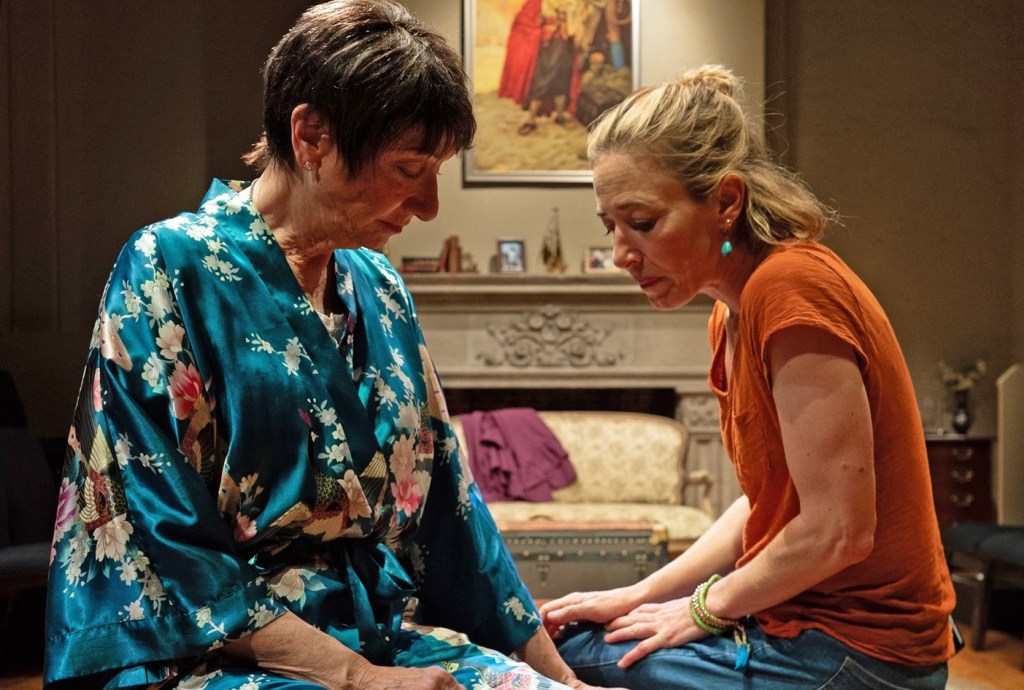
Her story drops us into a posh mansion in Lake Charles, Louisiana, where we meet pirate aficionado Brenda Barrow (Jan Zvaifler). Her passion is apparent through several tiny pirate ships around the room, the massive oil painting above the hearth, and Brenda’s first appearance being a panicked phone call about the annual Lake Charles Pirate Festival. She’s frantic because the
festival has just lost its Pirate Queen to illness. Brenda’s family founded the Noble Oil
Company, which affords them the luxury of financing a frivolous tribute to high-seas criminals
each year.
She’s soon joined by a would-be intruder, revealed to be her tree-hugging niece Katherine
Freeport (Lauren Dunagan). Katherine was once part of the family business before denouncing
her work and dedicating her life to environmentalism. This hasn’t exactly endeared her to
Brenda, especially since the last time the two spoke was when Katherine needed $26,000 in bail
money.
Dirty and tired, Katherine asks to stay the night since Brenda’s husband, Will, is away in Liberia
trying to influence government officials. The “family-first” Brenda can’t bear to turn away a
blood relation, so she agrees to put Katherine up for the night. Except that Katherine’s intentions
aren’t so cut-and-dry, something that becomes all the more apparent with the arrival of Steph
(Rezan Asfaw), an extremist comrade in Katherine’s pro-climate group. The two have until
sunrise to convince Brenda to make a radical change for the sake of saving the world. Brenda has
just as long to convince one of them to fit into the Pirate Queen costume.
The biggest strength of Milton’s script is the way it provides each character ample time to speak
without automatically making them right: Brenda sincerely believes Noble’s “carbon-offset”
program somehow makes up for the environmental devastation they wreak every year. Katherine
professes shame at her family and former employers, but their blood money has paid for her
boldest pro-climate ventures. And Steph — who may or may not carry a Glock in her backpack — is quick to jump to last resorts as she throws judgement at reckless oligarchs.
It gives the trio moral gray areas that feel realistic, with straw-people arguments only brought up to be emphasized as such. Also helping is dialogue that’s both funny (like the unprintable new name for Katherine and Steph’s group) and timely (“You know who the government calls a terrorist? Anyone they shoot at a protest.”). The play remains satirical without falling too far into farce.
The least-realistic part may be the ending, since it’s hard to believe one particular character could so fundamentally change after one loquacious night.
As helmed by company co-codirector Gary Graves, “After Happy” is exemplary of Central Works’ MO — doing a lot with only a little. Their intimate performance space in the Berkeley City
Club turns every production into a chamber play, yet “After Happy” feels grand in the way one
feels the characters’ pressing issues at play. Though not all the characters are given the most to do (Steph feels the least-developed of the trio), Graves keeps the audience’s attention sharp as he moves the performers around the confined space.
The play may not end on the most realistic note, but perhaps it’s Milton using her power to shape
the conclusion she wanted rather than one most likely to happen. It is a satire, after all.
Charles Lewis III claims to be an award-nominated journalist, culture critic, and performing artist born and raised in San Francisco. He alleges to have been published in the San Francisco Chronicle, KQED, the San Francisco Examiner, and many more. Dodgy evidence of this can be found at The Thinking Man’s Idiot.
‘AFTER HAPPY’
By Patricia Milton, presented by Central Works
Through: March 29
Where: Berkeley City Club, 2315 Durant Ave, Berkeley
Running time: 70 minutes, no intermission
Tickets: $35-$45; centralworks.org