
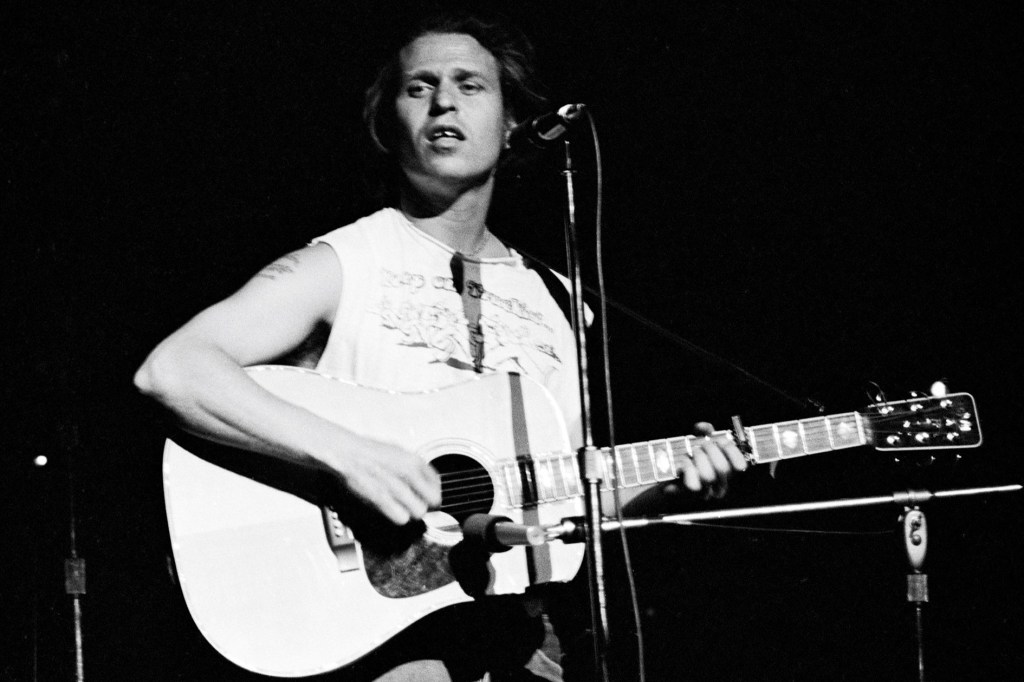
I was planning to write about something else today, but Joe McDonald died on Saturday, and, as Arthur Miller wrote, attention must be paid.
You probably knew him as Country Joe, the co-founder and lead singer of the iconic 1960s psychedelic band Country Joe and the Fish. He had lived in Berkeley since the early ’60s (and lived until his death), when he was a busker on Telegraph Avenue. He later became involved with UC Berkeley’s Free Speech Movement, and at about this time founded the Fish with guitarist Barry Melton.
They played their first gig in a chemistry lab on the Cal campus, along with poet Allen Ginsberg and The Fugs. As the decade wore on, they played alongside a who’s-who of the 1960s counterculture: the Grateful Dead, Jefferson Airplane, Jimi Hendrix, Canned Heat, Moby Grape, the Doors, Howlin’ Wolf, Richie Havens, Sam & Dave and poets/novelists Richard Brautigan and Kenneth Patchen.
They played at the first Human Be-In at San Francisco’s Golden Gate Park Polo Fields; the city’s Fillmore and former Avalon and Winterland ballrooms; the 1967 Monterey Pop Festival, and, of course, the iconic 1969 Woodstock music festival.
Joe’s most famous song was “I-Feel-Like-I’m-Fixin’-To-Die Rag,” an antiwar ditty that was especially popular among American troops in Vietnam, who loved to sing its refrain, “And it’s one, two, three/What are we fighting for?/Don’t ask me, I don’t give a damn/Next stop is Vietnam/And it’s five, six, seven/Open up the pearly gates/Well, there ain’t no time to wonder why/Whoopee! we’re all gonna die!”
He told the New York Times, “I was inspired to write a song about how soldiers have no choice in the matter but to follow orders, but with the irreverence of rock n’ roll. It was essentially punk rock before punk existed.”
Though he was a fierce critic of the Vietnam War, he spent three years after high school in the U.S. Navy himself and said he never thought of our service members as villains. To him, they were victims of the war too, and he spent the rest of his life fighting for their rights, especially the struggle to get the Pentagon to admit the connection between cancer and Agent Orange.
In later years, he led the successful effort to create the Vietnam Veterans Memorial in Berkeley and helped establish the Vietnam Veterans Memorial in San Francisco, as well as serving on city commissions on issues affecting veterans.
He performed at countless GI coffeehouses and commemorative events and benefits across the country for Swords to Ploughshares and Vietnam Veterans Against the War and at ceremonies at the Vietnam Veterans Memorial in Washington, D.C.
He had harsh words for old people who send young people off to war, including Lyndon Johnson and Richard Nixon (which earned him a spot on Nixon’s enemies list), but he was even harder on himself — for instance, my favorite of all his songs, “Who Am I?” which had a beautiful melody and a depressing lyric:
“What a nothing I’ve made of life/The empty words, the coward’s plight/To be pushed and passed from hand to hand/Never daring to speak, never daring to stand/And the emptiness of my family’s eyes/Reminds me over and over of lies/And promises and deeds undone/And now again I want to run/But now there is nowhere to run to/Who am I to stand and wonder, to wait/While the wheels of fate/slowly grind my life away?/Who am I?”
That was written back in the ‘60s; and as much as I admire his capacity for self-criticism, I think he was being unfair. In fact, he led a praiseworthy life, full of music, art and service to others.
Footnote: Country Joe and the Fish hold the distinction of being the only act in the 23-year history of The Ed Sullivan Show to be paid not to appear on the show. They were scheduled to appear, but Sullivan canceled at the last minute after hearing about a ribald modified version of their iconic “Fish cheer” spelled out (“give me an F!” etc.), which the band had debuted the week before at the Schaefer Music Festival in New York City.
The only problem was they had already been paid in advance, so Sullivan told the band to keep the money on the condition that they never appear on the show again. The following year the ribald version was performed at Woodstock, and now that’s the only version anyone remembers. You can see it the next time the Woodstock documentary airs on Turner Classic Movies.
Martin Snapp can be reached at catman442@comcast.net.