
On March 3 and 4, 2026, UCSB Arts and Lectures presented a Joyce Theater Production honoring the legendary Jerome Robbins at Santa Barbara’s historic Granada Theatre. The first evening offered a jewel-like intimacy of music and dance clarity, bringing Robbins’ choreography into vivid focus. Curated by the dynamic Tiler Peck with performances by Peck and dancers from New York City Ballet and Houston Ballet, they gifted the audience with the romance of this historic genius’ unmatched works.
The program opened with Four Bagatelles, premiered in 1974 and set to Ludwig van Beethoven’s Seven Bagatelles, Op. 33 and Op. 126, played by pianist Elaine Chelton. The ballet unfolded as a delicate conversation between two dancers who seemed to breathe the music into motion.
Emma Von Enck, a principal dancer with New York City Ballet, partnered by company soloist David Gabriel, brought both charm and spark to the work. Von Enck danced with a delightful firebrand spirit—her movement quicksilver yet grounded, delicate yet infused with strength. Robbins’ choreography, with its folk-tinged rhythms and playful romantic gestures, seemed to fit her naturally. Her phrasing skimmed lightly across Beethoven’s score, each musical idea shaped with buoyant clarity.

Emma Von Enck and David Gabriel in “Four Bagatelles” – Photo by Issac Hernandez.
Gabriel proved an ideal partner. His presence carried an engaging masculine assurance, attentive and supportive without drawing focus away from the conversational balance. Together they captured the ballet’s gentle humor and warmth, creating a performance that felt both refined and joyfully spontaneous. The charm and buoyancy of Four Bagatelles set an inviting tone for the evening, one that deepened as the program moved into Robbins’ luminous masterpieces.
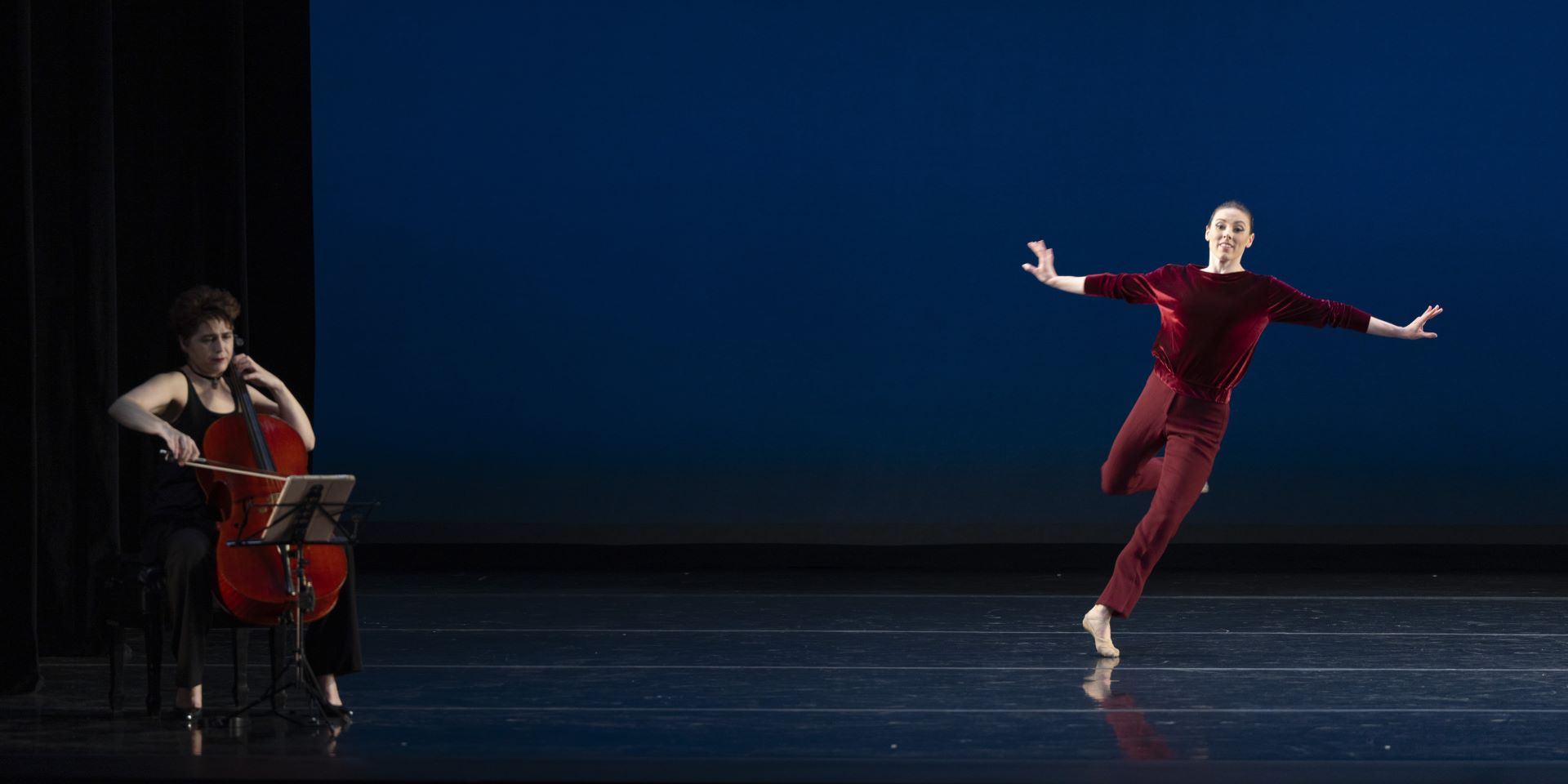
Jerome Robbins’ A Suite of Dances, the second offering, was set to selections from Johann Sebastian Bach’s Six Suites for Solo Cello and occupies a singular place in the Robbins repertory. Created in 1994 for Mikhail Baryshnikov, the ballet was built around the dancer’s extraordinary musical intelligence and expressive curiosity. Robbins responded with choreography that continually hovers at the edge of climax, the phrases cresting toward brilliance before receding into quiet introspection. The piece becomes less a display of virtuosity than a meditation on phrasing and the architecture of movement.
For this Santa Barbara presentation, Tiler Peck undertook the formidable challenge of performing a role traditionally danced by a male soloist. With the blessing of the Jerome Robbins Foundation, Peck stepped into Robbins’ introspective landscape with evident respect for the work’s lineage.
The performance unfolded in intimate dialogue with cellist Hannah Holman, whose live rendering of Bach’s score anchored the ballet in rich musical presence. Their collaboration served as a reminder that the piece ultimately lives in the conversation between movement and sound.
Peck approached the choreography thoughtfully, resisting the temptation to turn the ballet into a display vehicle. Instead, she sought to absorb the work’s muscularity and contemplative spirit, allowing phrases to unfold with restraint. Yet the role, so closely associated with Baryshnikov’s unique balance of strength, elasticity, and philosophical ease, remains a formidable interpretive challenge. At times Peck seemed slightly constrained, with moments that might naturally crest instead felt held back, the phrasing occasionally cautionary.

Emma Von Enck and David Gabriel in “Four Bagatelles” – Photo by Issac Hernandez.
Still, the attempt itself was admirable. Peck is a brilliant dancer, quick, buoyant, and sharply musical, beloved for her spirited attack and crystalline technique. Her willingness to step outside that familiar identity and confront a work so deeply rooted in another performer’s legacy was both courageous and artistically generous.
Peck’s interpretation may not yet fully unlock the ballet’s profound calm and expansive phrasing, but her exploration of the role revealed an artist willing to test the boundaries of her own artistry.
Dances at a Gathering, as the final tribute of the evening, expanded with a romantic sweep of Chopin’s waltzes, études, scherzos, and nocturnes. Robbins’ choreography reveals moments of self-discovery within a community of dancers, each figure entering and departing like thoughts within the music.
Robbins’ Dances at a Gathering remains one of the most beloved works in ballet repertoire, its atmosphere evoking fleeting romantic encounters and quiet human connections set within Chopin’s luminous music, played here with lyrical sensitivity by Hanna Kim.
Even in this presentation, performed with a reduced cast and somewhat less spatial breadth than the ballet traditionally enjoys, the work still suggested the whisper of a breeze on an early spring evening. The dancers clearly relished the clarity and freedom of Robbins’ choreography, embracing its conversational ease and natural warmth.
The entire cast demonstrated the formidable technical and lyrical capacity required for this deceptively demanding ballet. Yet, as always in Dances at a Gathering, certain personalities emerged more vividly through musical sensitivity, interpretive depth, or the ability to inhabit Robbins’ poetic world with ease.
Among the women, Indiana Woodward brought welcome lyricism, allowing Chopin’s phrases to bloom with soft musical responsiveness. Her dancing carried an openness that felt organically aligned with Robbins’ vision.

Tiler Peck in “A Suite of Dances” – Photo by Isaac Hernandez.
The petite delicacy of Yuriko Kajiya, however, seemed somewhat miscast as the Green Girl. Traditionally a role that carries flirtatious maturity and musical sophistication, often associated with interpreters such as the engaging Agnès Letestu, it benefits from expansive phrasing and playful rhythmic nuance. Though technically secure, Kajiya’s performance felt slightly forced, the piece appearing worked rather than fully breathed.
Mira Nadon attacked the choreography with notable commitment, throwing herself into the phrases with intensity. At times, however, that drive tipped toward forcefulness, sacrificing some of the lyrical softness that allows Robbins’ choreography to unfold with natural grace.
Emma Von Enck, whose light, youthful joyousness and musicality consistently drew the eye, seemed instinctively to “get” Robbins’ world. She moved with buoyant ease that captured the ballet’s spirit of discovery and play. Her phrasing sparkled throughout, and her presence brought a freshness that made even familiar passages feel newly alive.
The men contributed considerable strength and personality. Adrian Danchig-Waring offered refined musical intelligence and quiet authority, shaping phrases with understated elegance. Roman Mejia injected buoyant energy and technical brilliance, his dancing charismatic and dynamic. Chun Wai Chan brought elegant line and attentive partnering, while David Gabriel added youthful vitality to the ensemble. Together these strong male personalities deepened the evening’s romantic atmosphere, creating a shifting landscape of encounters that allowed Robbins’ choreography to breathe and unfold. Even within the reduced scale of the stage, Dances at a Gathering retained its essential magic: a community of individuals discovering themselves and one another through the quiet poetry of dance.
This contribution was a true gift in a chaotic world. Thank you to UCSB Arts and Lectures, The Joyce Theater, the spirited Tiler Peck, the Robbins Trust and repetiteurs: Jean-Pierre Frohlich, Isabelle Guerin, Rebecca Krohn, and Christine Redpath for bringing Jerome Robbins’ inimitable work to California. One can only hope that Los Angeles audiences may soon have the opportunity to experience this beautifully curated tribute, a program that reminds us how timeless and profoundly human Jerome Robbins’ works remains. We are forever grateful to all who those who made that possible.
To learn more about UCSB Arts & Lectures, please visit their website.
Written by Joanne DiVito for LA Dance Chronicle.
Featured image: (L-R) Hannah Holman, cello and Tiler Peck in “A Suite of Dances” – Photo by Isaac Hernandez.
Follow us on Facebook on Instagram and on LinkedIn.