
A lot has been said about the mass migration from Venezuela. The exodus has been over a decade in the making, and the scale and rate of the diaspora are almost unrivaled in recent history.
However, as with every story, there are two sides — and only one side has yet been able to dominate the conversation.
This is an error that, on Feb. 26, Oakland University set out to correct.
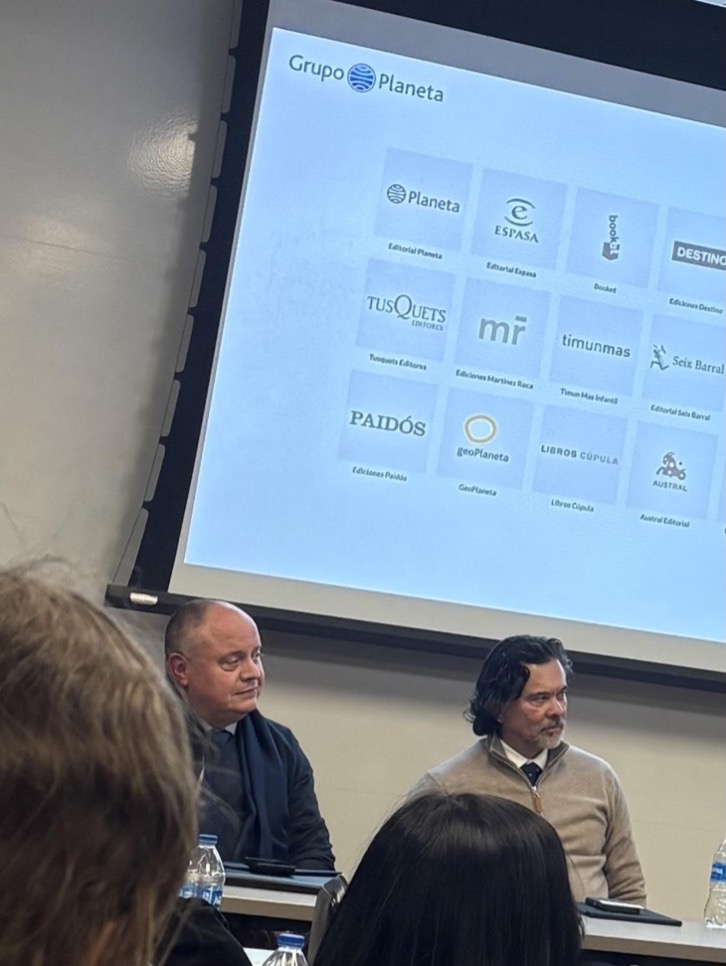
In the “Voices from the Venezuelan Diaspora” panel, OU’s Department of Modern Languages and Literatures and the Klein Center for Culture and Globalization featured two compelling guest speakers with stories to share about loss, journey, the family of a nation in crisis.
Adolfo Campoy-Cubillo, OU associate professor of Spanish, hosted the panel.
“I mean nothing against journalists, but it’s not someone [the two speakers] who has to gather information to do an article,” Campoy-Cubillo said. “It is someone who is there. Every day. In front of the immigration judge.”
There is something that simply cannot be replaced in being there. Even when reporters are there, the very nature of reporting calls for a voice both impartial and detached. An overly invested narrator jades the story.
Lermit Díaz-Salazar and Freddy Geraldo, the two speakers, demonstrated the merit of their unadulterated narratives.
“Since 2014, about 7 million people have left Venezuela,” Díaz-Salazar, an acclaimed author and translator, said.
“Venezuela is very small, only 30 million people,” he said. “It is the largest human movement in Latin American history.”
The number exceeds that of the Great Migration, an early to mid-20th century movement in which approximately 6 million African Americans moved from the Southern United States to the Northeast, Midwest and West.
It is easy to look at such a massive number of people and jump to conclusions. It is harder — but nauseatingly necessary — to really digest the scale of human suffering that can push a people to an exodus of biblical scale.
Inflation of the Venezuelan bolivar peaked in the millions of percent in 2019.
Stories are often passed around that a wheelbarrow of money was needed to buy a loaf of bread in Germany before the Second World War. Venezuelan hyperinflation reached even greater numbers (in terms of overall rate — the Weimar Republic experienced a much faster rate of hyperinflation).
It takes a lot to push a person on a hike through jungles and deserts across 11 countries. Waking up to one’s money being worth nothing with no official coherent solution might be just that push.
“It is important,” Freddy Geraldo, a financial analyst, said, “for the Venezuelan people, being one of the wealthiest countries in the world in the early 20th century … to make a salary close to 3$ (USD) a month.”
For decades, Venezuela was the wealthiest country in Latin America, and for several of those decades boasted a greater GDP than that of many countries in Europe. The nation’s massive oil revenue led to the nickname, ‘Saudi Venezuela.’
However, Venezuela in the 21st century demonstrates that, like a building, an economy too dependent on one pillar will suffer the same fatal architectural fault: collapse.
The wealth of Venezuela was incredibly stratified, constituting a driving force behind the Bolivarian Revolution. People searching for equality seemingly wished for it with a monkey’s paw.
They found it. Together. In the gutter. The glistening skyscrapers of Caracas — built meticulously in the 1960s and 1970s — are slowly rotting, like a goat being picked at by turkey vultures.
This story goes almost entirely untold.
The Darien Pass has more in common with “Mad Max” than what a typical Westerner would conceptualize as a path to freedom. It is a lawless, treacherous and dangerous odyssey across the least navigable regions of 11 countries.
Every step is a late-night dance, risking death, human trafficking, beasts of the jungle and fates perhaps even worse. The smell of the green canopy, gunpowder and death fills the air.
The presence of many of the world’s largest criminal syndicates is far more evident than the law enforcement arms of any nation across the globe.
If the event was meant to start a dialogue, then let the dialogue commence.
Would anyone flee the South Side of Chicago through the Darien Pass for a mere chance at a better life? Benton Harbor? Saginaw? Flint?
This same drive has brought much success to the Venezuelan community — and many others before. Consider how well the Cuban American, Irish American, Lebanese American and Iraqi American communities have flourished.
There is clearly an existing model of flight from a country that is falling apart, regardless of whether or not the motherland ever rises again.
The event creates a unique human opportunity to appreciate the importance of translation work. Language is universal, but it does not always capture the same ideas, and even when it does, those ideas are presented very differently.
Translators are not like computer programs; not simply Google Translate or ChatGPT. They are also storytellers.
Language carries within it unique cultural memes and traumas used to convey incredibly important concepts and imagery.
Translators do not get to bill 20 cents a word because they are sophisticated, charming and well-educated. Those 20 cents a word are because words do not always mean precisely what they appear to mean. Feelings are human and contained by the speaker.
Yet, as a culture, there is a great stigma towards foreign language speakers.
Consider the outrage at the recent Bad Bunny halftime show.
The anxiety felt by many when they sit next to an Arabic speaker in a shemagh on a plane.
Why the negativity? Arabic and Spanish are two of the most economically industrious languages in the world.
Crime affiliations? Our investigation agencies almost always report having too few foreign language speakers.
Yet, in education, bilingual children face real problems. Efforts to teach foreign languages in public schools are constantly attacked, and there is a real push on the right to enshrine English as the true legal official language of the US.
This would disenfranchise the non-English-fluent in myriad ways.
With many humanitarian crises mounting south of the border and across the ocean, and a stagnating economy at home, it is likely time to stop cutting the ties that bind us.
Immigration is becoming harder, not easier. Languages are silent, not saved. Schools like Oakland can continue to decide whether to have a voice in the great language debate — and in the fate of the Venezuelan diaspora.
Campoy-Cubillo and the speakers stressed that amid the crisis, two kinds of people leave their homes: those who leave by choice, because of privilege, and those who must leave it all behind.
There is a great need for dialogue about the fate of the latter.