
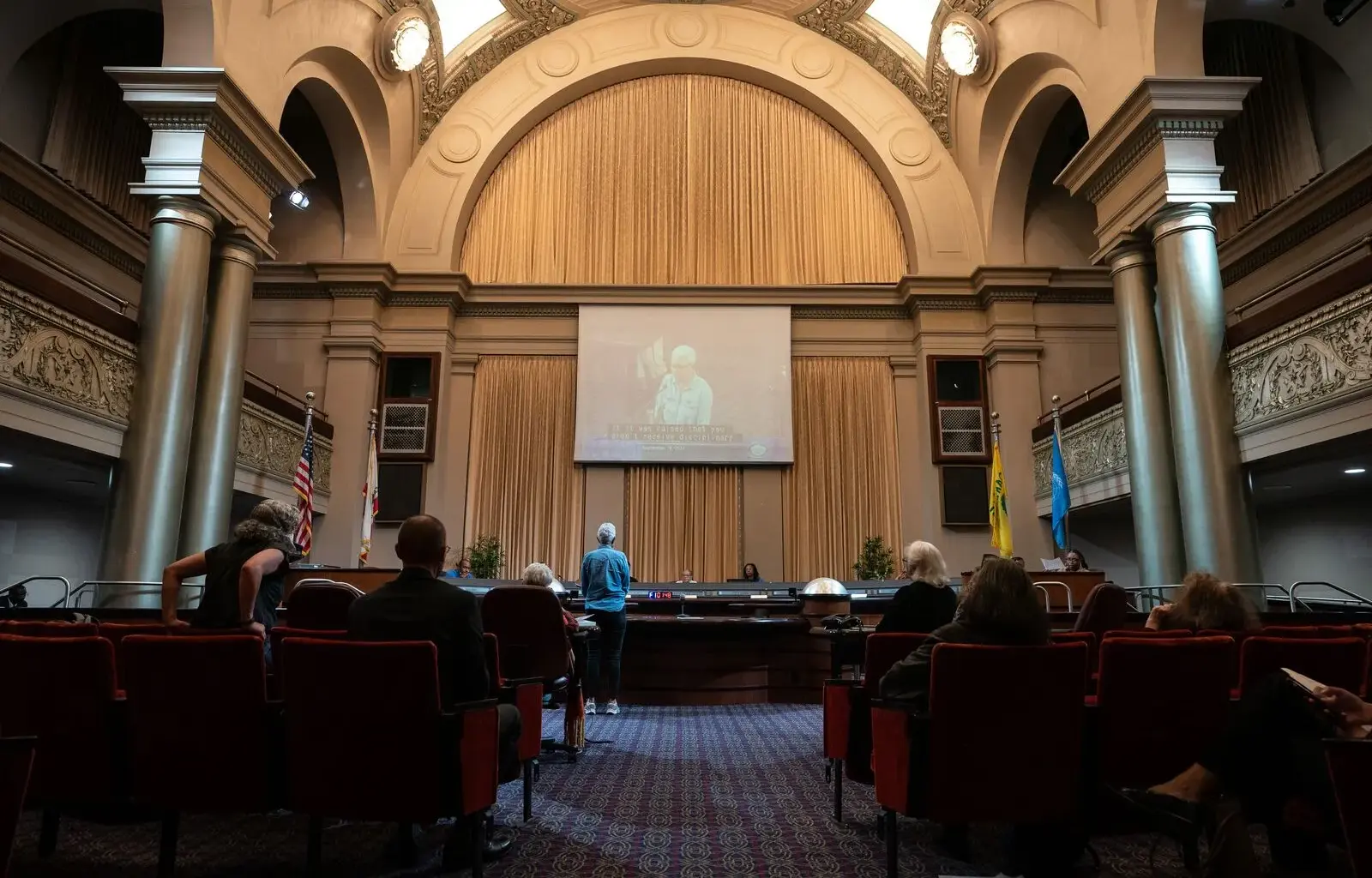
Oakland’s police commission is understaffed, which is undermining the city’s efforts to reform the police department and complete OPD’s two-decade-old federal oversight program.
That’s one of the big takeaways from a new report published today by Oakland’s independent City Auditor.
The Police Commission, a board of seven civilian volunteers who oversee OPD’s policies and procedures, and its two sub-agencies, the Community Police Review Agency, which investigates police misconduct, and the Office of Inspector General, which audits OPD, have struggled to live up to their promise.
At a high level, the auditor found that the Police Commission hasn’t accomplished much of what it’s supposed to, according to its responsibilities as they are defined in the City Charter and municipal code — the city’s laws. The oversight bodies are subject to many different requirements under Oakland law. These include responsibilities ranging from holding public meetings to procedures for removing the police chief. The auditor, who is required by law to review the police commission on a regular basis, selected 43 duties to evaluate and found that the commission and its sub-agencies are only fulfilling 26 of these.
Staff vacancies, frozen positions, low minimum staffing requirements, and leadership turnover have interfered with the commission’s goals, according to City Auditor Michael Houston.
“The City and the community have vocalized a commitment to rigorous police oversight, but the City has not given enough resources for these three agencies to deliver rigorous police oversight,” Houston wrote in a press release.
OPD has been under federal oversight since 2003 following a civil rights lawsuit over a group of corrupt police officers who were accused of kidnapping, torturing, and planting drugs on people. The Negotiated Settlement Agreement, the roadmap for OPD reform, includes 52 tasks the city promised to accomplish.
Following a series of scandals in 2016 involving OPD officers who sexually exploited a teenager, Oakland residents approved Measure LL, creating the Police Commission and Community Police Review Agency. In 2020, voters approved Measure S1, strengthening the commission and creating the Office of Inspector General.
OPD appeared to be close to exiting federal oversight in 2022. But two years later, the federal judge overseeing OPD extended the reform program after investigations revealed serious failures in OPD’s internal affairs disciplinary procedures.
Earlier this year, a federal judge said he was optimistic about the city’s progress, but indicated there is more work to be done before Oakland regains full control over its police department.
“Supporting the police oversight agencies with the resources necessary to fulfill their mandates will demonstrate that the City has a proportionate commitment to providing assurance that constitutional policing will be consistent and ongoing,” Houston wrote in his press release.
Police oversight bodies are making improvements, but low staffing is making things harder
The Police Commission and Community Police Review Agency have made some strides since the last time the auditor reviewed them in 2020. For example, the commission developed procedures for running public meetings and publishing annual reports, and the review agency standardized its investigation plans.
But the agency still needs to adopt formal policies and procedures for investigations, establish direct access to OPD internal affairs files, and implement an agency-wide training program.
The staffing problems haven’t changed much over the past six years. The volunteer police commissioners rely on just one full-time staffer to handle everything from legal contracts to public records requests. The commission has also experienced high turnover and vacancies.
According to the auditor, the city’s decision to cut an unfilled administrative analyst position may violate the City Charter, which requires Oakland leaders to budget enough money for the commission to perform its duties.
The Community Police Review Agency has five investigators available to oversee complaints against police officers. But the City Charter requires one investigator for every 100 sworn OPD officers, meaning there should be roughly seven investigators. And according to a letter from the Police Commission that was included in the audit, two of the review agency’s investigators are actually supervisors who do not conduct investigations, meaning the ratio of police officers to investigators is actually closer to 200-to-1.
Understaffing slows investigations and increases the risk that the statute of limitations will expire for cases before discipline can be imposed, according to the auditor. The vacancy rate among review agency investigators, including frozen positions, ranged between 22-56% between 2016 and 2025, according to the report.
The inspector general, the position created in 2022, is supposed to make sure OPD’s policies and practices are constitutional, efficient, and modern. They accomplish this by conducting audits and studies and making recommendations. These can include reviews of many of the tasks in the Negotiated Settlement Agreement. But last year, the City Council froze half of the inspector general’s staff positions, including two performance auditors. The city gave the inspector general $122,500 to pay an outside firm to do audits. But the report noted that the agency’s one available audit manager cannot adequately evaluate the 52 police reforms outlined in the settlement agreement.
The report also noted that the city administrator’s “strong influence” over the OIG budget “represents a structural threat to independence,” which diminishes the agency’s ability to conduct audits.
There is also an inherent conflict of interest in having the city administrator propose the budgets of the police oversight bodies to the mayor and city council, according to the auditor.
“Particularly when budgets are tight, and minimum staffing provisions are suspended, there may be an incentive to cut oversight in favor of operations, especially as the police oversight agencies are entirely funded by the city’s general purpose fund,” the auditor found.
Structural independence, in the auditor’s view, would help ensure Oakland’s police oversight agencies have the resources and authority to do their jobs.
What should change, according to the auditor?
The rules governing civilian police oversight in Oakland are rife with conflicts and confusing language, the auditor found.
For example, the city’s municipal code says that the Police Commission, with the assistance of the city administrator, is responsible for hiring the inspector general. But the City Charter states that the commission has the power to fill vacancies. In another example, the City Charter authorizes the commission to terminate the Community Police Review Agency’s executive director without cause but requires cause for firing the Inspector General.
The auditor is recommending that the City Council and police commission revise the rules to resolve these conflicts. In a letter included with the audit, City Attorney Ryan Richardson wrote that his office is willing to administer a staffing study if the City Council wants it and allocates sufficient funding.
City Administrator Jestin Johnson has not responded yet to the audit.
The Police Commission appears to agree with some of the auditor’s findings, according to a letter included with the report. The commission noted that an oversight body can’t be independent “if its operations are influenced by the entity subject to oversight (here, the Oakland Police Department), swayed by political concerns, or hindered by inadequate resources.”
“*” indicates required fields