
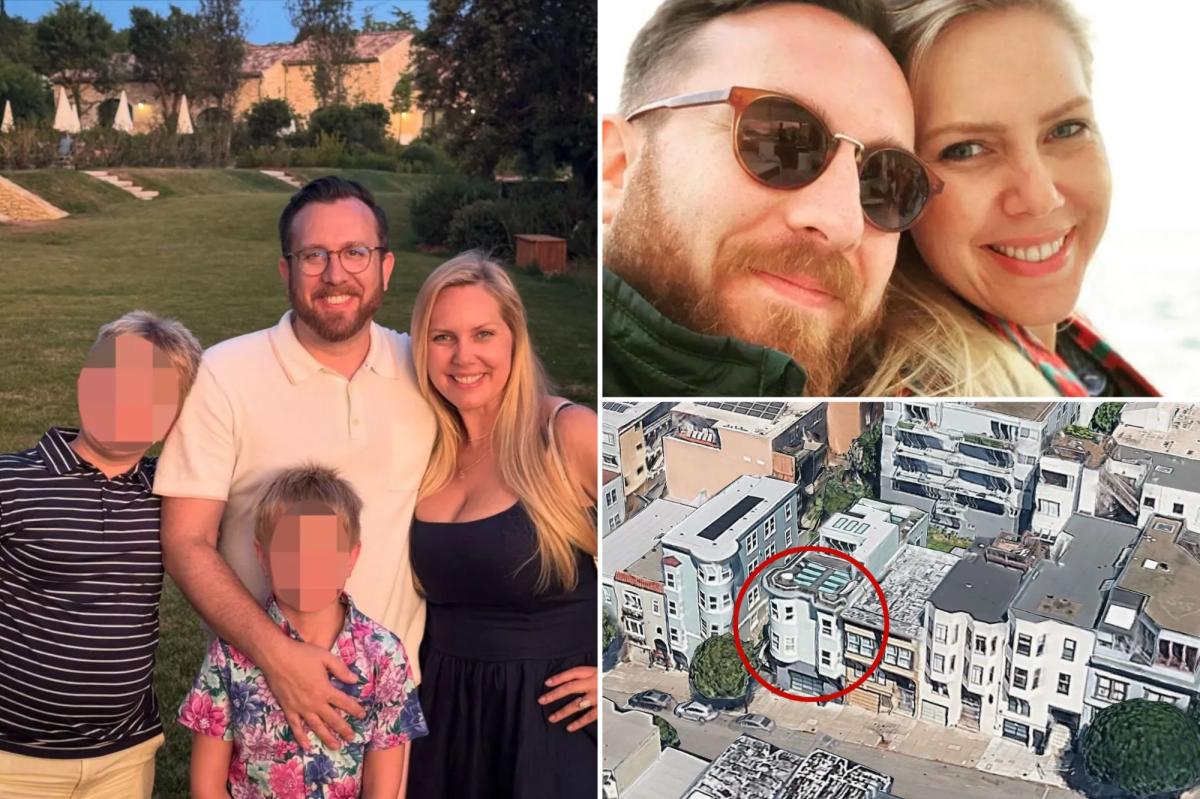
What looked like the ultimate San Francisco score is turning into a bureaucratic nightmare.
Katelin Holloway and Ben Ramirez thought they had found their forever home when they purchased a spacious North Beach property for $4.75 million in 2021 — a four-story residence with five bedrooms, sweeping skyline views and room for their growing family.
Instead, the couple is now facing the possibility that the house must be carved back into four separate apartments after city officials determined the building was improperly converted from a multi-unit property years before they bought it, according to the San Francisco Chronicle.
A San Francisco family’s $4.75 million dream home has turned into a legal and financial headache after city officials determined the property was illegally converted from a four-unit apartment building into a single-family residence before they bought it. Facebook / Ben Ramirez
The home at 524-526 Vallejo St. checked nearly every box for the longtime North Beach residents.
The roughly 3,700-square-foot property featured an open kitchen flowing into a sunlit living area, a rooftop deck overlooking Chinatown and the Financial District — and enough bedrooms for their two sons, visiting relatives and home offices.
Single-family houses are exceedingly rare in the historic neighborhood, making the purchase feel like a once-in-a-lifetime opportunity.
But the dream unraveled after city inspectors arrived following an anonymous complaint. As Holloway recalled, the mood changed after planning officials toured the four-floor property.
“They looked at us and were like, ‘You guys are screwed,’” Holloway told The Chronicle in an interview.
According to city officials and tenant advocates, the building had previously been altered from a four-unit apartment complex into a single-family residence without proper permits. That means the structure is still officially classified as a multi-unit property in municipal records — and may have to be restored to that configuration.
Tenant activists argue the issue is bigger than one household. In a city facing a severe housing shortage, they say losing residential units is unacceptable.
“These units have to be reconstituted on this site,” Theresa Flandrich, a North Beach resident and longtime tenant organizer told the outlet. “They have to be. North Beach has lost so many of these units, period.”
Holloway and Ramirez acknowledge they were aware the property was technically listed as a multi-unit building when they bought it — though its interior clearly resembled a single home.
“We are the numbnuts who signed a four-unit building,” Holloway said.
Still, the couple say assurances from real estate professionals and the previous owners left them believing the discrepancy would not pose a serious problem.
“We thought it was fine,” she added. “Turns out, it’s not fine.”
Katelin Holloway and Ben Ramirez purchased the 3,700-square-foot house in 2021 believing it could serve as their long-term family home, but after an anonymous complaint prompted an inspection, the city said the building must comply with records that still classify it as a four-unit complex. Facebook / Ben Ramirez
Over the past four years, the family has been pulled into a maze of permits, hearings and appeals as they try to legalize the home’s existing layout. They say they have spent thousands of dollars hiring architects and navigating the city’s planning bureaucracy while researching the building’s renovation history.
If their latest appeal fails, the consequences could be drastic. The couple may have to divide the residence into four separate apartments — potentially installing kitchens in the primary bedroom, a child’s bedroom and the downstairs guest room. The construction could cost millions and force the family to move out during the renovation process.
“We just want to live here,” Ramirez said. “We bought this place with hopes that it would be this forever, generational home.”
The couple previously proposed a compromise to city planners, offering to convert a downstairs bedroom into a studio unit with its own kitchen while keeping the rest of the home intact. But the Planning Commission deadlocked 3 to 3 on the proposal last year, effectively rejecting the plan and sending the dispute to the Board of Supervisors for a final decision.
Their children seen on the rooftop of the home. Facebook / Ben Ramirez
Housing advocates remain unmoved by the homeowners’ predicament.
“Do we really want to say, as a city, ‘If you buy a $5 million house and claim ignorance, that we’re going to make an exception for you and say the law does not apply to you?’” said Meg Heisler, policy director of the San Francisco Anti-Displacement Coalition. “What message does that send to the department that is trying to do these enforcement cases, to the (planning) commission and, more crucially, to the real estate industry?”
Unpermitted conversions are widely believed to occur across San Francisco, though they are difficult to track because renovations typically happen out of public view. Complaints from neighbors often trigger investigations.
“It’s an open secret kind of a thing that this happens,” Heisler said.
City officials say reversing housing losses is a key priority. Applications to merge units into larger residences face intense scrutiny, particularly when they reduce the number of available homes.
“Anecdotally, merger applications have to clear a very high bar at the Planning Commission,” said Dan Sider, chief of staff for the planning department.
That’s partly because planners “approach any loss of housing, particularly the loss of more reasonably sized units, with a very, very high level of scrutiny,” he added.
If their appeal fails, they could be forced to split the home into four apartments–potentially adding multiple kitchens and undergoing costly renovations that could run into the millions. Google Earth
It remains unclear exactly when the Vallejo Street building was transformed from four apartments into a single residence. City records show inspectors signed off on the property as a four-unit building as recently as 2016.
Peter Iskandar, a contractor and real estate broker who purchased the property in 2010, said he completed substantial renovations but did not officially merge the units. When he sold the building in 2017, he said it still contained four kitchens and fire doors separating each apartment.
“I would not sell a building that is not compliant,” he said.
Meanwhile, the city’s Department of Building Inspection is reviewing other properties linked to the development team involved with the renovation. Investigators have already identified several additional buildings that may contain illegal construction.
“We have identified at least six other properties where we suspect illegal construction or the illegal removal of housing units may have occurred,” department spokesperson Patrick Hannan said.
For Holloway and Ramirez, the ordeal has turned what once felt like a lucky break into a painful lesson.