
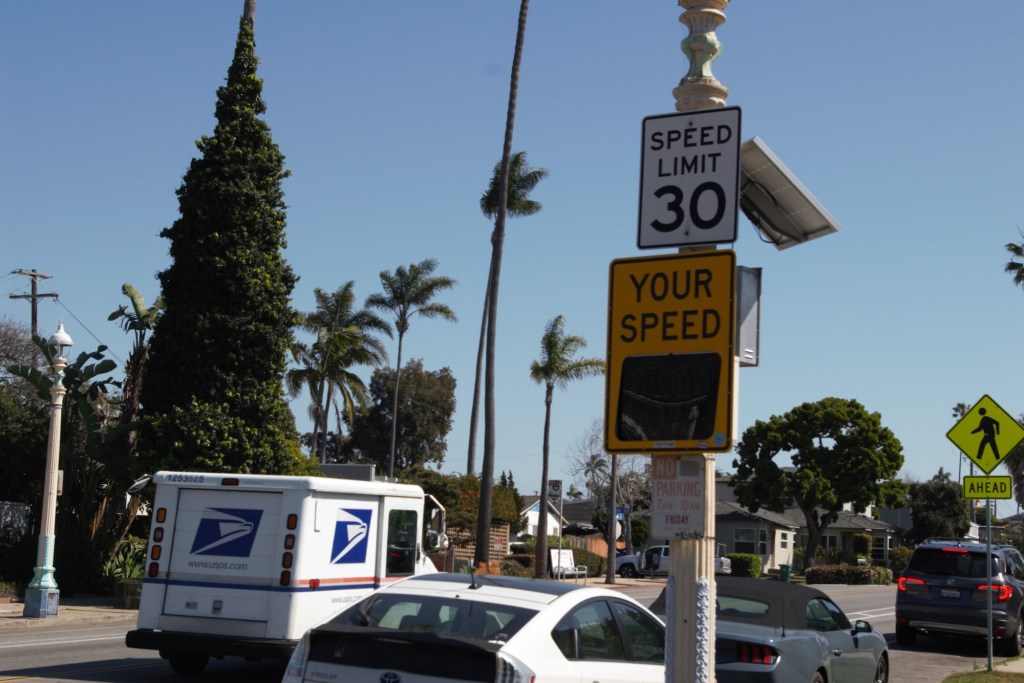
Dozens of road segments on the Point Loma Peninsula have been identified in a city of San Diego analysis as candidates for speed limit reductions. And as city leaders review the study, some members of community planning boards in Point Loma and Ocean Beach are bemoaning what they see as an ineffectual approach for their neighborhoods, despite welcoming the idea of lower speeds.
California Assembly Bill 43, signed into law by Gov. Gavin Newsom in 2021, allows municipalities to reduce speed limits, provided the reductions are justified by an extensive analysis. The city of San Diego compiled a 135-page speed management plan that was published in February and presented to the City Council’s Active Transportation and Infrastructure Committee.
All four members of the committee voted Feb. 19 to recommend that the full council approve city staff’s proposals for new speed limits on the streets specified in the plan.
The plan identifies various streets as being in business districts, school zones or safety corridors, which are road segments with a history of serious crashes.
Among the more than 1,500 segments of streets listed in the study, dozens of miles’ worth in Ocean Beach and Point Loma are included for possible speed limit reductions. Others would maintain their current speed limits instead of having them increased under previous state law that generally required cities to set the speed limit for a section of a roadway at the 85th percentile of the speeds cars typically are driven on that street.
Some of the more prominent local stretches listed in the speed management plan are Sunset Cliffs Boulevard between Ladera Street and West Mission Bay Drive, Voltaire Street between Catalina Boulevard and West Point Loma Boulevard, Bacon Street, Newport Avenue and Santa Monica Avenue in Ocean Beach, and several segments of Nimitz Boulevard, Rosecrans Street and Chatsworth Boulevard in Point Loma.
Mandy Havlik, vice chairwoman of the Peninsula Community Planning Board, welcomed the proposed changes in concept.
“I have seen firsthand how speeding puts lives at risk,” said Havlik, who is running for the City Council’s District 2 seat, which covers OB and Point Loma. “When someone is hit at 40 mph, the outcome is drastically different than at 25 [mph]. That is just a fact.”
But other community planners argue that without stronger enforcement, the reduced speed limits would prove ineffective in making the roads safer.
Andrea Schlageter, chairwoman of the Ocean Beach Planning Board, said she would encourage more police presence in the Ocean Beach area to achieve that end.
“No one follows the rules of the road anymore because no one ever gets moving violations,” Schlageter contended. “I have almost been hit by multiple cars because no one stops at stop signs and red lights. The city can make all the rules they want, but until they start giving out consequences, behavior won’t change.”
Havlik and PCPB Chairman Eric Law echoed that sentiment.
“Speed reduction, paired with consistent enforcement and smart infrastructure investments, will make our streets safer for pedestrians, cyclists and drivers alike,” Havlik said.
Law pointed out Nimitz Boulevard, saying it “really … needs enforcement, not a reduced speed limit.”
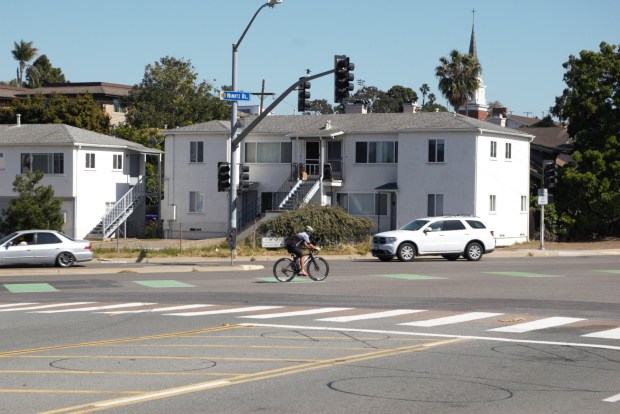 A cyclist crosses Nimitz Boulevard at Atascadero Drive in Point Loma. (Tyler Faurot)
Margaret Doyle, current District 2 Councilwoman Jennifer Campbell’s communications director for Point Loma, said Campbell is prioritizing infrastructure improvements and police enforcement in budget discussions for the coming fiscal year.
“Council member Campbell is supportive of measures that will increase road safety, although as residents have noted, enforcement is also a key component to that equation,” Doyle said.
The speed management plan acknowledges that speed reductions are only part of the solution.
“Lowering posted speed limits alone will not achieve ‘Vision Zero’ [the city’s goal, launched in 2015, of reducing traffic fatalities to zero],” according to the plan. “Speed limit changes must be paired with street design improvements, education and enforcement to meaningfully change driver behavior. The city will continue to advance traffic-calming, intersection safety improvements and public education alongside speed management.”
Community organizers also criticized what they see as a lack of meaningful dialogue with the city.
“We have asked for pedestrian crosswalks at Santa Cruz [Avenue], Orchard (Avenue], Bermuda [Avenue] along Sunset Cliffs and at Froude [Street] and Voltaire,” Schlageter said. “The city did install a lit bed crosswalk at Froude and Voltaire. We have [only] ever requested pedestrian enhancements, not speed reductions.”
The Peninsula Community Planning Board sent a letter to Campbell’s office in 2023 regarding “urgent” safety concerns from residents about the stretch of Voltaire between Catalina Boulevard and Froude Street. The letter called for reduced speed limits as well as increased enforcement, traffic-calming measures and improved pedestrian infrastructure.
That stretch of Voltaire is listed in the speed management plan, stretching one block past Froude to Ebers Street.
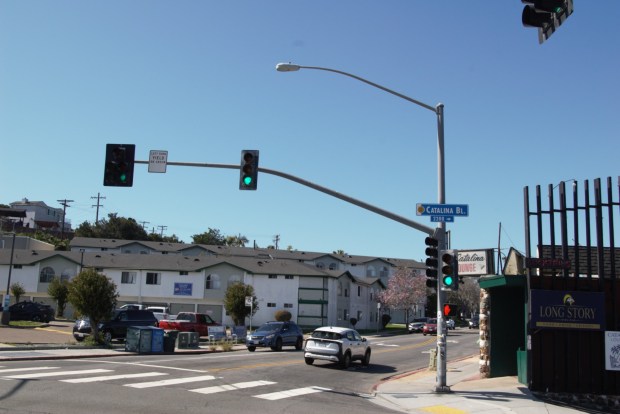 The intersection of Voltaire Street and Catalina Boulevard in Point Loma is the eastern end of a stretch of Voltaire included in the city of San Diego’s speed management plan for possible speed limit reduction. The western end of the segment is at Ebers Street in Ocean Beach. (Tyler Faurot)
Still, Law decried what he sees as a lack of amenability to local concerns.
“The city couldn’t spare a few minutes to consult with the occupants of our neighborhoods or even with their elected planning group representatives,” Law said.
Doyle said Campbell would decide how to vote on the transportation committee’s recommendation after hearing public comments at council meetings.
City officials said the proposed lower speed limits would require $2.4 million for 3,000 new signs, 1,200 new poles and overtime wages for Transportation Department workers who would install them.
Implementation of the plan in its current iteration is expected to take a year.
See the full list of affected street segments and recommended speed limits at bit.ly/40lYRr0.
Related story:
Not so fast on new safety measures on ‘high-crash’ Midway District street, S.D. says