
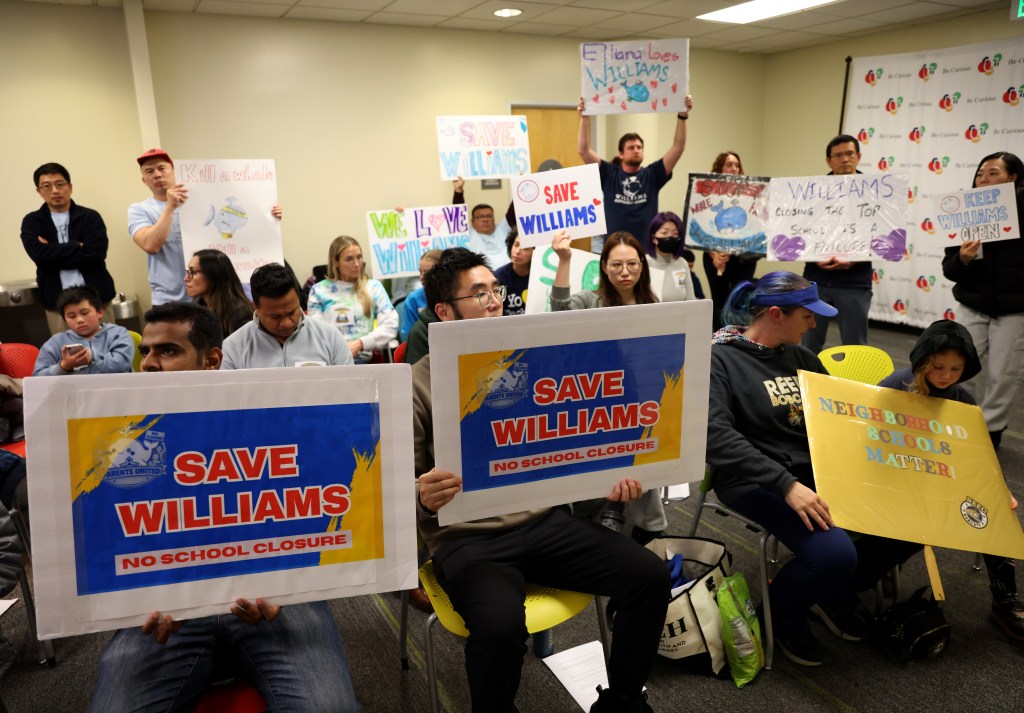
After debate and protest, a special committee recommended the San Jose Unified School District close five elementary campuses before the next school year.
The recommendation Tuesday comes as the district has said it needs to close campuses and consolidate schools in response to a 20% decline in enrollment since 2017. The district has said the decision to close schools is not motivated by financial need or budget constraints but rather by improving students’ academic experience.
Currently, some San Jose Unified schools have combined grades into a single class to address shrinking student bodies. The Schools of Tomorrow initiative, launched last fall, defines an “ideal school” as one with three classes per grade.
Tasked with recommending campuses for closure, the Schools of Tomorrow Implementation Committee recommended the district’s board of education close Canoas, Empire Gardens, Gardner, Lowell and Terrell elementary schools. The committee had previously considered closing as many as nine campuses.
The district’s board is expected to vote on the recommendation March 26.
Those in favor of the plan said it closes only the smallest schools, keeps neighborhood communities together, doesn’t overcrowd facilities and maximizes the number of students within walking distance to school.
“It can’t be overemphasized that by combining these schools, we understand that it’s hard for the families and the students and the staff,” said committee member Jodi Lax, the district’s associate superintendent of instruction.
Opponents pointed out that the recommendation leaves many students at under-enrolled schools, which could mean the district will be forced to consider additional school closures in the future.
“There’s going to be a bunch of schools left behind,” said committee member Manjusha Gangadharan, a parent at Simonds Elementary. “Yes, it solves an immediate problem, but it does not offer stability for the community in the next two to three years.”
Parents, students and community members have spoken out against the school closures since the plan was announced last month, arguing closures would hurt students’ academic and social well-being, as well as disproportionately affect Black and Latino students by focusing largely on downtown campuses.
The committee also recommended the board of education evaluate magnet school programs, middle schools and high schools for potential consolidations or closures, regularly review elementary school enrollment to maintain ideal school sizes and track the academic impact on students who changed schools.
Parents and families can see which elementary school their child would be assigned to under the district’s school locator. Special education and bilingual programs at closing schools would be moved to other campuses, not shuttered, under the recommendation.
The district will provide no-cost access to three hours of after-school activities to affected students at their new schools — and bus transportation for those who live more than 1.5 miles from their new campus.
Officials said any elementary slated to close will receive twice its usual funding to support the transition for the remainder of the 2025-26 school year, while schools that will receive new students for the 2026-27 school year will receive twice their usual funding to support integration. The district has not specified where that funding would come from.