
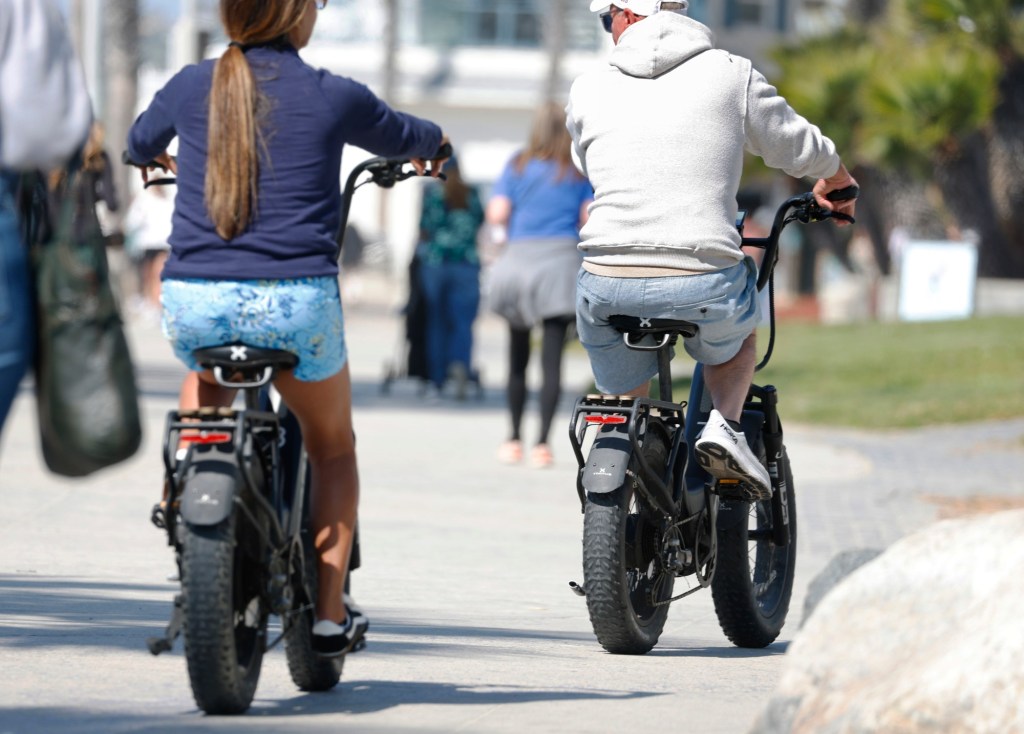
San Diego officials on Wednesday endorsed a crackdown on electronic bikes that will include banning use of some e-bikes by children under 12 — but cycling and mobility advocates called the city’s plan badly flawed.
Critics said San Diego is targeting the wrong kinds of e-bikes — class 1 and class 2 e-bikes — and that the real problem is faster and more powerful vehicles that are more like motorcycles and that many parents buy, mistakenly thinking they’re e-bikes.
They said a smarter crackdown is new legislation spearheaded by state Sen. Catherine Blakespear, D-Encinitas, that would strengthen consumer protections for the sale and marketing of e-bikes and e-motorcycles.
Her proposed law, SB 1167, would prohibit sellers from labeling an electric vehicle as an e-bike if it doesn’t meet certain requirements — no more than 750 watts of power, no faster than 20 mph on a throttle and no faster than 28 mph when pedal-assisted.
“SB 1167 makes clear to consumers whether they are buying an e-bike, which has defined limits for power and speed,” Blakespear said.
Despite the criticism from groups like the San Diego County Bicycle Coalition and Circulate San Diego, the City Council’s Public Safety Committee voted 4-0 Wednesday to crack down instead on Class 1 and Class 2 e-bikes.
San Diego would become the sixth city in the county to join a state pilot program that makes it illegal for users under age 12 to ride Class 1 and Class 2 e-bikes.
Chula Vista, Carlsbad, San Marcos, Poway and Santee have already joined that state pilot program, which is limited to cities in San Diego County and is the product of legislation sponsored by Assemblymember Tasha Boerner, D-Encinitas.
The goal of the program is gathering data between now and 2029 about how such a crackdown will affect e-bike usage, safety, enforcement and related issues.
Councilmember Raul Campillo, who is leading San Diego’s effort, said recent e-bike crashes and injuries make a crackdown smart.
“I will no longer wait for another tragedy to strike before we do everything we can under state law to protect our children,” said Campillo, stressing that city law would focus on education instead of punishment.
Campillo and his staff will now work with City Attorney Heather Ferbert to write the city legislation and then bring it back for approval by the full council this spring or summer.
The state pilot program requires a 30-day public education campaign and then a 60-day grace period before the city would start writing $25 citations. Violators willing to take a safety course could have their fines canceled.
Councilmember Jennifer Campbell enthusiastically endorsed Campillo’s proposal.
“E-bike issues are impacting many neighborhoods across the city,” Campbell said. “I can’t in good conscience allow for this to go on without any safety regulations.”
Arya Grossman, a policy manager at Circulate San Diego, said she’s not convinced this kind of city law will make anyone safer.
“It’s unclear the direct danger class 1 and class 2 e-bikes present to children under 12,” she said. “I’m concerned we don’t have enough evidence to justify this proposal.”
She also said the crackdown could be harmful.
“The proposal could have unintended effects, including inequitable enforcement, disincentivizing young people from cycling, setting us back on climate goals and just limiting the mobility of San Diego,” Grossman said.
The San Diego County Bicycle Coalition also panned the idea.
Ian Hembry, the coalition’s executive director, said the city would benefit more from greater enforcement of existing laws.
He stressed that e-motorcycles, the main source of danger and fear, can’t be legally driven by people under 16. He said the city is instead targeting young people who want to commute by e-bike.
“E-bikes provide important independent mobility,” he said.
Several local residents, including several members of a Tierrasanta Girl Scout troop, spoke in favor of the city’s move.
Other residents spoke against it, including Harry Bubbins of Respect Bird Rock.
“Let’s build infrastructure that separates people from fast-moving vehicles rather than banning different ages of people from using clean mobility options,” Bubbins said.