
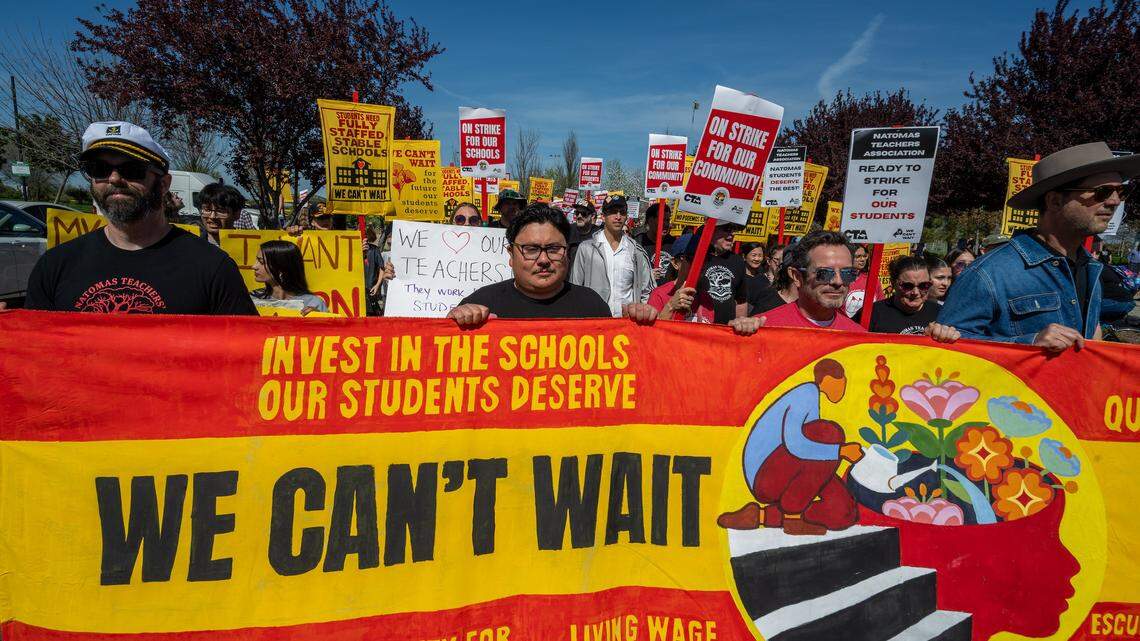
Around 2,000 Northern Sacramento teachers reported to picket lines instead of their classrooms Wednesday morning, as strikes in two school districts continued. Public leaders, frustrated parents, exhausted classified employees and concerned students are calling for districts to cede to union demands, putting an end to the strikes.
Leaders at both districts have put offers on the table that align with a neutral third-party’s recommendation, saying that their proposals balance employee needs with fiscal reality. Teachers unions at both Twin Rivers and Natomas Unified School Districts are holding out for increased pay, improved health care benefits and smaller class sizes.
Wednesday marks the fifth day of Twin Rivers United Educators’ strike. No agreement emerged from four-hour negotiation sessions held Tuesday and Wednesday — meetings that Assemblymember Maggy Krell, D‑Sacramento, requested and attended. The district and the union will return to the table Thursday morning.
Meanwhile, kids are largely not receiving instruction or not attending school at all. Twin Rivers reported a relatively high attendance rate of 72% on the first day of its teachers strike, but parents and students have overwhelmingly reported poor school conditions.
At Natomas, spokesperson Deidra Powell said that around 50% of students across the district attended school on Tuesday, the first day of the strike, and that the majority of classified employees, like food service workers and bus drivers, showed up for work.
Krell has also called for Natomas Unified, which is facing the second day of its teachers strike, to honor “fair and reasonable requests” from its teachers union, including limiting overcrowded classrooms, providing competitive wages and ending its reliance on outside contractors.
“A fair and equitable collective bargaining agreement creates the working conditions our educators deserve, and the learning conditions our students need to succeed,” the letter reads.
The note was cosigned by Krell, Sacramento County Office of Education Trustee Mariana Corona Sabeniano and former state Sen. Dr. Richard Pan, but was sent by a California Teachers Association representative.
There are no bargaining sessions scheduled for Natomas as of 2 p.m. Wednesday. The two sides have not met since Sunday.
Parents, students urge end to strikes
Many parents, concerned about the wellbeing of their children, and students, tired of being crammed into gyms and overcrowded classrooms, are calling on Twin Rivers leaders to meet the union’s demands.
Hundreds took to the Twin Rivers school board meeting Tuesday evening to urge an end to the strike. Several students echoed teachers’ sentiments that what is good for educators is good for kids in the classroom. Other speakers called on the teachers union to make concessions.
Senior Brooklyn Mountjoy described crowded, overwhelming conditions at Rio Linda High School that put her and other students with disabilities at risk. Mountjoy had an anxiety attack in the gym on the first day of the strike, a situation she said could have been prevented if accommodations outlined in her individualized education plan were provided as is legally required.
“Students deserve classrooms that are properly staffed,” she said. “I know the strikes are disturbing, but sometimes people have to stand for what is right. Please remember when you negotiate, behind every contract there’s a decision for students like me who have education problems and need safety.”
Keisha Woods, president of the district’s union for classified employees, spoke to her members’ exhaustion and frustration watching the strike stretch on.
“(California School Employees Association) members have been standing in the gap during the strike. They have been standing strong. They are tired and they are worried,” she said. “It’s been hard watching our colleagues, our friends, on the picket line. It’s been heart-wrenching.”
She noted that classified employees were also struggling to keep up with their expenses and that they are seeking improved compensation and benefits as well.
Community member Kelly Cooper criticized teachers for seeking higher compensation, comparing a mid-career Twin Rivers teacher’s salary of about $95,000 to the median income in Del Paso Heights, which she calculated to be between $36,000 and $64,000.
“The reason that this matters tonight is because while negotiations are happening, students are the ones losing classroom time,” she said. “Families in the district rely on schools not just for education but for stability, supervision and opportunity. Many parents cannot simply stay home or find child care when students are when schools are closed.”
Most speakers supported the union and asked for the board to put a swift end to the strike by offering a contract in line with teachers’ demands.
The Natomas Teachers Association plans to rally at their district’s board meeting Wednesday at 5 p.m.
Leaders criticize state teachers union’s involvement
The strikes are a part of a statewide initiative organized by the California Teachers Association. In February, CTA President David Goldberg wrote that coordinated negotiation efforts across the state build structures that will power their campaign to “protect and strengthen school funding.” The union has long criticized Gov. Gavin Newsom for what they call a loophole in providing minimum funding to California public schools.
In the past several months, superintendents in large urban and suburban districts — including Natomas and Twin Rivers — have signed open letters to state legislators asking for more robust funding for schools, citing economic instability and labor disputes.
But Twin Rivers and Natomas leaders will say that forcing these politics into local labor-employer relationships is wreaking havoc. A news release from Twin Rivers associates recent union wins in five urban school districts with significant financial troubles and layoffs.
Natomas Board President Micah Grant said that the district has made a “really good and sincere offer” but that they can’t match the union’s “maximalist” demands without abandoning programs for students. He chalks this up to California Teachers Association’s statewide coordinated campaign to have districts bargain at the same time.
“Maximalist in the sense that their ask is overshadowing local realities,” he said. “We’re a small local government, right? We’re not Congress, this isn’t the state of California. This is Natomas Unified — we could walk this community in two hours. And so I think we really have an obligation to look at what every stakeholder is saying, including the people that call us every week and say, ‘hey, what makes Natomas unique?’ We want to hang on to those things.”
The local strikes have prompted conversations about California and the United States’ prioritization of education, especially as the United States allied with Israel to launch joint strikes on Iran this month.
In a somber comment at the end of a tense five-hour Twin Rivers board meeting Tuesday night, Trustee Basim Elkarra said that painful moments like these force a bigger question: “What are our moral priorities as a society?”
“I’m angry we’re going through a strike,” he said. “Right now our country is spending billions of dollars on war with Iran. On the first day of the war, we destroyed a school in Iran with over 150 massacred, mostly school girls. In a matter of weeks, the cost of missiles, military operations, and deployments will dwarf the entire budgets of school districts across the country.
“Yet here at home, we are told there isn’t enough money for people who educate our children. We’re told to tighten our belts. We’re told to make cuts. We’re told simply there isn’t enough.”
“But when it comes to war, there’s always enough. I think our families see this contradiction and I think our teachers feel it deeply. If we can spend billions on destroying things overseas, surely we can find resources to build minds here at home.”

The Sacramento Bee
Jennah Pendleton is an education reporter for The Sacramento Bee. She previously covered schools and culture in the San Francisco Bay Area. She grew up in Orange County and is a graduate of the University of Oregon.