
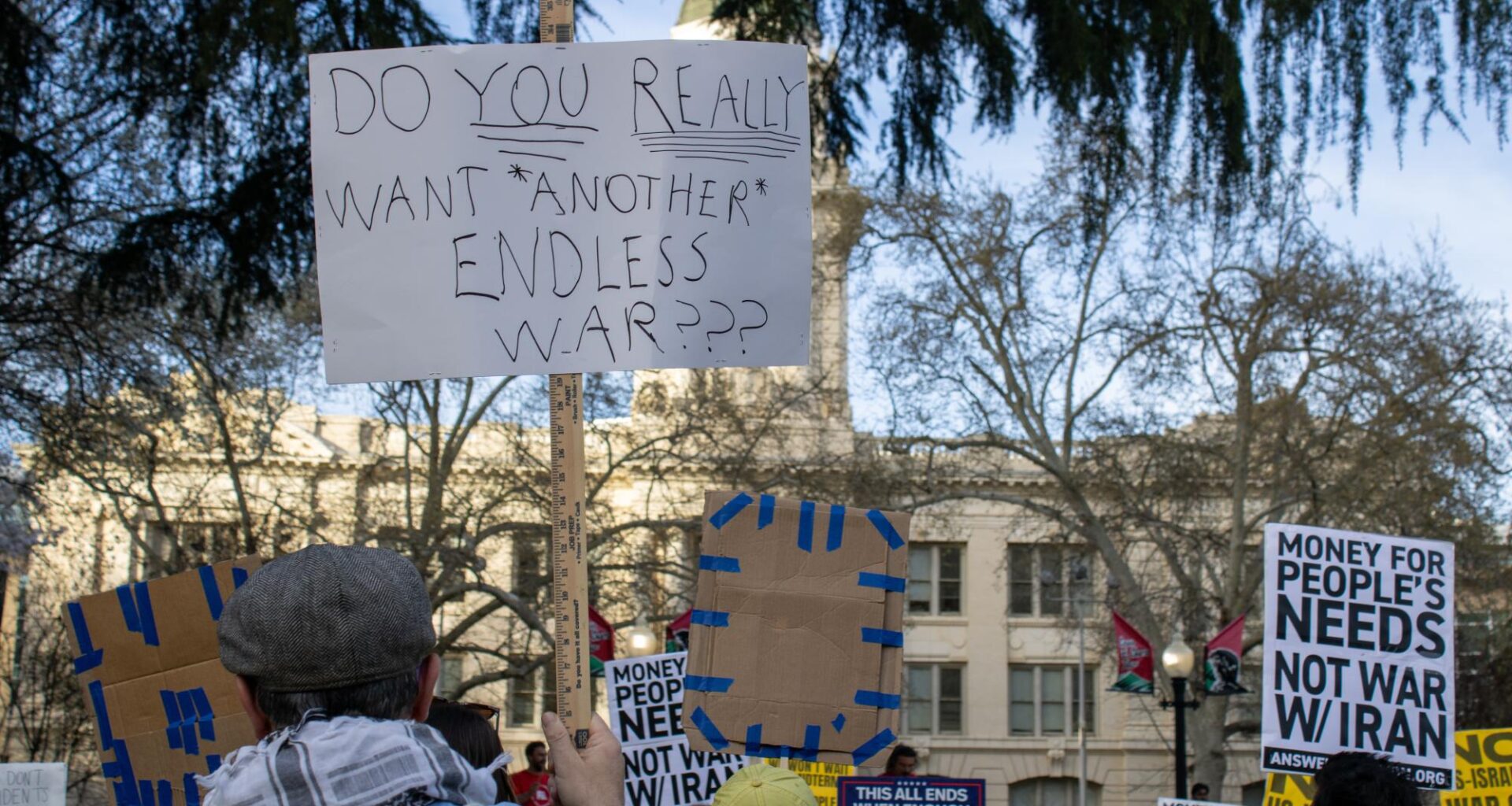
The United States and Israel launched a series of strikes against Iran on Feb. 28, escalating a conflict that had been simmering for years. Sacramento State political science professors said the current fighting cannot be understood without looking at the long history of tension between the countries.
As experts on the subject, the professors say the attacks mark a significant shift in U.S. foreign policy, and could have long-term consequences for the Middle East and beyond. They note that these actions are rooted in a long history of tension, including proxy conflicts, sanctions and prior military engagements that have shaped the current dynamics.
Jamie Jackson, an assistant professor of political science at Sac State, said the conflict can be best described as a preemptive escalation. These escalations are often used on the international stage to deter perceived threats before they materialize, though the unpredictability of retaliation can quickly turn these actions into bigger conflicts, Jackson said.
“I would say that the scale of what we’re seeing right now is surprising,” Jackson said. “It’s not uncommon for countries to make threats to sort of try and change behavior, but I think the naval buildup that we saw ahead of these recent strikes was a very clear signal of something to come.”
Jackson said the tensions can be pinned far back in history, even after the Iranian Revolution in 1979. In particular, in 1953, the United States and the United Kingdom backed a covert operation that removed Iran’s democratically elected prime minister, Mohammad Mossadegh, after he nationalized the country’s oil industry.
“You could also ask whether there would have been a revolution in 1979 that brought about the Iranian Islamic Republic if the United States and the U.K. hadn’t taken over the Iranian government in a coup after Mohammad Mossadegh was elected into office in 1953,” Jackson said. “You can go pretty far back with this history.”
Jackson said it is not the first time the U.S., Israel and Iran have exchanged attacks in recent years. However, past incidents were usually limited in scope and quickly followed by diplomatic efforts to de-escalate tensions.
“A couple of years ago, there were warnings, threats and posturing followed by a strike, and then negotiations discussion and things kind of disappearing,” Jackson said. “I think what we’re seeing now is more of a full-blown conflict situation where, because of the preemptive attacks from the U.S. and Israel on Iran, Iran is now striking back at allies of the U.S. and Israel in the region.”
This escalation differs from previous incidents because it is rooted in deep historical context. The combination of targeted strikes, retaliatory attacks and the involvement of multiple regional actors increases the risk of a drawn-out conflict, Jackson said.
“What we’re seeing now that’s more dangerous is this isn’t a one-off attack on a targeted location followed by diplomacy and shouting and then some agreement,” Jackson said. “What we’re seeing feels very much like a buildup to a more protracted conflict.”
RELATED: Students left unsatiated after Israel-Palestine roundtable discussion
Sahar Razavi, director of the Iranian and Middle Eastern Studies Center and an associate professor, said that these strikes interrupted ongoing negotiations where Iran had reportedly agreed to U.S. concessions. Razavi emphasized that such interruptions can undermine trust in diplomacy, and make future negotiations even more difficult.
“In the middle of the negotiation, for the second time in less than nine months, the United States and Israel attacked Iran,” Razavi said. “Well, we have the justifications that are offered by the Trump administration. Then we have the background context that we know, and those two aren’t necessarily the same.,”
Razavi said preemptive strikes like this are illegal under international law, a claim that is corroborated by legal and human rights experts. The U.N. Charter Article 51 restricts self-defense to actual armed attacks, not perceived or non-physical attacks. Framing these strikes as defense sets a dangerous precedent in international relations, Razavi said.
“Neither the United States nor Israel has even attempted to make a case that there was an imminent attack that they needed to thwart,” Razavi said. “This is why this past Saturday, China and Russia called an emergency meeting of the United Nations Security Council to address this blatantly illegal act of war.”
The killing of Iran’s supreme leader does not destroy the regime, as there are levels of succession similar to the U.S. government. Additionally, replacing an entire system of government is unlikely to be successful, Razavi said. Iran has already appointed a new supreme leader, Mojtaba Khamenei, despite the US hopes of dismantling the current regime.
“Iran’s political system is deeply entrenched and includes multiple powerful institutions,” Razavi said. “A new supreme leader will be selected according to constitutional procedures, so the government remains intact despite the attack.”
David Andersen-Rodgers is a professor of international relations, peace and war. He said that the overall purpose of the military operation is still unclear, as the administration has stated multiple reasons for attacking Iran, such as regime change and destabilizing its nuclear program.
Andersen-Rodgers said America’s concerns could be valid, but its tactics are not reflective of its goals.
“They’re obviously targeting Iranian security forces, but most of the nuclear sites that they had targeted in June haven’t been targeting priorities 1773299255. That raises a lot of questions in terms of the goal,” Andersen-Rodgers said. “Them putting into place an entirely different political system; that’s just not how things work.”
However, Andersen-Rodgers remained critical of the aggressive foreign policy changes from the administration, as he predicted long-term impacts on the U.S.’s power on the global stage.
“The tragedy of it is that there are other mechanisms by which the world has been very effective at controlling nuclear proliferation,” Andersen-Rodgers said, “So, the fact that we’re abandoning things that we know work in order to become the global police officer is a tremendous long-term cost.”
Joshua Pryor, a political science professor, said the conflict can also be understood through the broader geopolitical struggle for inclusion in the Middle East. Pryor said wars are often shaped by multiple political pressures, including lobbying by regional allies, domestic politics and economic interests.
“War is the most expensive way to achieve political goals,” Pryor said. “We’ve already lost troops. We’ve spent billions of dollars. And our supply chains are already stretched.”
So far, the war has cost over $3 billion in the first 100 hours of the conflict, according to the Centre for Strategic and International Studies. Despite this, there are some short-term costs Andersen-Rodgers expects Americans to see at home amid the overseas conflict, in addition to potential boots-on-the-ground deployments.
“The immediate effect is that oil prices are going up. We are already paying extra money based on tariff regimes that are put into place, and now extra costs that are associated with fuel prices,” Andersen-Rodgers said.
Nearing two weeks into the war, the price of oil has already risen and is hitting American consumers at the gas pump with an increase of $0.60 per gallon. Prices are expected to worsen as Iran continues its blockade of the Strait of Hormuz, a central international route for oil and natural gas shipments.
As the costs and benefits are still being weighed, Andersen-Rodgers said the scale could tip towards either a short-term or long-term stay in Iran. Based on the pattern of the current administration, he says they typically pull back when actions become a political liability.
“It’s a little bit hard to make any sort of predictions on where we’re going to be next because it could just be the United States stops bombing Iran and then forgets about it,” Andersen-Rodgers said.
An end to the war remains up in the air as the U.S. and Israel disagree on a timeline for the operation despite President Trump’s indication that the U.S. has almost completed its mission. Iran has stated its own conditions for peace negotiations to begin, such as reparations, sovereignty and prevention of future aggression.