
Why this matters
Pollution in the Tijuana River has impacted communities on both sides of the U.S.-Mexico border for decades. As officials seek solutions, the public health crisis continues to plague residents.
For decades, billions of gallons of wastewater have poured into neighborhoods throughout the Tijuana River Valley, polluting one of the region’s largest estuaries and keeping beaches closed for years. Sustainable solutions to the public health crisis have largely eluded policy makers who have long struggled to repair and maintain underfunded sewage treatment facilities.
A new report offers what its two U.S. authors – former Environmental Protection Agency official Doug Liman and former commissioner of the International Water and Boundary Commission Maria Elena Giner – call “a five-pillar framework” for long-term binational solutions.
Their report offers a clear and thorough look at a persistent problem. Its five areas of focus are:
Infrastructure funding and the rehabilitation of critical assets,
Operations and maintenance,
Governance and accountability,
Public communication and transparency, and
Long-term water management, reuse and planning.
The new document reads like an introduction to and a guidebook for officials looking to understand both big-picture issues and the detailed problems that need to be addressed.
In 38 pages, it condenses failures and fixes dating to a 1944 water treaty and breaks down the varied ways wastewater laced with industrial chemicals spills into and impacts the region during dry weather.
It’s also a warning that plans need to account for fast-paced regional growth.
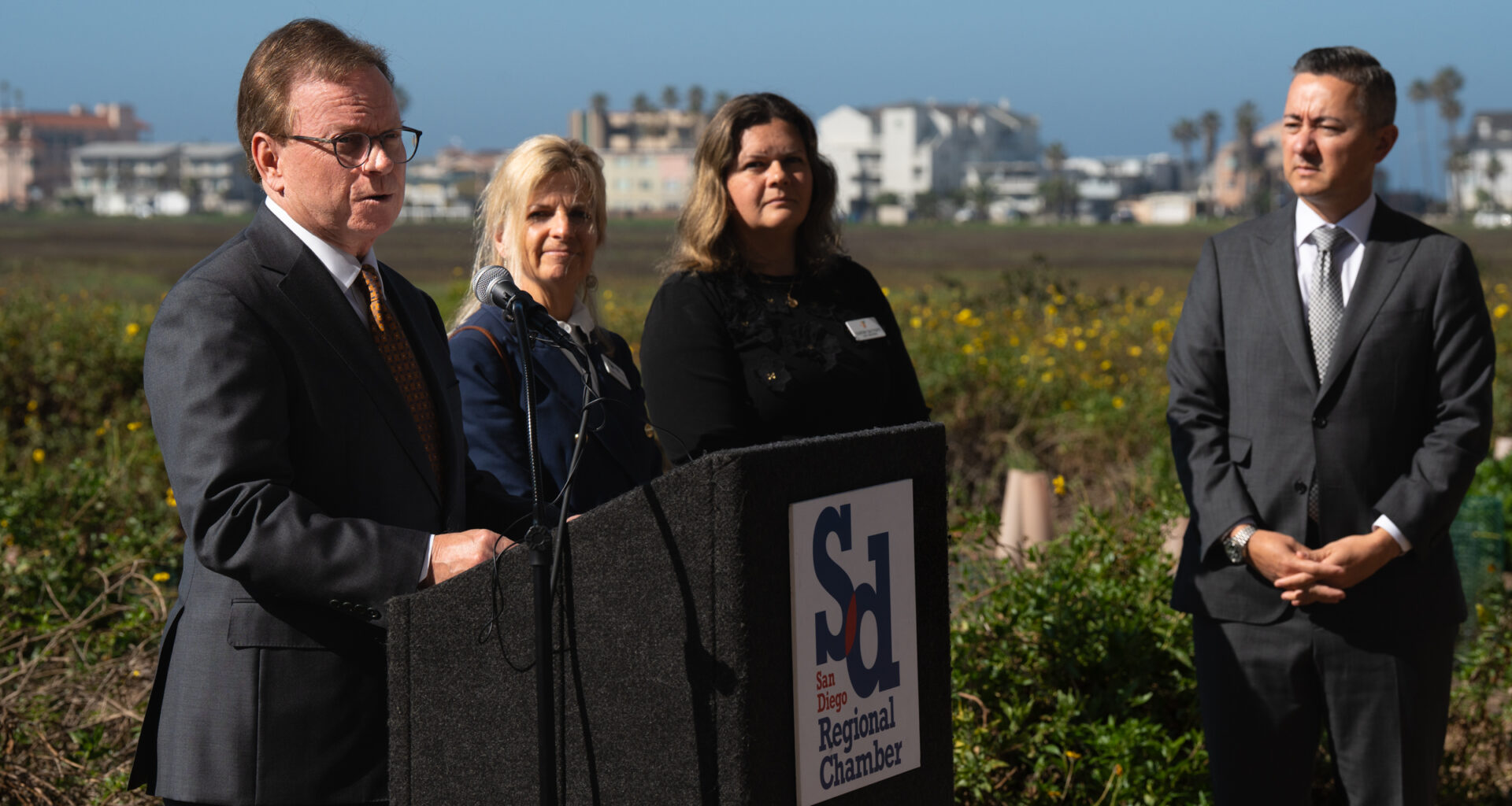
Several speakers underscored that point at a news conference held to discuss the report at the amphitheater of the Tijuana River National Estuarine Research Reserve on Wednesday.
“Public health should never be compromised by failing infrastructure and fragmented governance,” said Chris Howard, president and CEO of Sharp HealthCare.
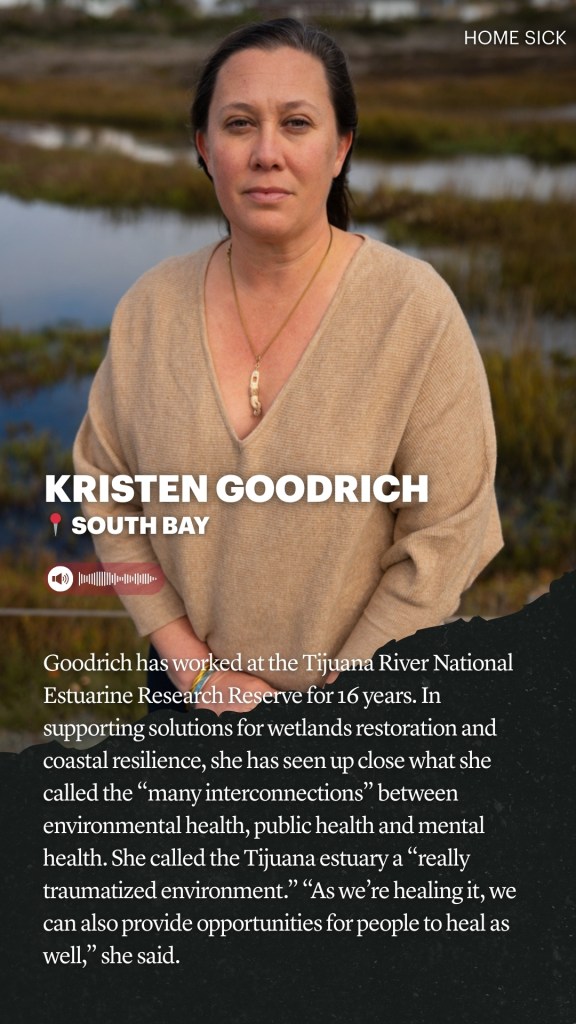 Kristen Goodrich is one of 100 residents impacted by the Tijuana River sewage crisis. Click to hear their experiences.
The report was commissioned by the Prebys Foundation for the San Diego Regional Chamber of Commerce, many of whose business members rely on the cross-border economy.
Authors Liden and Giner have been key figures in advocating for Tijuana River sewage solutions. Liden has worked on wastewater projects in the southwest border region for more than 20 years. Giner helped secure millions of dollars in funding for expanding the South Bay International Wastewater Treatment Plant during her tenure at the IBWC during the Biden administration.
Their report confronts one of the major challenges for the pollution crisis: a revolving door in leadership on both sides of the border and the accompanying difficulty in retaining institutional knowledge and addressing long-term goals. The report also provides a blueprint for how to transform years of largely reactive patch-work solutions to a proactive strategy.
“This is not a short-term fix,” said Chris Cate, the president and CEO of the San Diego Regional Chamber of Commerce. “It is a durable strategy, and it requires binational collaboration, sustained investment and accountability at every level. Today, we’re not just releasing a report, we’re presenting a roadmap.”
Liden and Giner’s recommendations include:
Urging Mexico to update its “Gran Visión Tijuana” assessment to identify its wastewater system deficiencies,
Suggesting the U.S. commit to spending up to $30 million a year to operate and maintain the South Bay International Wastewater Treatment Plant,
Creating a special binational committee within an already existing work group to resolve stalled projects,
Seeking the U.S. federal government to hold annual binational stakeholder meetings to gather feedback on progress,
Establishing a binational master plan for managing projects that is renewed every five years so it accurately reflects projected growth in the region, and
Conducting a study for the feasibility of diverting and treating the river on the U.S. side of the border.
In December, the U.S. and Mexico signed a new agreement referred to as Minute 333 that set timelines for completing wastewater infrastructure projects on both sides of the border and outlined plans to address trash and sediment impact on the wastewater system.
Courtney Baltiyskyy, a leader with the Tijuana River Coalition and vice president of policy and advocacy at the YMCA of San Diego County, spoke of a need for greater urgency.
“We’re at a tipping point of awareness about this issue, but the solutions are complex,” Baltiyskyy said. “There’s absolutely no reason why we shouldn’t fund and move forward with realizing this plan.”
Update, 11:15 a.m. Wednesday, March 11: This story has been updated to include comments from a news conference called to discuss the report.
Type of Content
News: Based on facts, either observed and verified directly by the reporter, or reported and verified from knowledgeable sources.