
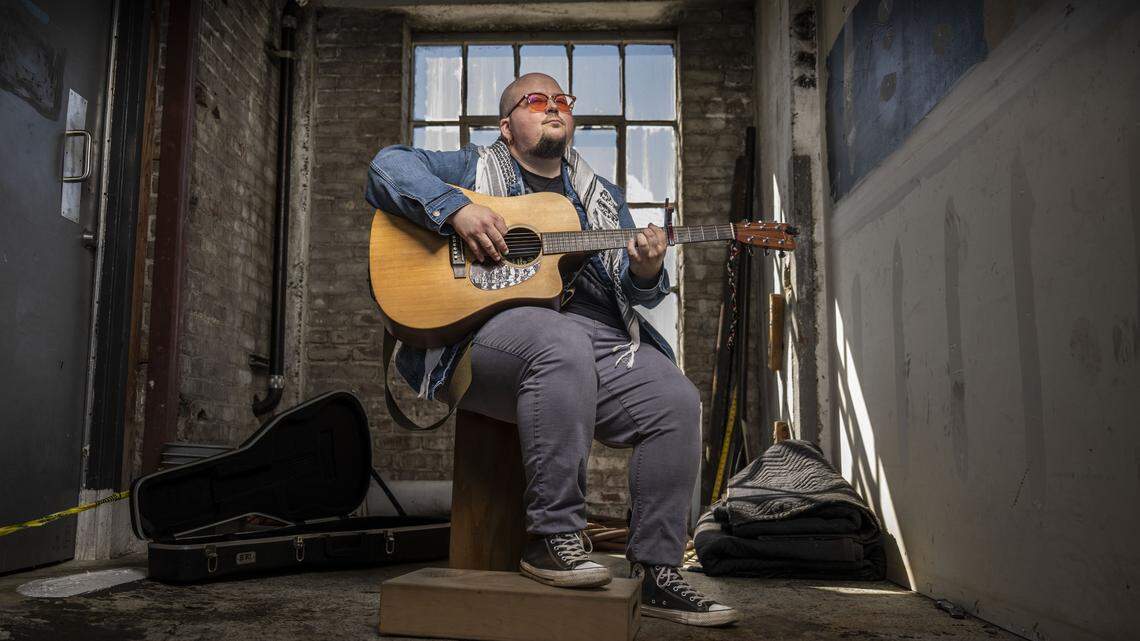
Protest music is surging back into civic life, filling spaces where traditional politics increasingly feel stalled.
Volunteers in a fast-growing activist movement based in Minneapolis called Singing Resistance are spreading out across the country, gathering outside of U.S. Immigration and Customs Enforcement offices and other federal buildings, singing simple choruses meant to be learned in minutes and carried into protests.
Though protest music has long been associated with American civil disobedience, it is experiencing a resurgence, particularly since Renee Good of Minneapolis was killed by an ICE agent while demonstrating against federal immigration raids in Minnesota. In the aftermath of Good’s killing on January 7, Singing Resistance was formed and spread to other cities, including Sacramento.
Then Bruce Springsteen wrote ‘Streets of Minneapolis’ in Good’s honor and a movement was set to music.
By late January, Northern California singer-songwriter Richard March performed Springsteen’s song before a packed outdoor crowd at SacYard Community Tap House.
“My guitar player … saw like 40 phones go up and just start filming us,” March said. “Afterward, during the break, people were like, ‘Man, I’m so glad you played that song.’”
Eli Conley, a 40-year-old singer-songwriter, signed up early for a virtual Singing Resistance training and began working with other Sacramento locals to launch a chapter.
“It’s not just that we have to hold on and things will get better inevitably, but that through the act of singing, of protesting, of organizing together, that’s what’s going to bring the dawn,” Conley said.
Shana L. Redmond, a Columbia University professor who studies protest music and movement culture, said protest music spikes during periods of political unrest and violence, especially when such events are facilitated by the state. Protest music aims to mobilize those already “on board,” but it’s also trying to grow the base, Redmond said
From internet feed to folk hero
Hunger for this music has propelled a largely unknown artist to unlikely heights. Jesse Welles, 33, vaulted from relative obscurity after his satirical songs “United Health” and “Join ICE” went viral. He earned four Grammy nominations and appearances on late-night TV after a period where he considered quitting music.
Another millennial artist, Carsie Blanton, expanded her following to a younger demographic after she listened to her conscience and began writing more songs “about our shared political life.”
“I’m connecting to something in the zeitgeist,” Blanton said. “There’s a great longing for that feeling of solidarity right now, so I’m trying to write songs that allow people to feel that. And it is bringing a lot of people to my songs.”
Her fans are unusually engaged in leading change: When she asks, “Who here’s a political organizer, works for a nonprofit or does social work?” she estimates it’s “probably 60% of the crowd.”
Songs for a fractured moment
Blanton said she’s now a socialist rather than a Democrat. Last October, she accepted an invitation to join the Global Sumud Flotilla, a collection of activists seeking to provide aid to Gaza before the Israeli Navy intercepted them. The group was treated as enemies of the state, Blanton said, strip-searched, zip-tied and deprived of food and sleep. Her U.S. touring schedule was interrupted while she was detained in Israel.
But while on the flotilla, Blanton played her song, “Little Flame,” with her boatmates, and they shared videos of them all singing it together. Within days, she said, they learned musicians around the world were performing the song in support of them.
“We would wake up on the boat and look at our phones,” she said, and feel buoyed by people covering her song. “It felt … like a folk song.”
The track stitches Johannesburg to Palestine, Wounded Knee to Tulsa — what Blanton calls a “continuous thread of solidarity through time and space.” The “little flame,” she said, represents the spirit of revolution, the belief that food, housing and liberation must be for everybody.
If protest music is a barometer, it suggests the Democratic coalition is shifting. Blanton said she isn’t plucking words like liberation, solidarity and revolution out of the air but rather reflecting what she is hearing in her circle and from her fans.
Polling suggests a sizable share of Democrats and young adults are willing to entertain economic language that used to be politically radioactive. A 2025 Gallup survey, for instance, found that, “Democrats are the only partisan group of the three that views socialism more positively than capitalism — 66% to 42%, respectively.”
A revival no one is marketing
Sacramento has been a cradle of expression in the protest movement. In the late 1960s, a group of Latino artists and activists formed the Royal Chicano Air Force, which promoted the cause of justice for farmworkers.
Juan Carrillo, co-founder of the Royal Chicano Air Force, said protest music comes from “a failed promise” — the gap between what America says it is and what it delivers. That’s why, he asserted, a performance like Bad Bunny’s Super Bowl halftime performance can land as “in-your-face protest,” even for people who don’t understand every lyric.
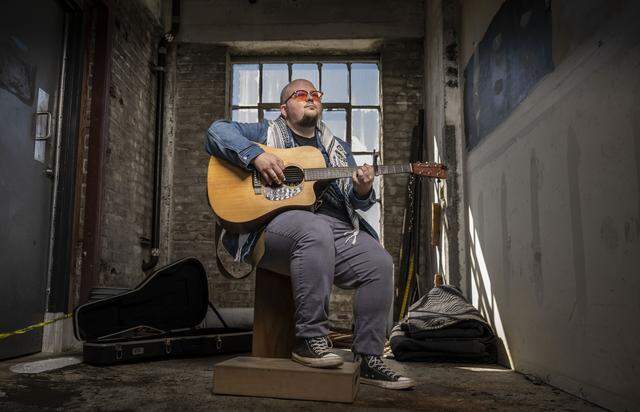 Singer-songwriter K.C. Shane, who has performed protest songs at local rallies and demonstrations, warms up his guitar to play an original song called “Someday” in Sacramento on Friday. HECTOR AMEZCUA hamezcua@sacbee.com
K.C. Shane, a Sacramento-area singer-songwriter, regularly fields requests to perform his protest songs at rallies and demonstrations. His song, “Someday,” written for a Trans Day of Remembrance memorial, imagines a future “when we’ll all be safe, no more bodies slain.”
Carrillo and Blanton said it’s the people who are demanding protest music, seeking a kind of social glue at a moment of collective stress.
Concert promoters “haven’t figured it out yet,” Blanton said, but the crowds have.
When institutions feel brittle and politics feel stalled, people reach out for culture — and culture is answering back in song.
“We collectively are in the battle of being able to be liberated and be free to be who we are,” Shane said. “The powers-that-be have created division between all of us.”
Cathie Anderson covers economic mobility for The Sacramento Bee. She joined The Bee in 2002, with roles including business columnist and features editor. She previously worked at papers including the Dallas Morning News, Detroit News and Austin American-Statesman.