
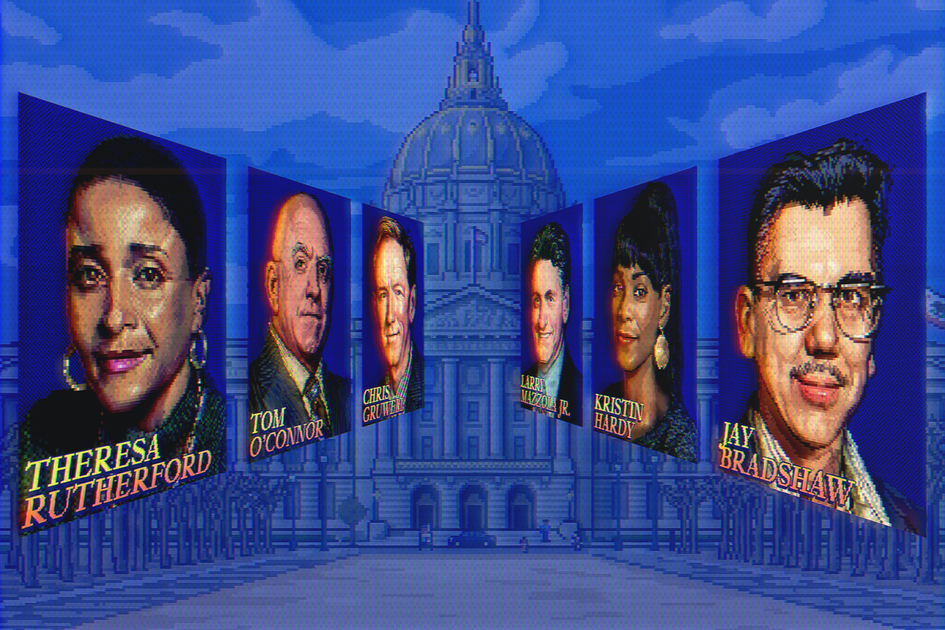
They can mobilize armies of foot soldiers to put a politician into office. They pour big bucks into local elections. Their pressure campaigns can shake City Hall to its foundation. They can call for strikes that disrupt day-to-day life. But their names and faces are unknown to the vast majority of San Franciscans whose lives their work directly touches.
They are the rulers of San Francisco’s most powerful labor unions, one of the least understood sources of influence in city politics and beyond.
The city and surrounding region have long been considered a union powerhouse. The San Francisco-Oakland-Fremont metropolitan area was home to 329,473 union workers as of 2024, according to the UC Berkeley Labor Center. That’s 12.4% of the area’s workforce, above the national average of 10% in 2025. Nearly all of San Francisco’s roughly 34,000 city workers are represented by unions. And out in front of this vast army of laborers are a select few leaders, who are often seen raising fists and bullhorns on the steps at City Hall or emerging from the bargaining rooms where the real decisions are made.
Unlike elected politicians, union leaders can stick around for years. “One day, Daniel Lurie will be gone,” said one longtime labor ally. “These are institutions.”
The Standard set out to understand the forces behind the city’s labor movement. We spoke with union leaders, line staffers, City Hall insiders, and others to understand the movers and shakers of San Francisco labor.
Based on those interviews, we’ve assembled a list of 37 figures, whom we’ve placed into seven boxing-themed categories, from the heavyweights who pack the biggest punches to the cornermen offering strategy and coaching. Forgive the violent caricatures, but union leaders can be world-class grapplers, using equal parts intellect and muscle, jabs and uppercuts, to achieve their aims. Their school of martial arts contrasts with the high-stakes political poker practiced by City Hall, which we detailed in our previous list of power players, “The House of Daniel Lurie.”
The timing of this list is important: 2026 will be a watershed moment for the city’s labor factions as populist sentiment sweeps the nation, affordability remains a top issue for voters, and a business-aligned mayor navigates the tricky political tests unions are setting out for him. Unions plan to spend big to promote their priorities for the June ballot, including their signature “Overpaid CEO Tax” measure. Meanwhile, the mayor’s charter and commission reform efforts could face stiff resistance from labor. On top of it all, the city’s $877 million budget deficit is prompting layoffs, teeing up a major showdown between workers and City Hall.
Let’s get ready to rrrrumble!
These are labor’s knockout artists: Historically important leaders whose impact is felt not just within their unions but throughout the entire political ecosystem.
Mike Casey
President of the San Francisco Labor Council. Represents: 100,000-plus citywide union members. Salary: $93,699.
If San Francisco has labor royalty, Casey is king. At first glance, he doesn’t look like a monarch. His outfits are worn, as if they’ve been in the labor movement as long as he has — since 1986 — and his sleeves are perennially rolled up, as if he just left the picket line (opens in new tab). For two decades, he has flexed his political muscle leading the San Francisco Labor Council, an alliance of nearly every union that is vying to prevent Lurie from weakening union power by reforming the city charter, among other changes. Casey is in negotiations with the mayor’s office to stop business interests from gutting workers’ healthcare and is drawing a line in the sand over Lurie’s attempt to make it tougher to place measures on the ballot — a key tactic labor uses to raise money through parcel taxes or taxing corporations to pay for everything from staff raises to workforce housing. Casey is positioned to go toe-to-toe with City Hall: He led Unite Here for 21 years (opens in new tab), showing that striking hotel workers can bring San Francisco’s lucrative convention business to a standstill. “Our union used to have a lot of old-style union leaders who were good negotiators but who weren’t organizers,” Casey said. ”And my generation … we were organizers.”
David Canham
Executive director of SEIU 1021, cochair of SF Labor Council’s Public Employee Committee. Represents: 60,000 nurses, administrative and nonprofit staffers, and others across Northern California. Salary: $200,179.
Canham grew up in South Africa and held multiple roles at SEIU, the city’s most powerful public-sector union, before landing the executive position in 2021. While he’s not doing the boots-on-the-ground work representing the nurses and other workers of SEIU 1021, Canham is deeply influential in marshaling the city’s enormous public-sector workforce. He is among the labor officials who meet most often with Lurie during budget season, according to calendar records. Most recently, Canham’s union has thrown its weight behind the contentious Overpaid CEO Tax, spending $150,000 on a ballot measure labor says will raise $200 million for the city’s general fund. The measure has prompted a competing proposition from the city’s business community, a showdown that is likely to become one of the biggest political stories of 2026. Canham’s life partner is the next person on this list, Debra Grabelle, romantically linking two of the city’s most influential public-sector unions.
Debra Grabelle
Executive director of IFPTE Local 21, cochair of SF Labor Council’s Public Employee Committee. Represents: More than 13,000 engineers, librarians, accountants, and other government employees. Salary: $226,749.
Grabelle’s entrée to labor was helping to unionize a bread factory in Ohio. “The employer would change people’s hours the day they came to shift, which was really terrible,” she recalled. “That meant people couldn’t know when they would get off of work so they could take care of their children.” After a stint at the California Nurses Association, she was brought on in 2018 to lead the IFPTE, which reps more City Hall employees than any other union except SEIU. Grabelle calls its 6,478 San Francisco employees the “public-sector nerds.” She’s directly involved in top-level City Hall conversations during budget season, calendar records show, but is also not afraid to get her hands dirty. Last year, she was arrested alongside about a dozen others (opens in new tab) in the Board of Supervisors chambers during protests against budget cuts. “She is fiery,” said one longtime labor leader. “She doesn’t take any shit. And she’ll call out somebody if they’re speaking against workers.” Another said: “When you’re in a fight, you want Debra … but also Debra knows a deal has to be made at the end.” Grabelle’s union is supporting the Overpaid CEO Tax and will be pulling out the big guns to protest the mayor’s personnel cuts this budget season.
Cassondra Curiel
President of the United Educators of San Francisco. Represents: 6,000 teachers, school counselors, campus security guards, and other school workers. Salary: $91,501 (teacher salary from SFUSD).
Those who know her swear that Curiel isn’t the firebrand she played during the recent teachers strike. She’s patient and affable, helpful traits for the decade she spent coaxing middle school students to hit the books in her English classes. But don’t underestimate her: She suffers no fools in the San Francisco Unified School District. Politically, Curiel’s United Educators of San Francisco falls even farther to the left than most people in this liberal stronghold, a stance that landed the union on the losing end of a 2021 campaign (opens in new tab) to recall three like-minded school board commissioners. After that loss, Curiel pivoted away from electoral politics toward pure organizing. In February, her union’s roughly 6,000 members overwhelmingly backed shutting down the city’s 122 schools, leading to a four-day educators strike, the city’s first in 47 years. While the union successfully wrangled the district to provide fully paid dependent healthcare for educators, Curiel will now have to navigate the aftermath of that win. This year the district is pinning layoffs and school closures to the top of its syllabus — with Curiel fighting against them at every step.
Olga Miranda
President of SEIU Local 87, secretary-treasurer of the SF Labor Council. Represents: 4,500 private-sector janitorial workers. Salary: $140,666.
How we reported union leaders’ salaries:
Salary information comes from the U.S. Department of Labor and the Internal Revenue Service. This data has limitations and may not fully reflect current compensation. Filing periods vary by organization, and some figures may reflect prior years depending on the most recent available report. Salaries are not available for every individual.
Union leaders across San Francisco describe Miranda as a powerhouse. She’s “fucking great,” said one. She exercises power the old-fashioned way: members marching behind her, a bullhorn in hand, the volume turned up to 11. “Olga’s in your face,” one leader said. Because many of her union members are immigrants, Miranda frequently mobilizes against (opens in new tab) deportation threats; she pushed Lurie to be more vocal against the federal government early in his administration. And the mayor clearly values Miranda, featuring her in a September video (opens in new tab) alongside the Mexican consul general. The mayor’s allies tapped Miranda to serve on the Downtown Development Corp., raising money for civic efforts alongside bigwigs like crypto billionaire Chris Larsen and former eBay and Hewlett-Packard CEO Meg Whitman. Of course, revitalizing downtown will help Miranda’s members, who work at Salesforce, Marriott’s St. Regis, Lyft, Oracle Park, and other significant locations. She also serves as secretary-treasurer of the Labor Council, strategizing for public- and private-sector unions’ fights with city leaders. Miranda said her chief goal this year is educating immigrant workers on their citizenship rights, something Local 87 can’t take on alone. “It’s got to be the entire labor movement who has to answer that call,” she said.
Tony Delorio
Principal officer of Teamsters Local 665, member of SF Labor Council Executive Committee. Represents: 6,000 delivery drivers, truckers, parking attendants, and others. Salary: $192,554.
A third-generation San Franciscan and Teamster, Delorio could recognize the union’s logo — two horses and a wheel — by the time he was 2. He oversaw the parking garage at 5th and Mission before joining the union’s senior ranks and becoming its leader in 2019. One union figure described him as a “product of old-school San Francisco”; another called him “super loyal” and “unfiltered (opens in new tab).” Delorio has ties to Assemblymember Catherine Stefani (“They’re like Italian cousins,” one person said), Assemblymember Matt Haney, and District Attorney Brooke Jenkins. The Teamsters are at the forefront of the labor battle against artificial intelligence; particularly, autonomous vehicles that could affect delivery drivers. “Their end game, make no mistake, is parcel delivery,” said Delorio. His outfit has also been battling drone-delivery testing (opens in new tab) in the Mission, and Delorio is one of the lead advocates for Lurie’s Muni tax measure, serving as co-chair of the initiative.
Theresa Rutherford
President of SEIU Local 1021. Represents: 60,000 nurses, administrative and staff, nonprofit staffers, and others across Northern California. Salary: $100,522.
Rutherford moved to the U.S. from Jamaica in the late ’90s and worked as a nurse assistant at Laguna Honda Hospital. She became interested in labor issues after seeing the mental and physical abuse endured by healthcare workers. She has climbed the ranks of SEIU and was appointed president in 2022. The union plunked more than $1.5 million into the 2024 election, supporting an additional tax on autonomous vehicles, the reelection of Supervisor Connie Chan, and opposing Mark Farrell’s mayoral campaign. While Canham, the union’s executive director, oversees 1021’s field directors, Rutherford connects with other labor groups and works on overall strategy. She is having a busy year: Her union will be campaigning for the Overpaid CEO Tax while trying to fend off layoffs and other budget cuts. “We’re not just throwing our hands up in the air,” Rutherford said of the city’s budget deficit. “We’re putting our money where our mouth is.”
Rudy Gonzalez
Secretary-treasurer of the San Francisco Building & Construction Trades Council, member of the SF Labor Council’s Executive Committee. Represents: 35,000 iron workers, electricians, plumbers, and others. Salary: $168,645.
A longtime labor organizer with roots in the Teamsters, Gonzalez is known for getting developers to use union work for the city’s construction projects. As a member of the Labor Council’s Executive Committee, Gonzalez is generally at the head of the table alongside other key union figures. “He basically knows what makes people tick,” one fellow labor leader said. “Why they’re doing what they’re doing. Are they politicians? Do they like to smoke cigars? Do they really want to help people?” In February, Gonzalez resigned (opens in new tab) from the Labor Council’s Public Employee Committee, exposing a fissure between his trades and the city’s public-sector unions, which are likely to put up a fight over layoffs. Meanwhile, Gonzalez needs to stay in City Hall’s good graces if he is to get work for his members, who have been affected by the dearth of development.
Larry Mazzola Jr.
Business manager and financial secretary treasurer of Local 38, president of the Building & Construction Trades Council. Represents: 2,600 plumbers, steamfitters, and HVAC/R workers. Salary: $326,199.
Known for his colorful quotes (“I wouldn’t know that dude if he fell face-first in my soup,” he once said of future Mayor Daniel Lurie) and propensity to wear sunglasses indoors, Mazzola hails from a dynastic line of labor organizers. His grandfather and father led Local 38 for decades before he took the reins in 2013. A product of area Catholic schools, Mazzola has capitalized on his deep civic roots by serving on city boards, including the influential Parks Commission. He has traditionally sided with the city’s moderate factions, including developers he can push to secure union construction jobs. But the council does have some progressive tendencies, endorsing Supervisor Connie Chan for Congress last month over state Sen. Scott Wiener, with whom it has quarreled over worker protections.
Kim Tavaglione
Executive director of the San Francisco Labor Council. Represents: 150 unions with a total of 100,000 members. Salary: $148,686.
Tavaglione built her bona fides as a rep for SEIU and a political director for the National Union of Healthcare Workers. At the Labor Council, she holds one of the most critical (and grueling) roles, overseeing the city’s many unions — which don’t always get along. That means steering the priorities and personalities of the labor bloc while also granting authorization if a union wants to strike. Tavaglione is considered by her peers to be a brawler more than a strategist. “Kim is someone you would want to be your field general for war, but she’s not someone who would cut a deal,” said a fellow labor executive. Tavaglione is gearing up for multiple fights, including Lurie’s charter reform ballot measure, which she said is driven by business interests.
They meet their government counterparts with a variety of jabs, kicks, and chokeholds. They’re the specialists focusing on their own fiefdoms, sometimes well beyond the octagon of San Francisco.
Jay Bradshaw
Executive secretary-treasurer of the North Coast States Carpenters Union. Represents: 57,000 carpenters, drywallers, pile drivers, and others along the West Coast. Salary: $350,869.
A state-level figure with deep contacts in San Francisco’s business community, Bradshaw and his carpenters have famously been at odds with Mazzola’s trades over issues like modular housing. The split came to a boiling point in 2021, when members of the trades criticized the modular construction of 833 Bryant St., a housing complex for formerly homeless people, overseen by Lurie’s nonprofit Tipping Point Community. “Some trades guy doesn’t like me? Cool, whatever,” Bradshaw said when asked about the dustup. Bradshaw is described in colorful ways by those with whom he has worked: “shit disturber,” “behind-the-scenes operator,” and “not someone to be dismissed or underestimated.” His union is expected to engage in a number of battles this year, including supporting supervisor campaigns for Stephen Sherrill and Alan Wong, and state Sen. Scott Wiener’s congressional race.
Hunter Stern
Assistant business manager for International Brotherhood of Electrical Workers Local 1245. Represents: 29,000 utility workers in California and Nevada. Salary: $298,417.
While he may not be engaged in day-to-day City Hall squabbles, Stern plays a critical role in fending off political attacks against Pacific Gas & Electric, one of the most powerful businesses in town. “He’s an operator, a deal maker, a fierce advocate for his members, and a fierce defender of PG&E,” one labor figure said. The utility came under heavy criticism in December after blackouts caused mayhem across the city. The fiasco, caused by a fire inside a PG&E substation, pushed Wiener to propose a bill that would make it easier for cities to break away from the utility. For Stern, that means war. “We will have a fight again,” he said of the state senator’s efforts. “He has repeatedly attacked the utility. He doesn’t know anything about electricity.”
Mary Bravewoman
President of AFT2121, City College of San Francisco’s educators union. Represents: 900 full- and part-time educators. Salary: $111,853 (teacher salary from City College).
Bravewoman takes union representation so personally that she only recently started eating grapes. Growing up in Santa Cruz, her family joined a grape boycott to support the United Farm Workers’ fight for fair wages. A City College math teacher, (opens in new tab) the AFT 2121 president successfully campaigned to replace the school’s board trustees who voted to lay off educators. More union-friendly trustees now sit on the board. Unlike some union leaders, Bravewoman still works her day job but is paid “release time” for her union work. She hasn’t always had electoral success: She allied AFT2121 with SEIU 1021 to float Proposition O (opens in new tab) in 2022 to fund student workforce development classes through a parcel tax; the ballot measure failed. “We worked really hard. It was an opportunity for SEIU 1021 and AFT to come together,” she said. But other influences, including the landlord lobby, spent a boatload of money that “we weren’t able to beat.” Her local will have its hands full in November, as the union vies to elect candidates to four seats on the college board and support legislative aide Natalie Gee in her race for supervisor (opens in new tab). “We’ve got folks out there who’ve been door-knocking,” she said. Gee is running against incumbent Supervisor Alan Wong, a former college board trustee. No love lost there.
Pete Wilson
President of Transit Workers Local 250-A. Represents: 2,500 Muni operators. Salary: $96,752 (operator salary from Muni).
Wilson, who grew up in Santa Rosa, proudly touts his Italian immigrant grandfather’s role as a cement finisher. When Wilson made it to the city for college, he fell in love with Muni trolley buses (opens in new tab). He has spent the last eight years serving the union as a supporting player, long valued as a key strategist behind multiple presidents. In December, he finally took the driver’s seat, just in time for the agency’s generation-defining $307 million budget gap, which threatens to see Muni lines slashed. Wilson will lead his members out of their buses and onto the street to push for a regional ballot measure and local parcel tax to save the agency. “This is one of the biggest challenges we’ve had,” he said. And with no federal help on the way, “San Francisco is going to have to take care of itself.”
Peter Finn
Principal officer and secretary-treasurer of Teamsters Local 856 and president of the Teamsters Joint Council 7. Represents: 100,000 members in Northern California, Central Valley, and northern Nevada. Salary: $147,535.
Finn is a big shot at his union at both the local and state levels. He does dip his toes into San Francisco matters; on March 2, he spoke (opens in new tab) at a City Hall rally about the chaos Waymos caused during the December blackouts. He has also worked on unionization efforts of local Amazon warehouses.
Kim Evon
Executive vice president of SEIU Local 2015. Represents: More than 400,000 nursing and home-care workers. Salary: $246,422.
Evon’s union in 2023 helped secure $25 hourly wages (opens in new tab) for city-contracted caregivers. While she works on many statewide issues, she is a leading advocate for the Overpaid CEO Tax. Said one union figure of Local 2015, “They have the ability to mobilize and bring resources to the table.”
Criss Romero
Executive director of the Municipal Executives Association. Represents: 1,600 managers at City Hall, SFMTA, and Superior Courts. Salary: Undisclosed.
Romero’s job includes fending off calls to “chop from the top (opens in new tab),” a term Supervisor Connie Chan used last year during the budget deficit to push for cuts to management positions. The resulting layoffs were small.
Organizing isn’t their chief role — they most often hype workers’ priorities with politicians, moving and shaking to ensure laborers are top of the ticket.
Anand Singh
Director, Unite Here! International. Represents: 300,000 hospitality workers. Salary: Undisclosed.
Singh led Unite Here! Local 2 for nearly a decade, a tenure that included a national triumph and a historic collapse. In December 2018, Local 2 members celebrated their contract victory (opens in new tab) during a national strike against Marriott. In 2020, however, the pandemic decimated tourism (opens in new tab), leaving thousands of hotel workers — the bulk of Local 2’s membership — without jobs. The local almost closed entirely. But members made it clear they needed Local 2 to guide them through layoffs and navigate their next steps, and even tapped their benefits to keep the union afloat. “It was such a moving moment to see hotel workers, service-sector workers, people who are struggling to make ends meet use what little resources they have to ensure their union would survive,” Singh said. That solidarity stays with him as he serves as a bridge for Local 2 with Unite Here! nationally and on the executive committee of the San Francisco Labor Council. His role now is more political, relying on his relationships with city officials to help Local 2 under City Hall’s dome.
Vince Courtney Jr.
Political captain, LiUNA! Local 261. Represents: Concrete layers, gardeners, and street sweepers in the public and private sectors. Salary: $215,959.
Courtney grew up seeing his father — who ran SEIU Local 400 in the city —work in the office that would eventually become Miranda’s. He confidently plants one weathered boot in the world of journeymen laborers and one patent-leather oxford in the world of electoral politics. Past mayors Gavin Newsom and the late Ed Lee appointed him to the San Francisco Public Utilities Commission, where he served as president and could approve policies and projects that benefited workers. Since stepping down in 2019 while under ethics scrutiny (opens in new tab), he has committed more of his time to coordinating PACs to direct funding toward labor issues and electing labor-friendly politicians. He also serves on the Labor Council’s Executive Committee, wielding influence over strategies to defend workers citywide. One union leader described Courtney as a “hemorrhoid” in cross-union strategic meetings. His response: “I voice my opinion, oftentimes aggressively, because our guys are hungry.” The tension stems from different beliefs: Laborers often fall on the other side of unions that tend to be anti-development and anti-growth, Courtney said. Laborers count on construction for work, but non-laborer unions sometimes take stances against construction as part of progressive political maneuvering. Despite entering its political echelons, he sometimes finds himself opposing City Hall, such as when Local 261 sued the SFPUC for retaliation (opens in new tab) after union leadership blew the whistle on a citywide corruption scandal. His efforts aren’t limited to San Francisco: He rallied laborers for Proposition 50, Newsom’s redistricting measure, and said he’s working to ensure that Rep. Nancy Pelosi’s replacement in Congress is a staunch labor ally.
Joshua Arce
Senior program manager, strategic initiatives, Northern California District Council of Laborers. Represents: 30,000 laborers from Fresno to the Oregon border; 5,600 in San Francisco, San Mateo, and Marin. Salary: Undisclosed.
Arce doesn’t negotiate contracts, file labor grievances, or directly organize workers. Instead, he wades into politics, ensuring that elected officials pass legislation friendly to blue-collar workers and advocating for infrastructure projects. A former civil rights attorney, Arce wears many hats: He’s president of the San Francisco Public Utilities Commission; a leader with the Northern California District Council of Laborers; a member of Local 261, which represents gardeners and concrete washers; and sits on the San Francisco Democratic Party board. His skills can cut both ways: Some in the labor movement characterize him as too cozy with politicians. One salty rival said, “People are like, ‘What’s his job?’ Nobody knows.” To that, Arce said, “I just work here.” It’s clear he has influence, however. In 2024, he joined with labor legend Dolores Huerta, a founder of the United Farm Workers Association, to campaign for Rep. Adam Gray, who unseated John Duarte (opens in new tab) in the Central Valley. Huerta came through for Arce and Local 261 when she joined them on the steps of City Hall in January to back legislation that would ensure higher pay for street cleaners. At a Democratic Party meeting in late February, Arce flexed his political muscles again, arguing that the party should endorse an earthquake safety bond that would bring “thousands of union construction jobs we need really, really bad right now.” The party’s delegates followed his lead, overwhelmingly.
John Doherty
Business manager of the International Brotherhood of Electrical Workers Local 6, vice president for subcrafts at San Francisco Building Trades Council. Represents: 2,600 active workers. Salary: $286,041.
Doherty’s remit is vast: His union represents private- and public-sector employees, including power generation workers, traffic signal technicians, transit mechanics, and insider wiremen (what a layman would call a general electrician) across multiple agencies, such as the San Francisco Unified School District, City College, Public Works, and the SF Municipal Transportation Agency. Electricians, with highly technical expertise, are a “little harder to represent,” one union leader said. “They’ll second-guess you more. They’ll challenge you on the floor more.” Doherty navigates those tensions by being twice as prepared — and, as a colleague said, “wicked smart.” Representing electricians puts him on the front lines of climate policy debates. He chastises politicians who complain about the visual mess of Muni’s overhead wires. “Do you want to look at the air or do you want to breathe it?” he asks them. Doherty’s role as vice president for subcrafts at the San Francisco Building Trades Council puts him in rooms with City Hall power brokers, including this year’s Charter Reform Working Group. When Lurie’s allies suggested changing the city charter to require more signature gathering to place measures on the ballot, labor took issue right away. “That will basically quiet anybody who’s not a billionaire,” Doherty said. “It’ll silence you.” Whether he’s sitting with politicians or across from management, he always keeps in mind the physical risks his members take. “They work their tail off. We’re in construction. Shoulders go out, or knees go out, or wrists, or ankles. These folks, they use up their bodies,” he said. “It’s heartbreaking.”
The emerging movement leaders who are already punching well above their weight class.
Lizzy Tapia
President of Unite Here! Local 2. Represents: 15,000 hotel and restaurant workers across the Bay Area; 8,000-10,000 in San Francisco. Salary: $92,841.
When Tapia was 9, her parents, both nonprofit attorneys, took her to a picket line of Mexican farmworkers in their home of Watsonville. She still remembers the picketers’ slogan pushing to raise the price of produce for a fair wage: “Five cents for fairness.” The sea of people pushing for change inspired her. “I remember it, the feeling of it,” she said. Now, Tapia is in her second year as president of the hotel and restaurant workers union, picketing with her own sea of people: She led a successful 93-day hotel workers strike that rocked convention-goers and downtown denizens in late 2024. During the strike, she was detained by police (opens in new tab) for nonviolent civil disobedience that blocked downtown streets (and cable car tracks). It was one of the city’s largest strikes in a decade, prompting the intervention of Lurie, the mayor-elect, who called Marriott brass to nudge management. While new to leadership, Tapia has organized union actions for 18 years. Local 2 doesn’t have much money to spend on campaigns, Tapia said, but it’s “going in deep” to mobilize members to stump for (opens in new tab) Supervisor Connie Chan’s congressional race. Tapia respects that Chan supported minimum wage and healthcare for airport workers, a contract Local 2 is actively bargaining. Tapia and her members will soon suss out if they need to ignite strikes at Chase Center and Oracle Park, where they fear technology may begin to edge out workers. “We recognize that AI and technology is something that exists in our world,” she said. “It’s not about stopping it; it’s really about figuring out how does technology improve the lives of workers, and how do we maintain good standards and protect jobs for folks?”
Sam Gebler
Firefighter/paramedic, president of San Francisco Fire Fighters Local 798. Represents: 1,600 firefighters, paramedics, and EMTs at SFFD. Salary: Undisclosed.
Though he’s described by fellow union leaders as a humble, aw-shucks, Jimmy Stewart type, Gebler and his union put the “fight” in firefighters. While 798 isn’t known to raise vast sums to spend on elections, the firefighters’ endorsement is courted by politicians for its weight with voters. For politicians who spearhead their causes, like cancer care (opens in new tab), the firefighters will knock down walls. Gebler, who has worked since 2017 as a firefighter and paramedic, is facing early tests of his leadership, as he takes a front-and-center role in negotiations for higher wages, while working with the mayor and Board of Supervisors to pass an Earthquake Safety and Emergency Response Bond (opens in new tab) on the June ballot. The $535 million proposition would see $230 million go toward firefighting, expanding the city’s emergency water system on the west side, constructing a new fireboat manifold at Fort Mason, and renovating or replacing at least five seismically vulnerable fire stations. Union insiders say balancing the contract and the bond will be a difficult task.
Louis Wong
President of the San Francisco Police Officers Association. Represents: About 1,700 police officers. Salary: Undisclosed.
A veteran street cop, Wong last year became president of the police union, one of the city’s most vocal and influential labor organizations. The POA often acts like the department’s shadow leadership, equal parts political sledgehammer and SFPD bullhorn. The union didn’t endorse a mayoral candidate between 2020 and 2024, but it has regained political influence as public opinion has shifted back toward tough-on-crime policing. So far, Wong is a less cantankerous leader than his predecessors, focusing on bread-and-butter issues, like reducing the retirement age and increasing pay and benefits for officers. But he’s also been quietly acting as a liaison between the rank and file, City Hall, and the command staff. Whether he can deliver on his promises to members will be one of his largest tests as the union and city negotiate a new contract. It’s unclear if a raise is in the books given the giant budget deficit, even if city leaders are in a pro-cop mood.
Jim Araby
Strategic campaigns director at UFCW Local 5. Represents: 25,000 retail, cannabis, and agricultural workers. Salary: $130,189.
Araby led the United Food and Commercial Workers Western States Council for six years, pushing policies at the state level for California, Nevada, and Arizona. He now holds a top position in the largest private-sector union in Northern California, representing industries similar to those he supported in his previous job. Described as young, energetic, and rational, Araby is poised to become a bridge between the labor and business communities, according to one longtime labor figure. He was thrust into San Francisco politics after Lurie tapped him as a senior adviser on labor relations, filling a gap in an administration that does not have much union support.
Syd Simpson
Member of the California Nurses Association, executive committee member of the San Francisco Labor Council, steering committee of the California Working Families Party. Represents: Transgender civil rights. Salary: Undisclosed.
Simpson is making waves fighting for trans rights (opens in new tab). They helped organize the city’s Trans March (opens in new tab), bringing the first labor contingent to last year’s event. Sitting on the Labor Council’s Executive Committee and the steering committee of the California Working Families Party, Simpson played a leading role in organizing the debut congressional forum for successors to Rep. Nancy Pelosi and, as an executive board member of the Harvey Milk LGBTQ Democratic Club, started the group’s Trans Caucus. Simpson has their hands full organizing CNA, Rainbow Families Action, and the Labor Council to defend gender-affirming care from proposed federal rule changes (opens in new tab) at Kaiser, Sutter, University of California, and Stanford hospitals. “We haven’t heard from families that care has ended yet,” Simpson said. “We hope it holds.”
Zach Goldman
Political director of SEIU Local 1021. Represents: 60,000 nurses, administrative and staff, nonprofit staffers, and others across Northern California. Salary: $39,848.
Goldman is a member of the mayor’s charter reform group. He is known for developing relationships with City Hall, moving ballot measures, and representing the union in Sacramento.
Kristin Hardy
San Francisco vice president of SEIU Local 1021. Represents: 60,000 nurses, administrative and staff, nonprofit staffers, and others across Northern California. Salary: Undisclosed.
Hardy is one of SEIU’s five regional leaders. She’s usually one of the union’s front-line figures, holding the microphone during rallies, whether it’s protesting tech companies’ taxes, pushing for the city to hire more security guards at the library, or organizing for the Overpaid CEO Tax.
They’re the fixers behind the fighters — coaches and strategists who help union clients advance their priorities through City Hall by lobbying elected officials and staff.
Ramneek Saini
Lobbyist. Represents: Labor and corporate clients. Salary: Undisclosed.
Miranda of SEIU Local 87 and Jim Araby of UFCW Local 5 are arguably the closest union heads to Lurie’s administration. And their political right hand is Saini, a lobbyist (opens in new tab) who describes Araby as her mentor. Saini began her career supporting the San Francisco Labor Council, giving her the knowledge to float between the worlds of politics and unions. “My job, even with our corporate clients, is really providing them a pathway to labor. And really being that bridge,” she said. Saini is ubiquitous, attending any event where you’d expect to see (opens in new tab) City Hall elite, keeping an ear to the ground for the unions she represents. While Miranda’s members at Local 87 have the ultimate say on endorsements, Saini provides recommendations. Another mayoral connection — Han Zou, Lurie’s head of communications — used to work for Saini but departed to work on Lurie’s campaign, then stayed on in the administration. “I’m really sad. I thought Han was gonna come back after the mayor’s election,” Saini said. But Lurie made the right choice, she added. “Han’s brilliant.” And now Saini has another ally on the inside.
Chris Gruwell
Lobbyist, member of LiUNA! Local 261. Represents: Unions, corporations, local universities, and others. Salary: Undisclosed.
As CEO of the influential public affairs firm New Deal Advisers, Gruwell is an advocate for more than 50 clients. Lobbyist filings show him in constant touch with City Hall supervisors, department heads, and the mayor’s staff. Much of Gruwell’s work involves the firefighters union, Local 798, and Teamsters Joint Council 7, a regional body that reps workers in Northern California, the Central Valley, and northern Nevada. He has put the spotlight on increased cancer risks to firefighters and assists the Teamsters in strategies on pushing back against autonomous vehicles. The union has been able to block Waymo from making deliveries, and last year, it was front and center (opens in new tab) when a Waymo killed a beloved bodega cat.
Tom O’Connor
Former firefighter and past president of the Firefighters Local 798. Represents: Labor clients include Firefighters Local 798. Salary: Undisclosed.
Mark Gleason
Former secretary-treasurer of Teamsters Local 665. Represents: Labor clients include the Teamsters union. Salary: Undisclosed.
O’Connor and Gleason are former union heads who leverage their expertise to sway policy alongside Gruwell at New Deal Advisers. Gleason was a leader at Teamsters Local 665 when it first organized bus drivers (opens in new tab) working for Apple, Genentech, and other tech companies. Those drivers now enjoy robust benefits. “We’re very proud of that,” Gleason said. “It was the beginning of any organizing in the tech industry at all.” O’Connor, meanwhile, has racked up contractual wins for city firefighters. While their firm also represents real estate developers like Boston Properties, O’Connor and Gleason consistently put points on the board for labor. In January, O’Connor lobbied SFFD Chief Dean Crispen to ban harmful PFAS and other chemicals in protective gear on behalf of Local 798. Those “forever chemicals” lead to higher cancer rates, O’Connor said, and banning them makes firefighters safer (opens in new tab). “As a cancer survivor myself, I know that’s more than critically important.” O’Connor worked with Supervisor Matt Dorsey on behalf of the SF Deputy Sheriffs’ Association to support a payroll deduction that would fund donations for families of deputies killed on the job. And, on behalf of the Teamsters, Gleason lobbied airport officials to ensure that autonomous vehicles are held to similar regulations as Lyft and Uber.
Their peaks have passed, but these longtime organizers still have the ears of union leadership and command respect amongst the rank-and-file.
Susan Solomon
Former president of the United Educators of San Francisco, City College of San Francisco Board of Trustees member. Represents: 6,000 teachers, school counselors, campus security guards, and other school workers. Salary: $94,536 (as of 2020, paid by SFUSD before retirement).
When Solomon was growing up in San Francisco, her parents would sing “Solidarity Forever (opens in new tab),” the century-old labor song popularized by Pete Seeger. The message stuck. Two years after beginning work as a kindergarten teacher at John Swett Elementary School in 1999, Solomon became active with the UESF and was elected as executive vice president in 2012. She helped elect Board of Education candidates who championed union causes, pushed for a “restorative justice” approach to school discipline, and organized special-education teachers. “If we ran this show ourselves and we didn’t have to worry about money, what would we do?” she asked teachers. They distilled their answers into a document, “Solutions for Special Education (opens in new tab),” with short-term recommendations, including new lighting for sensitive students, that were implemented quickly. Long-term challenges, like addressing staffing shortages, remained a central plank even in UESF’s February strike. For many San Franciscans, however, Solomon is probably most closely associated with the bitter battle to bring kids back to school as the pandemic eased. Groups like Decreasing the Distance pushed for schools to reopen sooner, often clashing with Solomon and the union. “A distraught parent during a Board of Education meeting referred to me as ‘the most dangerous person in San Francisco,’” Solomon said, “and I was quite taken aback.” Still, she added, it was “necessary for schools to be safe.” The schools eventually reopened, and Solomon retired from the union in 2021. She now serves as a City College board trustee and is a grandmother of three — still singing Seeger songs.
Josie Mooney
Deputy director of SEIU Local 1021. Represents: 60,000 nurses, administrative and nonprofit staffers, and others across Northern California. Salary: Undisclosed.
Mooney previously ran SEIU 790, the public-sector employee union, before it merged with her current union and is now involved in external organizing, political research, and communications. “She’s kind of a whisperer behind the scenes,” said one SEIU organizer. She used to regularly get breakfast across from City Hall with Willie Brown when he was mayor, and the two still occasionally meet — most recently in February at the St. Regis, where Mooney was discussing gig work.
Sal Rosselli
President emeritus of the National Union of Healthcare Workers. Represents: 19,000 healthcare workers. Salary: $161,994.
Rosselli was a political fighter for decades, involved in the city’s two most prominent gay groups. He helmed the Alice B. Toklas LGBTQ Democratic Club in the 1980s and has been a member of the Harvey Milk LGBTQ Democratic Club since the 1990s. Out and proud during the height of the AIDS epidemic, Rosselli trailblazed for the gay movement in union leadership. “During the early days of the HIV-AIDS crisis, ignorance was our biggest enemy. We led the way on member education to ensure everyone understood the facts about the virus and felt safe treating their patients who were suffering from it,” he said. He was also at the epicenter of an internal power struggle at SEIU that was so contentious it has been referred to as (opens in new tab) labor’s “World War III.” Eventually, Rosselli founded NUHW, which has more than 19,000 members (opens in new tab). Though he retired as president in 2024, he’s still on the union’s payroll, leveraging his relationships to give NUHW members inroads to politicians. He also stumps for San Francisco, serving as a Democratic National Committee delegate (opens in new tab) during the 2024 presidential race. NUHW’s members voted to back state Sen. Scott Wiener’s campaign for Congress and Gary McCoy and Natalie Gee to the Board of Supervisors.
They don’t wear stripes or blow a whistle, but these are the figures whom both sides — local government and unions — trust to mediate their thorniest disputes.
Patrick Mulligan
Director of the Office of Labor Standards Enforcement. Represents: All San Francisco workers. Salary: $251,706.
Mulligan, a former financial secretary for the Carpenters Local 22, plays one of the key roles in city government directly involved with labor, since his 2016 appointment by the late Mayor Ed Lee (opens in new tab). The OLSE enforces city labor laws, making Mulligan the de facto sheriff (opens in new tab) of the workforce. OLSE can proactively audit employers but also depends on labor and community partners, like the Chinese Progressive Association, since enforcement is largely driven by complaints made to hotlines and the office’s website. In the 2024-25 fiscal year, the office collected $21 million for roughly 17,000 workers (opens in new tab) who were deprived of wages or healthcare benefits or otherwise swindled by management. Some labor leaders wish Mulligan were more of a champion to their causes, describing him as “coloring inside the lines” and a stickler for precision; he has tossed back more than a few complaints that were filed in a sloppy manner. Mulligan argues that running a tight ship ensures a complaint can make it all the way to court and a resolution that serves the city — and, more important, workers.
Lou Giraudo
Business executive. Represents: The bridge between labor and business. Salary: Undisclosed.
Giraudo is considered a rare breed as someone with a long history of business success who maintains deep ties to the labor movement. Considered a “big-time power broker” by one well-known labor figure, Giraudo has roots in San Francisco that run deep. His father, “Papa Steve,” bought Boudin Bakery in 1941, and Giraudo oversaw it before his son Dan bought it in 2021. Giraudo is known for his mediation skills, having hammered out a deal in 2005 (opens in new tab) that ended a nine-week strike between SEIU and California Pacific Medical Center, for which he received praise from Rep. Nancy Pelosi. Giraudo is working on a revitalization project for Fisherman’s Wharf, with the building trades’ agreement to complete it with union labor. “He’s of the shrinking breed of pro-labor capitalists,” said a labor representative. “He knows how to make money, but he doesn’t see unions as being in opposition.”