

Oakland’s aging housing stock — the Victorians in West Oakland and the diverse bungalows in the east — is part of its charm. But as residents of older homes know, these structures pose health hazards when poorly maintained.
A new $4.4 million grant from the federal government will help Oakland abate one of the most prevalent dangers: lead paint.
Toxic lead-based paint was often used to coat walls in homes until it was banned in 1978. Exposure among young children — such as when paint chips off walls and ends up on floors where toddlers crawl — can lead to lifelong physical and cognitive harms.
In Oakland, an estimated 80,000 rental units alone have lead paint. The city has an existing program to help households remediate lead paint, but it serves only 10 homes a year, according to the city.
The new grant — which still needs final approval from the City Council — still won’t come close to eliminating the problem. But it will serve about 50 additional households (both owned and rented) over the span of four years, the city says.
Habitat for Humanity East Bay/Silicon Valley will oversee the remediation work. Low-income households throughout Oakland with children under 6 will be able to apply for the grants. But the city will specifically reach out to and prioritize households in 33 Oakland census tracts that are in the top 5% of lead risk across the state. The tracts, according to a map provided by the city, are almost entirely in West Oakland and the East Oakland flatlands — predominantly communities of color.
The selected households will also have access to funds for remediating other home health hazards, like mold or radon.
The program is expected to launch this fall, said city spokesperson Jean Walsh. The application process is still being developed. In the meantime, she said, residents can check out similar existing services through the city, county, and Habitat.
Also included in the new grant is $321,000 for building up workforce and contractor capacity for lead paint abatement in Oakland. Workers need special certification to work with lead paint, and the cost of getting certified can be prohibitive for employees and small firms, according to city staff. Small businesses may need extra support to work on these projects, too; for example, lead paint remediation in multi-family buildings comes with additional requirements for contractors. (The new program will start with single-family homes as a result.)
A just-released study revealed gaping racial and gender disparities among companies Oakland contracts with for goods, services, construction, and more. It also found that the city too frequently waives its requirements to prioritize small and local businesses in its contracts.
With the federal lead program, the city is indeed asking the council to waive requirements around using small and local contractors for the work. Staff said that’s a reflection of the paltry number of firms qualified to work with lead paint.
“In our experience, it’s a very limited pool,” said Caleb Smith, a staffer in Oakland’s housing department, at Tuesday’s meeting of the council’s Community and Economic Development Committee. “It’s well-short of what we need to address our forthcoming pipeline. So that’s why it was important to us to include [in the grant] not just workforce development, but also small business development, to grow that capacity.”
Councilmember Carroll Fife, who represents West Oakland, said that including business development funds in the grant should be considered a “model” for future city grant applications.
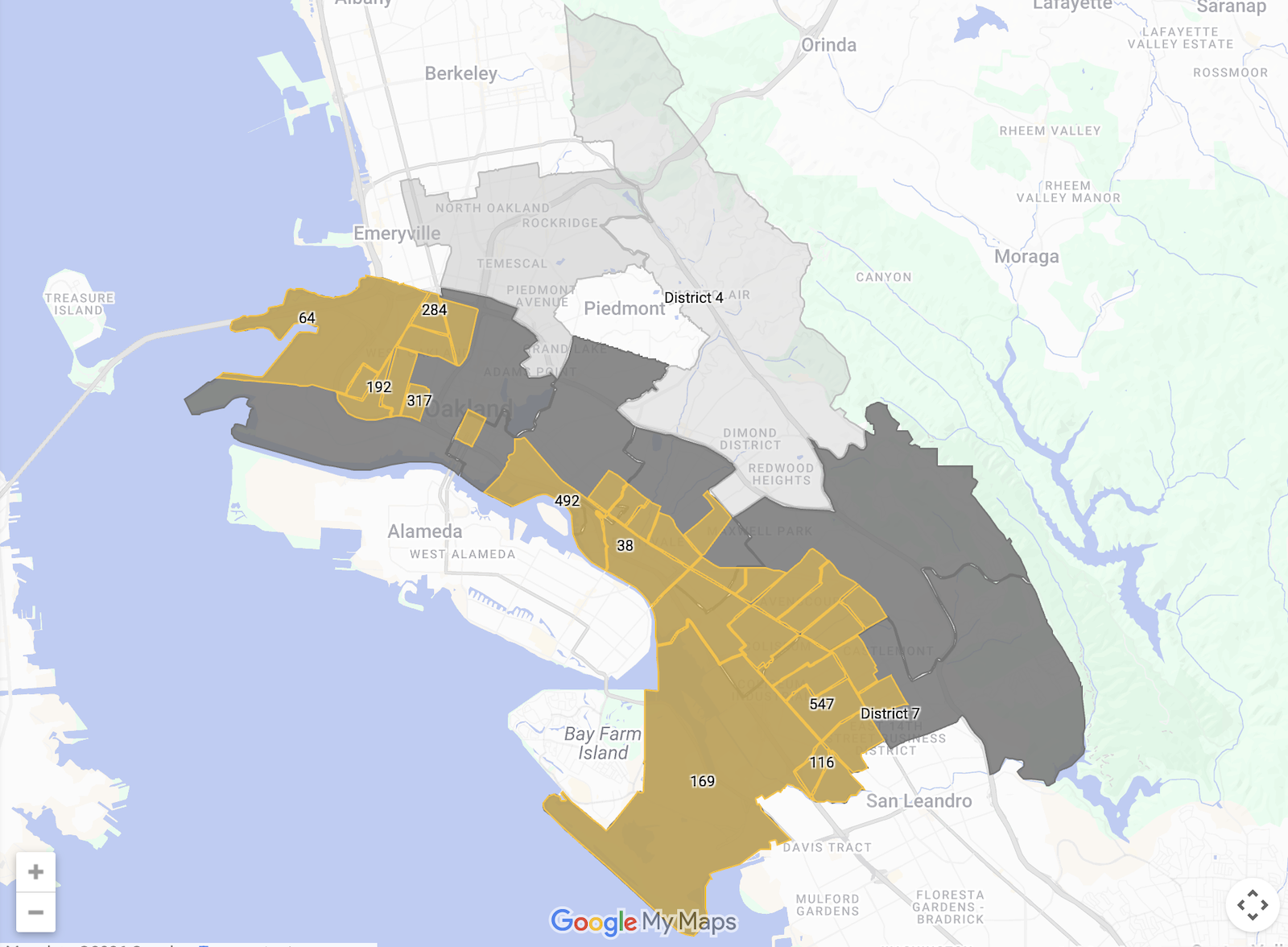 The yellow areas represent the Oakland census tracts in the top 5% for lead risk across California. The new grant will target those areas. Credit: City of Oakland
While the federal grant program, from the U.S. Department of Housing and Urban Development, has existed for years, this is the first time Oakland has applied. Alameda County has previously received funding.
Oakland housing staff say the city will be well-positioned to apply for more funds when the current grant runs out in four years.
A bigger solution to lead contamination is under development with money won in a lawsuit
If funding for lead paint abatement sounds familiar, you’re not experiencing déjà vu.
In 2019, a $305 million settlement was reached in a 19-year-old lawsuit filed by local governments in California against companies that sold poisonous lead paint. It took Alameda County and Oakland, which together received $24 million in settlement funds, two more years to reach an agreement on how to divvy it up. In 2021, it was determined that Oakland would receive $14 million and develop an equity-based program for remediating lead paint in its most vulnerable communities.
That program has still not been finalized. The city, which hired national consultancy Green & Healthy Homes Initiative for the project, says it’s close. A city working group has met with both professionals and community members this year for input on the program that’s expected to be fully designed by late spring and launched in the fall.
The new federal grant for lead paint remediation is entirely separate from the work stemming from the settlement. The programs have similar goals, city staff said. But there are some differences, including that the federal grant is available to homeowners while the settlement funds are for tenant-occupied housing only.
For years, the city has also pursued — at the urging of tenant advocates — a proactive rental inspection program. Under such a program, the city would systematically check rental units for violations and hazards like exposed lead paint, instead of solely counting on renters to report issues, which can put tenants at greater risk of both health issues and retaliation from property owners.
The city told us the inspection program is expected to launch in concert with the lead abatement program this fall.
At Tuesday’s Community and Economic Development meeting, the committee — councilmembers Rowena Brown, Zac Unger, Fife, and Janani Ramachandran — voted unanimously to forward the $4.4 million federal grant to the full council, which is expected to approve it, allowing the city to begin using the funds.
“*” indicates required fields