
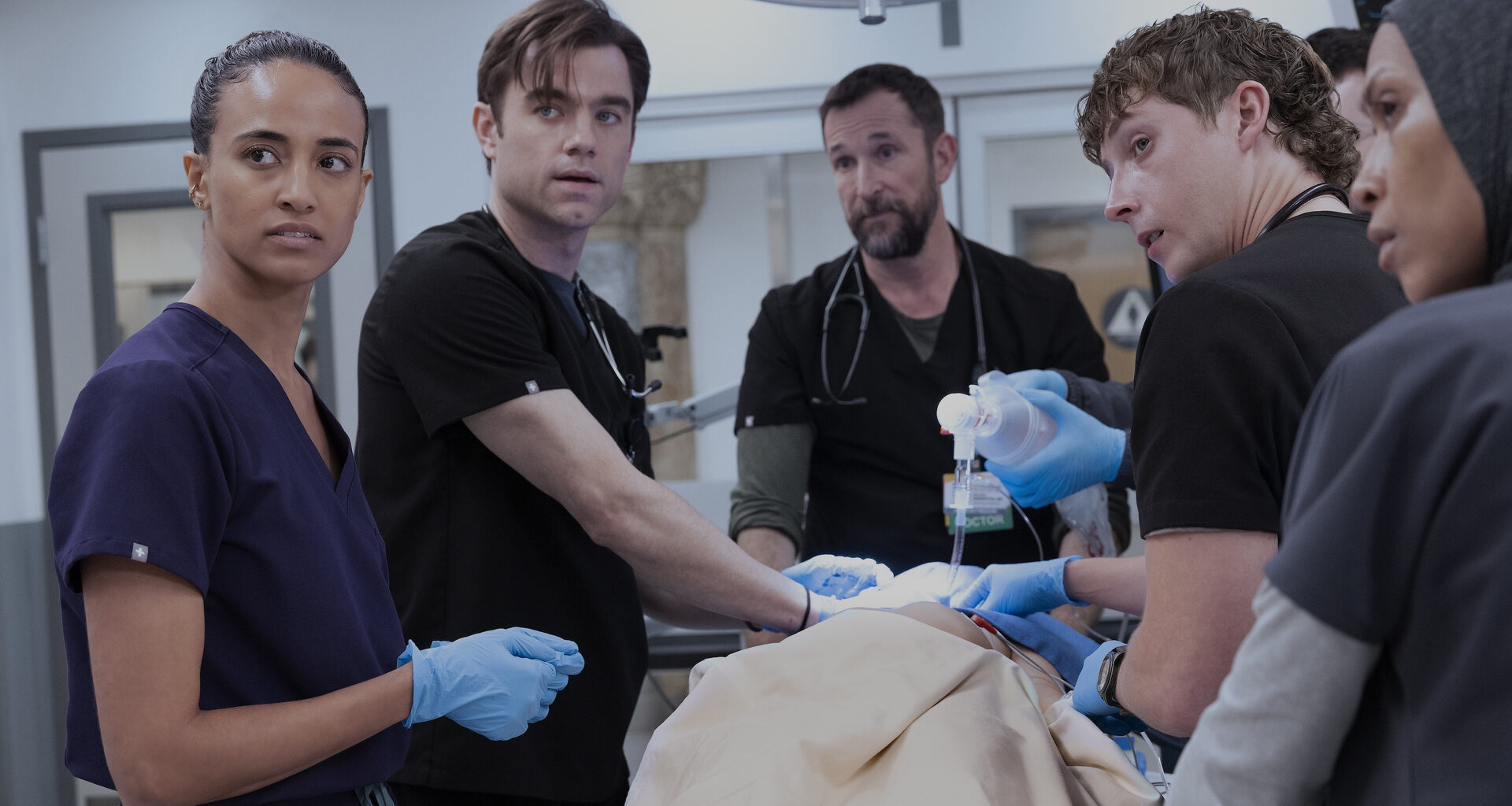
Ask people what they love most about The Pitt, the HBO Max medical drama that debuted in 2025 and went on to sweep the Emmys, and the answer is almost always the same: It feels so real.
The show’s pace appears just like an emergency room — lively and chaotic, always in motion. Its characters seem like real doctors and nurses you’d meet in an overcrowded urban ER: They’re highly competent and compassionate, sometimes curt and distracted, while bearing a mountain of responsibility and layers of trauma they absorb during their grueling 15-hour shift.
But what exactly goes into making the show, a massive hit with over 10 million viewers per episode, feel so real? How do you create an immersive, full-bodied world that pulls you in so far you forget that this place and these people don’t actually exist?
Turns out, two UC Berkeley alumni know all about it.
Nina Ruscio and Cathy Sandrich Gelfond both work on The Pitt — Ruscio as the production designer and Sandrich Gelfond as a casting director. They also both graduated from Berkeley in 1983 with degrees in English, widely regarded as one of the country’s leading programs. But the self-described “soul sisters” didn’t actually meet until they began pre-production and development for The Pitt in 2024.
“I always tell people who say that English is an impractical degree, ‘Are you kidding me?’” says Sandrich Gelfond. “It’s about storytelling. It’s about character and tone and human behavior. If you know how to write, if you know how to communicate your thoughts and ideas, you have the foundation to do just about anything.”
In this UC Berkeley News interview, Ruscio and Sandrich Gelfond talk about designing “triggering” hospital sets, casting for raw authenticity over Hollywood gloss and how their time at Berkeley taught them to watch life closely, turning every quirk and detail into material for an immersive narrative.
UC Berkeley News: Can you talk a little bit about your time at Berkeley? What defined your experience on campus, and how did it help prepare you for your careers?
Cathy Sandrich Gelfond: I was all about getting a Renaissance education, and I thought the best way to do that was to be an English major. I also took acting classes and managed to have a lot of fun in the theater department. I remember when I first got to Berkeley this amazing feeling of possibility. It was as if a new door in my brain had been opened, and it felt incredibly liberating.
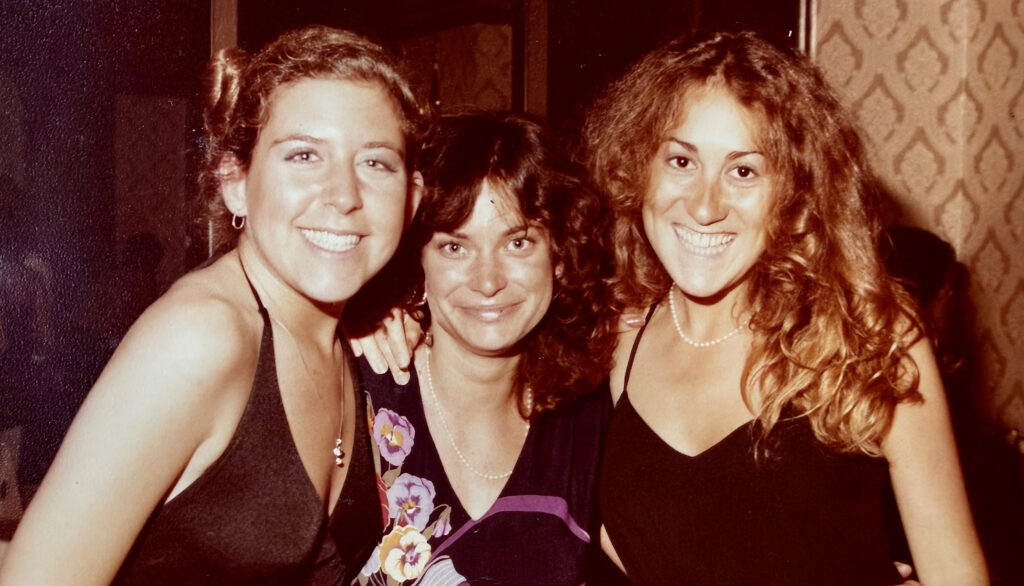 Cathy Sandrich Gelfond (center) with two of her good friends at UC Berkeley. She graduated with a degree in English in 1983.
Courtesy of Cathy Sandrich Gelfond
In our profession, it’s all about storytelling. I’m always looking for the meaning in and under the words, and I think English is an incredibly useful, overarching degree that teaches you how to do that. It also helps you learn to deconstruct a script and understand character development.
Growing up, reading was my refuge and joy, so to see all these brilliant actors breathe life into the story — that’s it for me. My desire to act was very fulfilled by reading with actors. I never needed to be in the spotlight; it was finding that true human connection and interplay that mattered to me.
Nina Ruscio: Berkeley for me was a scrappy experience, and not in a bad way. I was self-motivated to cherry-pick from the innumerable choices and follow my own path of discovery.
A liberal arts education teaches you how to think and feel, how to understand character. Studying English, where you examine texts from the inside out and see how the written word expresses character and story, feels incredibly applicable to my work life now.
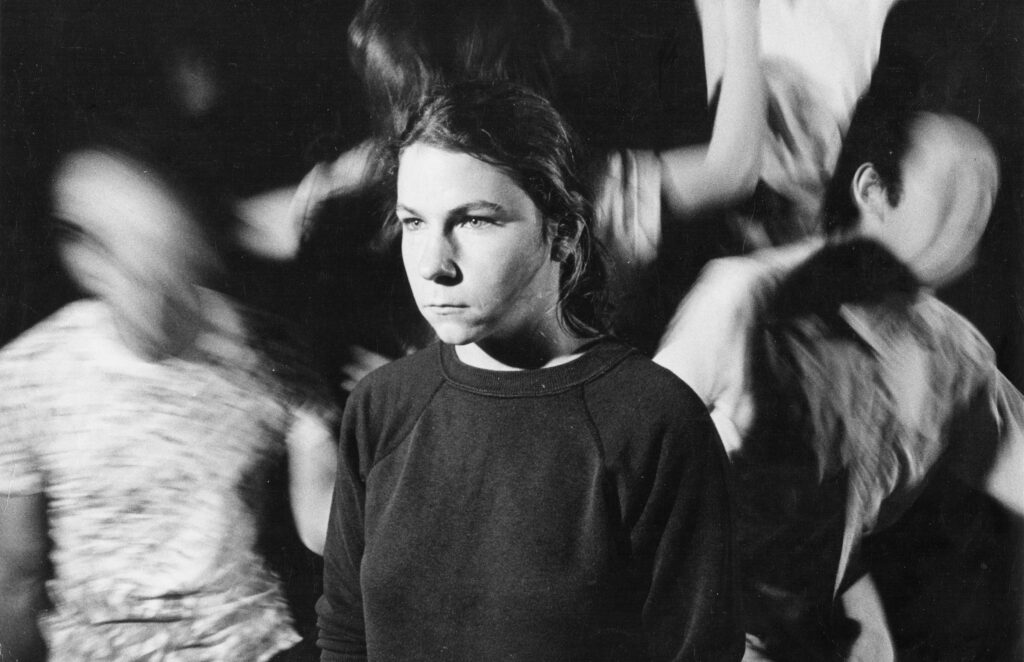 At Berkeley, Ruscio majored in English and worked on several student theater productions. Here she performs in the play HEARSAY, produced by the UC Berkeley-born group The Yam Complex.
Courtesy of Nina Ruscio
I spent much of my non-academic time embedded in the theater department, designing student projects in Room 7 in the lower levels of Zellerbach Hall, Zellerbach Playhouse and Durham Studio Theater in Dwinelle Hall. I was already a painter, so moving into three-dimensional spaces came naturally. I wanted to tell stories, and channeling other people’s stories visually worked out really well for me. I also had the privilege of taking a class with the late and legendary set designer Henry May. I loved that time in my Berkeley life — it was invigorating, inspiring and, ultimately, a direct line to my career.
Nina, when you’re beginning to build a new world for film or TV — in this case, an emergency room for The Pitt — where do you begin?
Nina Ruscio: As a production designer, I’m visually responsible for anything related to the physical environment that people are in — big or small. So I begin by researching everything. You are delving into worlds that are unfamiliar, no matter what it might be, and I like coming at it as an amateur sleuth.
The producers John Wells, Noah Wyle and Michael Hissrich, and showrunner R. Scott Gemmill, approached me with the unconventional idea of designing the emergency department before any episodes had been written. After I got over being incredibly flattered, I realized the horror of the responsibility of defining one space where 99% of a show would shoot 15 episodes a season. Then I took it upon myself to make sure I covered any possibility I could imagine.
What did you do?
Nina Ruscio: I went to every emergency department I could get myself into. I went places invited, and I went places uninvited. I had a bee sting that got infected, and I realized that if I drove even farther away, I could get into different emergency departments and see how they run. I read volumes on emergency room and hospital design. I just soaked myself in it.
How did you create a space that accommodates the perpetual motion of a trauma center while maintaining a sense of clinical realism?
Nina Ruscio: I wanted to offer them a space that looks endless and came up with a layout that has these curves that cup into each other. It’s like a tornado; the characters are always in motion and there are no dead ends in the physical space.
I also embedded lighting directly into the design. We don’t light from the ground or use bounce boards to fill out a person’s face; instead, it’s all top-lit and every horizontal surface is made of materials carefully selected to reflect that light upward. Because the actors don’t have any static positions, we couldn’t capture this level of vigorous movement on film if we had the physical impediment of traditional grip and lighting equipment.
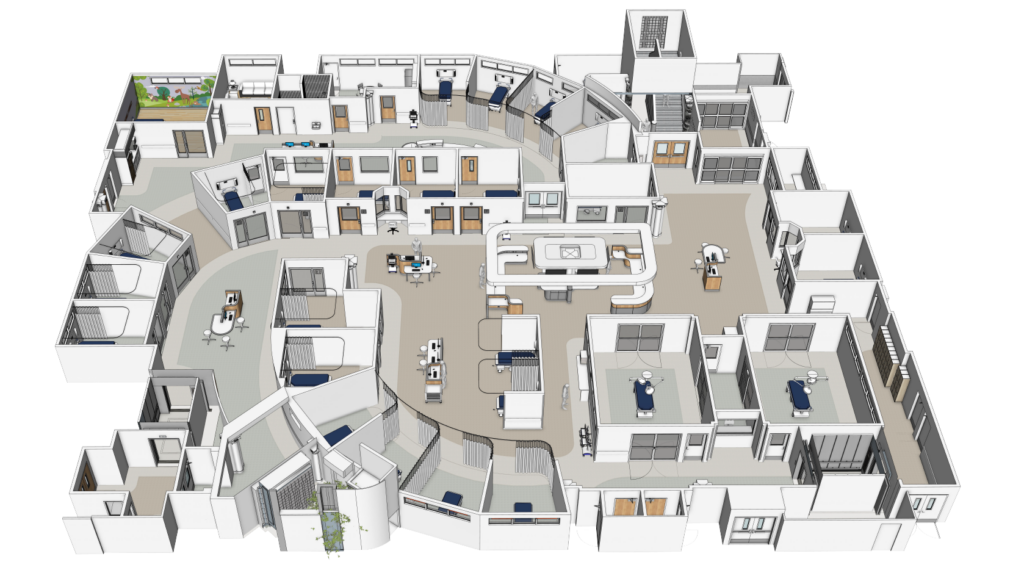 A perspective design of the emergency department and ambulance entrance for The Pitt by Ruscio. “I wanted to offer them a space that looks endless,” says Ruscio. “It’s like a tornado; the characters are always in motion and there are no dead ends in the physical space.”
Nina Ruscio
The colors of the walls, counters and curtains in the exam bays also look just like they do in a real hospital.
Nina Ruscio: Yeah, there’s a very blanched palette with a lot of whites, and that was part of the intention — to make the space sterile and triggering, like it often is when you go to a hospital. Movies and television shows that design hospital spaces can fall into this trap of making them overly attractive. For our purposes, that approach would not prompt viewers to feel the anxiety we hoped to make them feel.
Cathy, how do you think this kind of realistic design impacts the actors you’ve cast in the show?
Cathy Sandrich Gelfond: There is such a visceral sense when you walk onto that set. The actors, as human beings, you know they feel it — we’re all responsive creatures. I’m convinced it makes them better. The set informs their performance, and their performance informs the set. It’s a unique thing that I’ve never witnessed in quite this way before.
Nina Ruscio: It’s intentionally naked and intentionally raw. There are no places to hide. I remember early on Katherine LaNasa, who plays charge nurse Dana Evans, wrote me this little love letter expressing that actors usually need to suspend their disbelief when they go onto a stage, but that they didn’t need to use any of that energy on The Pitt’s set. It’s really a full-on immersive emergency department.
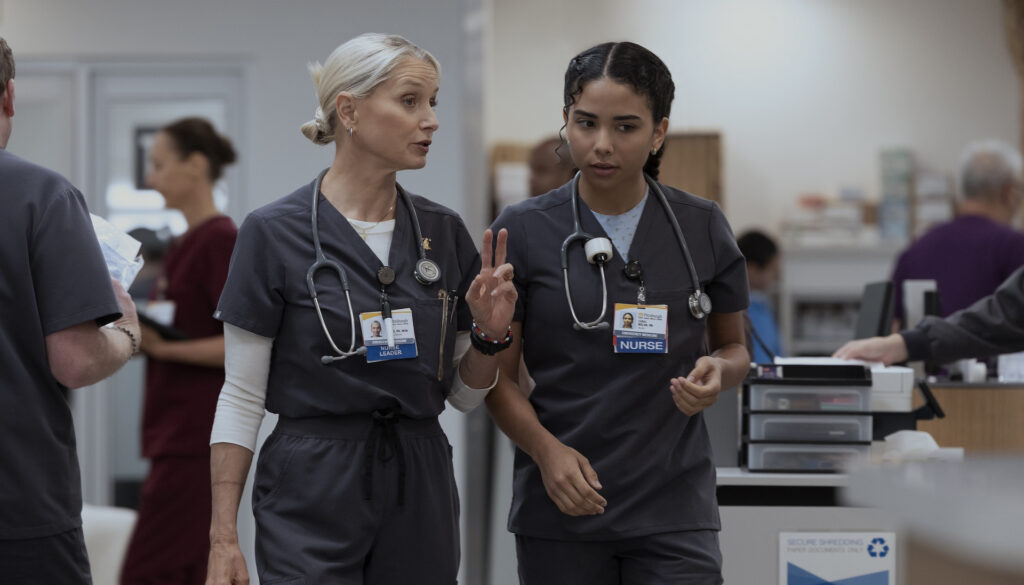 Charge nurse Dana Evans (left), played by Katherine LaNasa, advises recent nursing school graduate Emma Nolan (right), played by Laëtitia Hollard in her first professional role. “It is incredibly gratifying to give an actor their first big opportunity and one of the best parts of my job,” says Sandrich Gelfond.
Warrick Page/HBO Max
The Pitt is a teaching hospital, where young residents learn under seasoned doctors amid nonstop ER chaos. What do you look for in actors, Cathy, so that the ensemble represents real medical clinicians, rather than TV stereotypes?
Cathy Sandrich Gelfond: I’m constantly watching people, watching behavior, watching groups of people. I looked at pictures of people from Pittsburgh and asked: What qualities make people from Pittsburgh unique?
My co-casting director, Erica Berger, and I really wanted people who embodied these characters. Our job was to discover the right actors; we were not constrained by requirements to have “names” in these parts. Although this entails an enormous amount of work, it is also a casting director’s dream.
I do think the secret sauce of casting on the show is finding people who audiences don’t necessarily know (aside from star Noah Wyle, who was already in the show), because they don’t carry baggage for audiences and can more seamlessly fit into this gritty, real world we are creating.
It’s so freeing and exciting when you find the actor that fleshes the whole character out and helps tell the most interesting story.
Where did you find the actors who make up the original ensemble?
Cathy Sandrich Gelfond: We looked at a lot of people out of the theater, including student showcases, because working on The Pitt is such a high-pressure experience — you’ve got to be able to move, react and respond in highly technical, stressful situations at a moment’s notice. It’s an incredibly rigorous and demanding job.
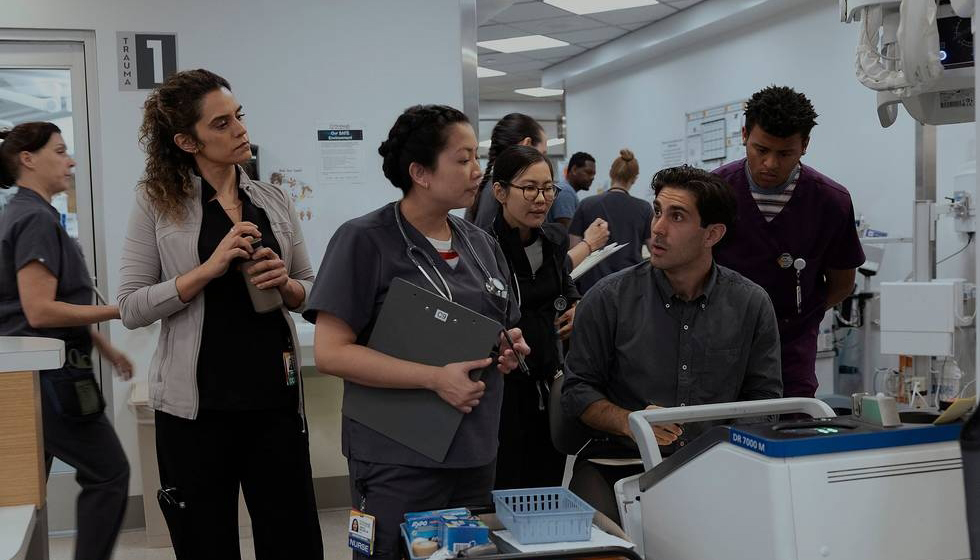 Several characters in The Pitt — including (from left) Dr. Baran Al-Hashimi, nurse Princess Dela Cruz, medical student Joy Kwon and radiologist Dr. Nick Barker — discuss medical equipment amid the chaos of the trauma center. In addition to the show’s core ensemble, The Pitt fills over 250 roles in one season. “Background artists are equally as important because they are the fibrous texture that populates the set, informing the entire experience,” says Ruscio.
Warrick Page/HBO Max
One of my favorite tests came from our producers: After we auditioned actors to play orderlies, we called back the people we liked and had them push a rolling desk chair down the hall, because it is very hard to say those kinds of lines while you’re pushing a gurney in the middle of chaos. You knew the ones that got it.
And like in plays, the entire ensemble is sometimes on stage not speaking; well-trained actors know how to do that. We tell agents, “They have to be prepared for days where all they’re going to do is walk down a hall without speaking, and that is just as important as anything else because it creates the fabric of the hospital.” Everyone is part of that, including Noah.
So we look for people who are not just perfect for the part, but who mesh with the ensemble so that they form a unit and a family, because that’s what this really is — a cohesive team of professionals doing the best they can every day.
It sounds like both of you are describing a kind of non-hierarchical realm in terms of both space and characters, where there’s no space or person that’s more important than any other.
Nina Ruscio: There’s no room for an egocentric position because there’s no value in it when everyone is equally essential.
In Cathy’s casting, there’s the core ensemble of the principals, but then there’s also this other layer of the background artists that’s equally important because they are the fibrous texture that populates the set, informing the entire experience. The whole crew wears scrubs in case they are unintentionally seen in a reflection.
It’s like a choreographed ballet with the cinematographer and the camera operators moving through it. The experience is thorough and lush. To find people who want to play like that, it’s rare. It’s very without hubris. It’s maybe a once-in-a-lifetime situation.
What is your biggest piece of advice for Berkeley students who are interested in pursuing careers in film and TV in similar roles as your own?
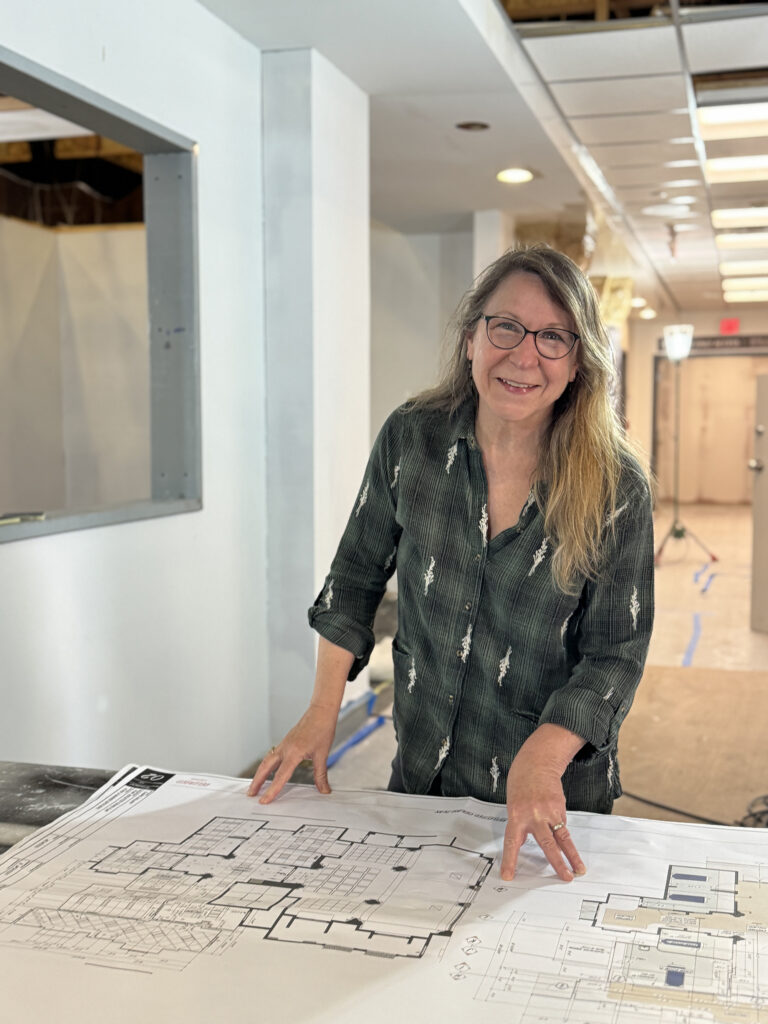 While technical skills like architecture are useful for a career in production design, Ruscio credits her success to an relentless curiosity about the world around her. “I’m a constant student every minute of the day,” she says.
Courtesy of Nina Ruscio
Nina Ruscio: There are a lot of practical disciplines that would be handy to explore early on, like architecture and graphic design. There are so many different jobs even within the art department; every single X-ray that appears in The Pitt is a week of graphic work on its own.
But the biggest skill of all is really being able to understand what would apply to a story — what spaces apply to a story, what evokes a character’s mood. To do this, it’s imperative to notice the details in every moment that you are anywhere. From the glorious, magnum landscapes of Montana to some diminutive gas station bathroom full of pathos. Remember it, look at what’s authentic about it. Ask yourself how it makes you feel.
I’m a constant student every minute of the day. The visual experience of a space is a manifestation of what a character is feeling and how they are experiencing the world.
Cathy Sandrich Gelfond: To do what I do, you have to love performance, understand acting and actors, and love movies, television and the theater. After graduation, I thought I wanted to act, so I moved to L.A., met a casting director, fell in love with it and never looked back. There are a lot of us who were actors and then found a better path for ourselves.
There are so many interesting jobs that the vast majority of people don’t know about — the two of ours are perfect examples. So make sure you know what jobs are out there in this business, and think about your strengths: Is communication your strength? Are you good with people?
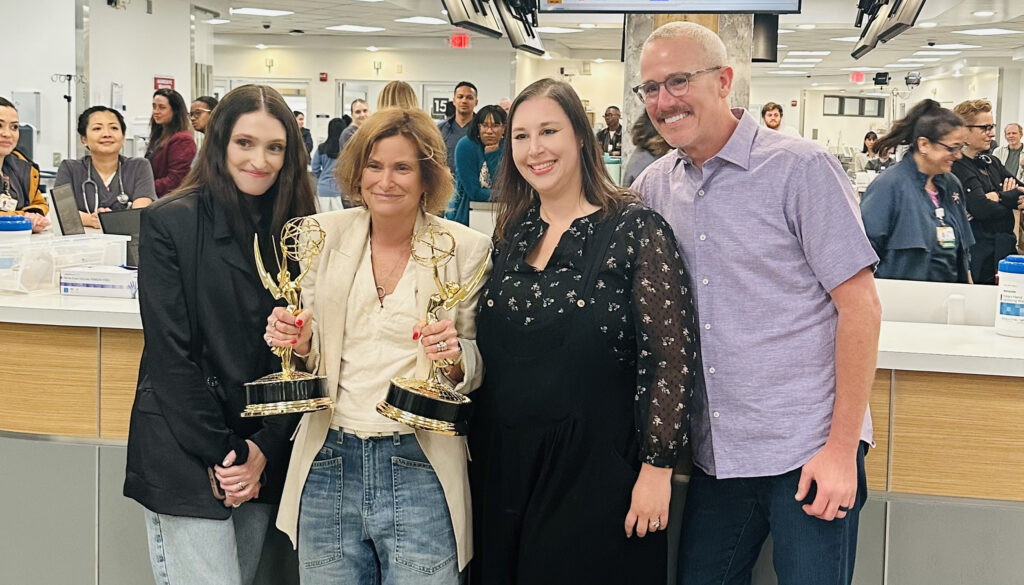 From left: The Pitt casting assistant Emma Johnson, casting directors Cathy Sandrich Gelfond and Erica Berger, and associate casting director Seth Caskey. Sandrich Gelfond and Berger won an Emmy for Outstanding Casting for a Drama Series during the 77th Primetime Creative Arts Emmy Awards.
Courtesy of Nina Ruscio
It’s all about being present and paying attention. Look around, read, learn, be curious and live as full a life as you possibly can. I always tell actors the more you know about the world, the better actor you will be. The amazing thing for actors now is they don’t have to wait for someone like me to bring them in; they can create their own work and put it out there and people like me will often see it.
How does it feel to be part of such a breakout hit? Are you surprised by its success?
Nina Ruscio: Everyone working on The Pitt, we all called it a grand experiment. None of us knew if our brave choices were going to work. In that first season, we were in our own private bubble. We’d come to work every day at the “hospital,” doing our different jobs; we all just wanted to do the best job we could do together in this unique community. We had no idea The Pitt would be so well-embraced. And now some people don’t even call it a television show anymore; they call it a phenomenon. It’s an amazing thing to be a part of.
This interview has been condensed and edited.
Ruscio and Sandrich Gelfond will be visiting campus this semester on April 16 to speak on an Alumni in Entertainment panel during the Division of Arts & Humanities Creative Careers week, aimed towards preparing undergraduate students with career connections. Check the campus events calendar as the date nears for the time and location.