
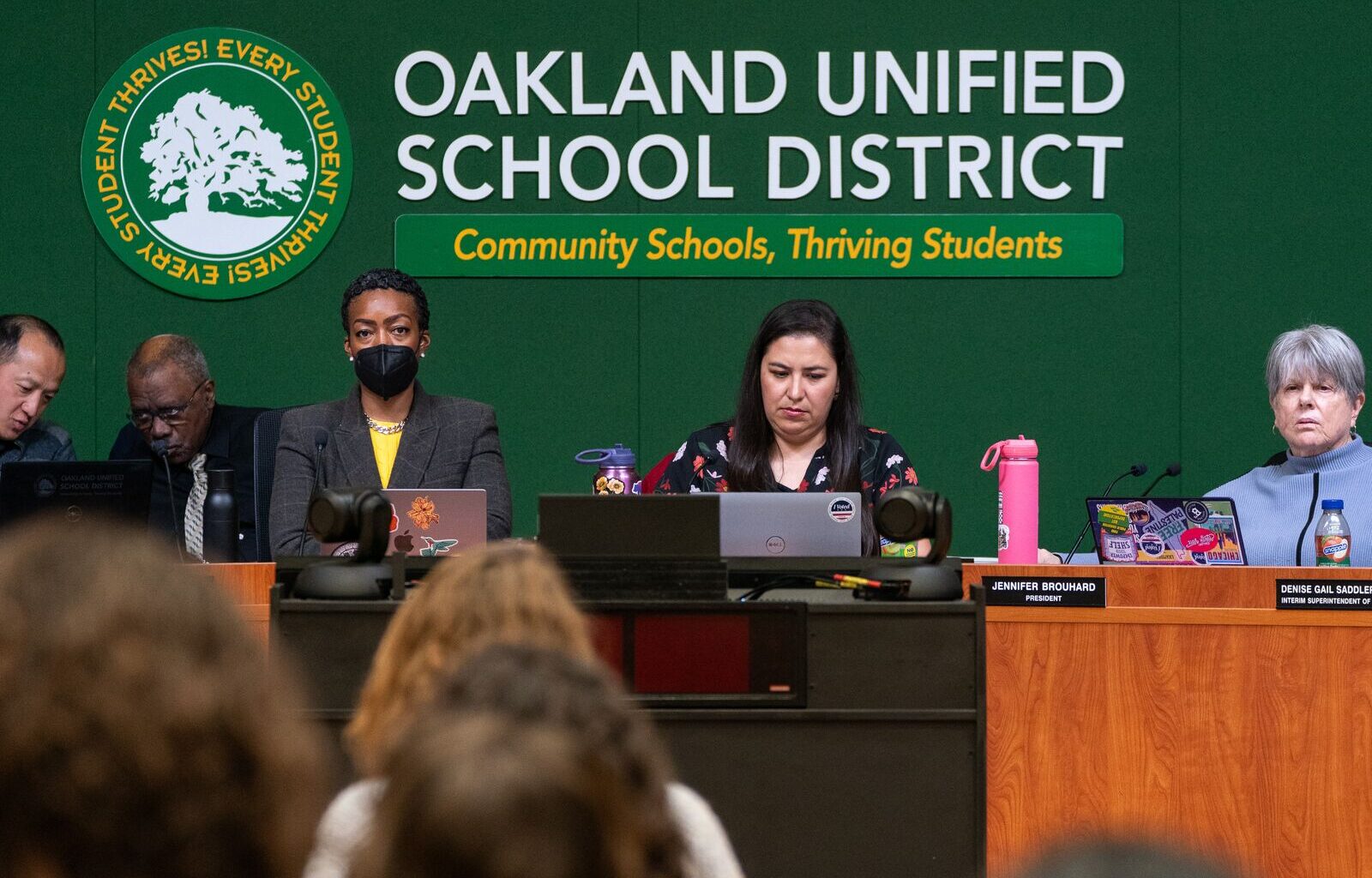
An interim budget report presented Wednesday revealed little new information about Oakland Unified School District’s budget situation; crucially, officials did not shed light on the financial impact of two new collective bargaining agreements — which could add millions to deficit projections over the next few years — or the scores of layoffs the board approved last month.
Ruben Frutos, OUSD’s contracted financial advisor, gave a report to the school board on Wednesday, presenting an analysis of the district’s finances through Jan. 31 of this year. It shows the district was projected then to have about $32.5 million in its unrestricted fund reserves at the end of the school year in June — just $3.5 million above the required 3%.
“If the unrestricted portion of the budget was the only budget, you would have a tremendously strong budget,” Frutos said. “Managing the restricted portion of the budget is of primary importance for the fiscal team of the district.”
His report does not present the most up-to-date picture of the budget since it doesn’t include some pivotal February decisions: layoffs of more than 400 positions and new labor contracts with school support staff and the teachers union. District leaders haven’t yet said how much money the layoffs will save, and parent and school leaders worry that eliminating essential roles such as literacy tutors, attendance clerks and case managers could hurt school quality in the long run.
The school board, superintendent, and district fiscal team have been working to stave off a significant deficit for the 2026-2027 school year of around $100 million and must pass a balanced budget by the end of June. The budget plan so far has included substantial reductions at the district’s central office, along with school site cuts and a reduction in special education spending. District officials haven’t said how the mass layoffs map to these plans.
The board voted to certify the interim budget report and submit it to the Alameda County superintendent as “qualified,” meaning the district may or may not be able to meet its financial obligations in the next two years.
‘A pattern of adding expenses before making cuts’
A new contract settled in December for school support staff, represented by Service Employees International Union Local 1021, gives the district’s lowest paid workers a 16% raise over two years and sets a $25-an-hour minimum wage. That new contract will cost OUSD nearly $40 million over three years, including $9.9 million this school year and $13.6 million during the next school year.
In her evaluation of the SEIU contract, Alameda County Superintendent Alysse Castro wrote in a letter that the board is “continuing a pattern of adding new expenses before making the cuts and tradeoffs to afford them.”
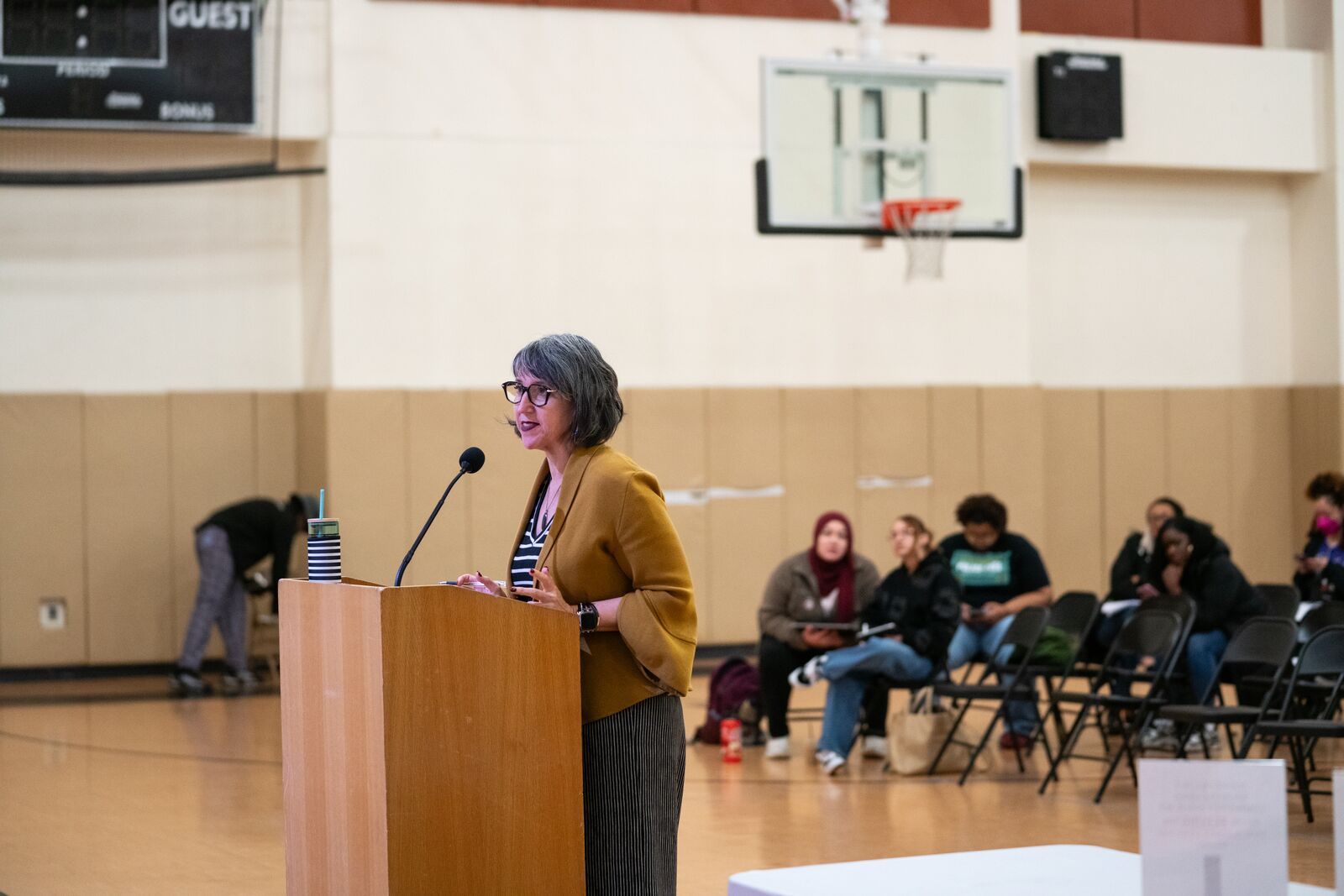 Alysse Castro, Alameda County Superintendent of Schools, addresses the Oakland school board at La Escuelita Elementary School in Oakland in February 2025. Credit: Florence Middleton for The Oaklandside
“The district has not yet identified the sustainable, ongoing solutions required to offset these new ongoing commitments and costs,” Castro wrote. “This agreement, while it predates the current leadership team, repeats OUSD’s same pattern of entering into multi-year financial commitments without clearly identified, board-approved, and sustainable ongoing solutions necessary to achieve and support long-term solvency.”
In late February, under threat of a strike, the district also came to an agreement with the Oakland Education Association for a new two-year contract. District leaders have not publicly provided an estimate for how much it will cost OUSD.
Teachers won an 11% to 13% raise over two years, depending on seniority. During negotiations, district officials said each 1% raise would cost $5 million, so the full contract may cost the district more than $50 million.
Castro will review this agreement as well, to ensure the district can afford the raises. The school board and union membership must also approve the tentative agreement.
Some parents and community members have been calling on Castro to exert more stringent oversight of OUSD’s finances. Parents planned a community forum with Castro that will take place Monday, March 16, at Life Academy in Fruitvale.
A hub for transitional kindergarten
During Wednesday’s meeting district leaders also offered updates on an expansion of early childhood education classes.
This is the first school year that the state has offered universal transitional kindergarten to all 4-year-olds. Many families that previously had to pay for private preschool now have access to a free public school option, which has led to increased demand in OUSD. Not every school in OUSD has enough space for families seeking to enroll at those sites, and OUSD has responded by creating early learning centers at hub campuses.
In District 1, Chabot and Peralta elementary schools received more than 500 applications for 72 transitional kindergarten seats for next fall; Cleveland and Crocker elementary schools had more than 450 applications for 48 seats; and Hillcrest, Montclair, Thornhill, and Laurel elementary schools received more than 1,100 applications for just 120 seats.
“We’re not capturing all the folks who want to come into our schools — not even a little bit,” said Kilian Betlach, OUSD’s executive director of enrollment. “And that’s a miss. There’s a clear demand and a need for more spots.”
In the fall, OUSD will open a transitional kindergarten hub at Carl B. Munck Elementary, with four transitional kindergarten classes serving 96 students whose families were seeking spots at Montclair and Thornhill elementary schools. The district will add one class each at its Burbank Early Learning Center and Kaiser Early Childhood Center.
District leaders are hoping to add two more classes near Crocker Highlands and Cleveland elementary schools for the fall, but haven’t identified a site yet. A dual language transitional kindergarten hub is also in the works for the 2027-2028 school year, district officials said.
OUSD leaders see transitional kindergarten enrollment as a key revenue driver. With eight new transitional kindergarten classes in the fall, district officials expect net revenues of around $1.1 million. Most transitional kindergarten families stay with OUSD for kindergarten; this year the district saw nearly 90% of its students matriculate to kindergarten.
“*” indicates required fields