
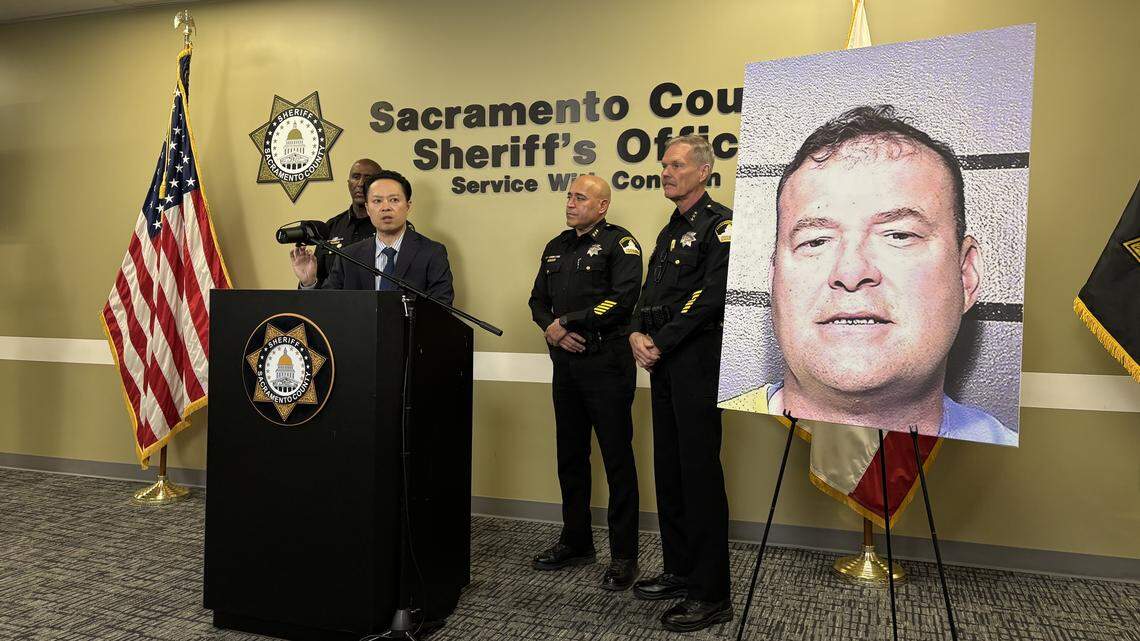
Sacramento County District Attorney Thien Ho, center, speaks during a news conference on Thursday, March 12, 2026, at the Sacramento County Sheriff’s Headquarters in Old Foothill Farms. Ho joined, from left, Sheriff Jim Cooper, Assistant Sheriff Salvador Robles and Undersheriff Mike Ziegler to call for reform to California’s Elderly Parole Program in response to the planned release of Gregory Vogelsang, pictured on the poster.
Kate Wolffe
kwolffe@sacbee.com
Sacramento County’s top law enforcement officers are calling on residents to help them keep imprisoned a man who kidnapped and sexually assaulted children in the 1990s.
Gregory Lee Vogelsang, a Roseville resident, was convicted in August 1999 of more than two dozen child molestation and kidnapping charges involving five boys. He served 27 years of a 355 years-to-life sentence, and was granted parole in November. He remains in prison, awaiting release.
District Attorney Thien Ho and Sheriff Jim Cooper held a news conference Thursday to urge residents to turn out to an en banc hearing next Wednesday, where a larger swath of the parole board will review the board’s initial decision in Vogelsang’s case.
“We’re asking people to show up to make a comment,” said Ho. “We’re also asking people to call in … and follow the prompts to leave a message.”
Ho’s office said the hearing is at 9 a.m. at 1515 K St., Suite 550, in Sacramento, and the number to call is 916-445-4072.
Vogelsang’s case comes on the heels of the California Board of Parole Hearings choosing to grant parole to David Allen Funston, a 64-year-old man convicted of similar crimes. Both men were eligible for a parole hearing under the state’s Elderly Parole Program, which Ho and Cooper now say must change.
“We need to exclude child molesters, exclude sexual predators, from elder parole,” Ho said. “We need to change the law because, frankly, those who pass these laws have let us down, and worse, let our children down.”
Ho said he had a “list of five other child molesters who are going to be up for parole,” and that it is imperative that the law is modified.
Earlier this week, several Republican state lawmakers asked Gov. Gavin Newsom to replace parole board members who authorized Funston’s release. Newsom did not comment on that request but has said he didn’t agree with the decision to release Funston. Parole board members are appointed by the governor and serve three-year terms.
History of the elderly parole law in California
Elderly parole in California emerged from a court order in 2014, according to a fact sheet from the California Department of Corrections and Rehabilitation. To address severe prison overcrowding, the department was ordered to “finalize and implement a new parole process whereby inmates who are 60 years of age or older and have served a minimum of 25 years of their sentence will be referred to the Board of Parole Hearings to determine suitability for parole.”
Those hearings are no guarantee someone will be released. Data from the Board of Parole Hearings found that in 2022, 9% of people eligible for an elderly parole hearing were granted parole.
“The public perception that California is letting people out easily or too permissively, that is really the opposite of what’s happening in reality,” said Su Kim, the senior policy manager for UnCommon Law, which represents incarcerated people in parole hearings.
In 2018, the elderly parole program was codified in California law. In 2021, the age threshold and amount of time served were both lowered as a result of AB 3234. That bill made it possible for a 50-year-old person who has served 20 consecutive years to qualify for a hearing.
The bill’s author, Phil Ting, said at the time the bill was a response to the COVID-19 pandemic, which sickened tens of thousands of prisoners and killed over 200.
“The current Covid-19 pandemic requires thoughtful and urgent measures to reduce the risk of harm inside the state’s prisons. This provides a deliberative process with safeguards for consideration for release for this high risk population,” Ting wrote in a bill analysis.
People who have been sentenced to death or life without parole are excluded from the program, as are people who committed first-degree murder against a peace officer or those who were sentenced under California’s three-strikes law.
Several elderly parole bills pending
A few hours after the news conference, Republican Assembly members Josh Hoover, R-Folsom, and Tom Lackey, R-Palmdale, announced legislation that would raise the minimum age for eligibility for the Elderly Parole Program to 65.
“Fifty years old is not elderly. Not even close,” Lackey said in a news release. “Just because someone turns 50 does not mean they are rehabilitated! We’re talking about releasing people who committed the worst crimes imaginable.”
The fight to raise the minimum age for elderly parole eligibility is a familiar one to state Senate Republican Leader Brian Jones, R-Santee. His latest effort, SB 356, would bring the threshold for the elderly parole program back up to 60 years of age, following 25 years of consecutive incarceration.
Jones also recently introduced SB 906, which would make the votes of the Board of Parole Hearings public, and the senator’s office said he is also collaborating with Sen. Roger Niello, R-Fair Oaks, in an effort to exclude sex offenders from elderly parole eligibility.
During Thursday’s news conference, Cooper said anything less than prohibiting sex offenders from early parole would be insufficient.
“Legislature, read the tea leaves. The public’s fed up. They’re tired of this … Soft on crime does not work.”
This story was originally published March 12, 2026 at 2:36 PM.
Related Stories from Sacramento Bee
The Sacramento Bee
Kate Wolffe covers the California Legislature for The Sacramento Bee. Previously, she reported on health care for Capital Public Radio in Sacramento and daily news for KQED-FM in San Francisco. She is a graduate of UC Berkeley.